
Chef Juliette
Various Almond Preparations
Five almond preparations, one discipline: remove the skins cleanly, dry every kernel through, then cut, toast, or cloak it in pale caramel without letting its fragrant oils escape.
A cooking platform built around craft, culture, and the stories behind what we eat.
Created by Chef Juliette
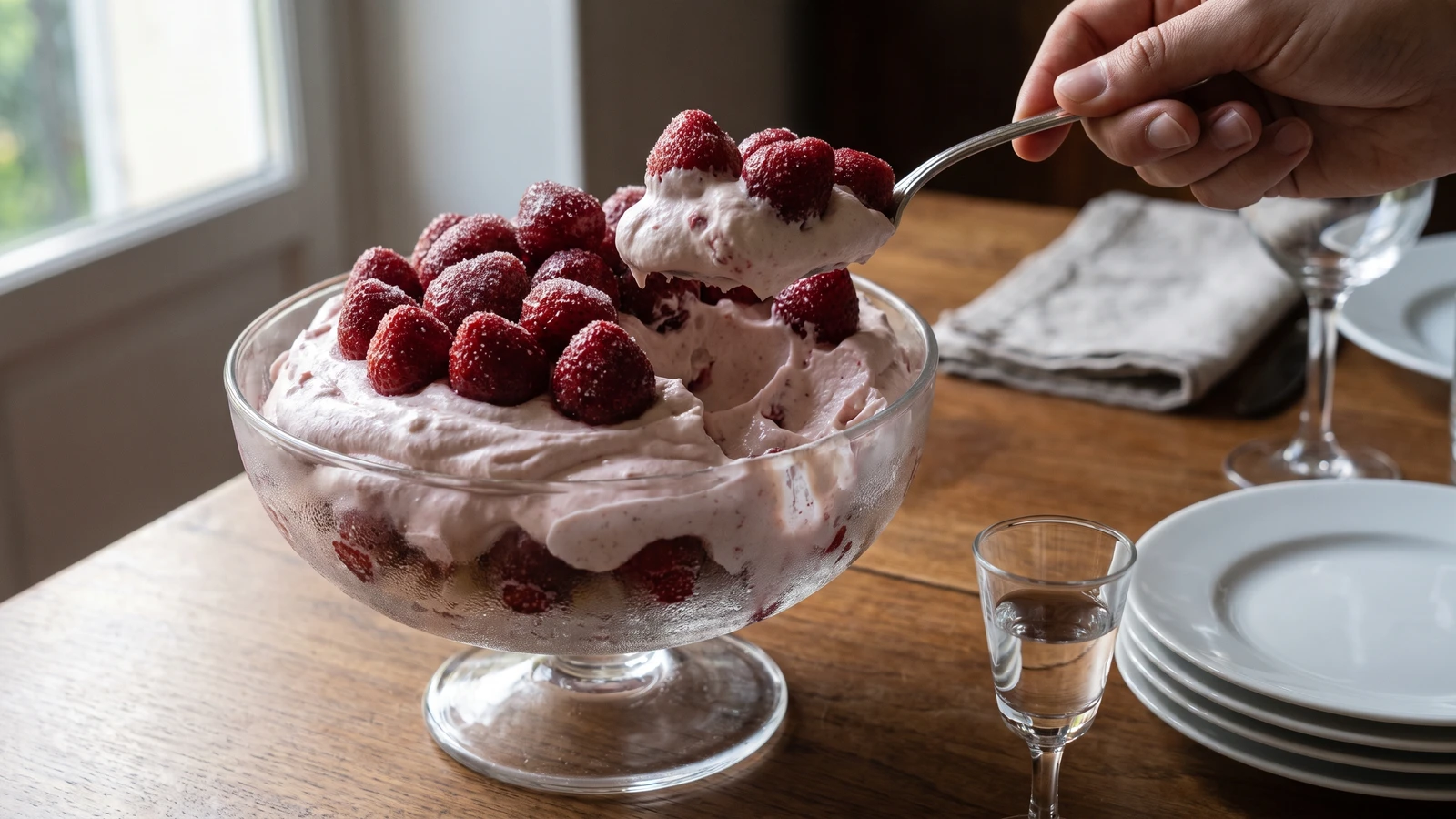
Based on No. 2676, Fraises Marquise, from Le Guide Culinaire (1907) by Auguste Escoffier
Fraises Marquise turns one precise ratio and one last-minute gesture into a cold strawberry dessert: two parts Chantilly, one part wild-strawberry purée, crowned with Kirsch berries whose sugar still sparkles.
Fraises Marquise (strawberries with wild-strawberry Chantilly) teaches that cold and timing can be structure. The one true thing to know before touching a bowl is that the sugared berries cannot wait: Kirsch draws juice, sugar pulls out more, and the glittering coat becomes syrup if it stands. Roll them only when the cream is cold and the table is ready.
The original direction assumed a service timbale banked in ice, a pastry station holding Chantilly, purée, and selected berries separately, and enough hands to finish every berry at the instant of service. Here the unspecified brigade batch becomes four portions, the cream is held in a freezer-chilled glass bowl and refrigerator, and the timbale needs an ice bath only if it must sit out. The intent stays exact: two parts prepared Chantilly to one part wild-strawberry purée, Kirsch maceration, and a complete covering of sugared fruit. One cook, one stove, one evening.
The ice-packed service vessel is scaffolding and can go. The ratio and last-minute sugar are the dish and must stay. Keep the purée and cream properly cold, fold only until the pale rose cream holds a soft mound, then stop. The final roll decides Fraises Marquise.
Fraises Marquise belongs to the Parisian grand-kitchen repertoire of cold entremets, where sweetened cream, perfumed fruit purées, liqueur, and a formal timbale were assembled for service rather than baked. Its timbale banked in ice was practical temperature control, while the title Marquise signaled a dressed presentation rather than a strawberry variety or regional origin. The source's “semolina sugar” means sucre semoule, fine granulated sugar rather than wheat semolina, and its last-minute roll preserves the brief dry sparkle that makes the finish.
Quantity
1 cup (240 ml / 240 g)
Quantity
3 tablespoons (45 ml / 23 g)
Quantity
1/2 teaspoon (2.5 ml / 2 g)
Quantity
1 cup (240 ml / 240 g)
chilled; from about 2 cups (480 ml / 300 g) fresh or thawed frozen wild strawberries
Quantity
2 cups (480 ml / 300 g)
hulled and dried completely
Quantity
2 tablespoons (30 ml / 28 g)
Quantity
1/2 cup (120 ml / 100 g)
for rolling
Quantity
2 tablespoons (30 ml / 30 g)
for rescuing overwhipped Chantilly
| Ingredient | Quantity |
|---|---|
| cold heavy cream, at least 35% fat | 1 cup (240 ml / 240 g) |
| confectioners' sugar | 3 tablespoons (45 ml / 23 g) |
| pure vanilla extract | 1/2 teaspoon (2.5 ml / 2 g) |
| unsweetened wild-strawberry puréechilled; from about 2 cups (480 ml / 300 g) fresh or thawed frozen wild strawberries | 1 cup (240 ml / 240 g) |
| fine, fair-sized ripe strawberrieshulled and dried completely | 2 cups (480 ml / 300 g) |
| clear Kirsch eau-de-vie | 2 tablespoons (30 ml / 28 g) |
| sucre semoule, fine granulated or caster sugarfor rolling | 1/2 cup (120 ml / 100 g) |
| cold heavy cream (optional)for rescuing overwhipped Chantilly | 2 tablespoons (30 ml / 30 g) |
Put the mixing bowl, whisk, and 1-quart (1-liter) serving bowl in the refrigerator for 30 minutes, or in the freezer for 10 minutes. If starting with whole wild strawberries, purée them without water, press the pulp through a fine sieve, and measure exactly 1 cup (240 ml / 240 g). Chill it thoroughly. Cold is part of the structure here, not a decorative precaution.
Put the selected strawberries in a shallow bowl, sprinkle over the Kirsch, and turn them gently so every surface is touched. Refrigerate for 20 minutes, turning once. Lift the berries onto a rack or clean cloth and let the excess Kirsch drain away; they should be perfumed and moist, not sitting in liqueur. Do not sugar them yet.
Make crème Chantilly, sweetened vanilla whipped cream, by combining the 1 cup (240 ml / 240 g) heavy cream, confectioners' sugar, and vanilla in the cold mixing bowl. Whisk at medium speed until the cream holds clear ridges and a peak whose tip bends slightly. It needs enough body to accept the purée, but stop before it turns stiff or grainy. If it does become grainy, stop immediately and fold in the reserved cold cream 1 tablespoon at a time until smooth. Ça se rattrape.
The whipped Chantilly should occupy about 2 cups (480 ml). Stir one quarter of the chilled wild-strawberry purée into the Chantilly to lighten it, then fold in the remainder in two additions with a wide spatula, cutting down through the center and lifting around the sides. Stop as soon as the color is evenly pale rose and the cream holds a soft mound. This keeps the source's exact ratio of two parts Chantilly to one part purée. If the mixture turns loose because it has warmed, stop folding and set the bowl over ice for 5 minutes; once the cream firms, give it two slow folds and no more.
Spoon the strawberry Chantilly into the chilled serving bowl and shape it into a generous low mound. Cover and refrigerate for 20 to 30 minutes. The original timbale surrounded with ice was a holding method, not a special way of setting the cream; a properly chilled bowl and refrigerator do the same work. If the dessert must wait on the table, nest its serving bowl in a larger bowl of crushed ice.
Only when everyone is ready for dessert, spread the sucre semoule in a clean, dry shallow bowl. Roll each drained strawberry lightly through the sugar and place it directly on the chilled cream, pointed end outward, arranging the berries closely until the Chantilly is completely covered. Do not coat them ahead or leave them waiting on a tray. If the sugar in the bowl becomes wet and clumpy, discard that damp patch, blot the remaining berries, and continue with dry sugar. Ça se rattrape, but the clock is running. Carry the finished Fraises Marquise straight to the table. À table!
1 serving (about 240g)
Culinary guides, cultural storytelling, and the editorial depth that makes cooking meaningful.
Discover Culinary ExplorerChef Juliette
Five almond preparations, one discipline: remove the skins cleanly, dry every kernel through, then cut, toast, or cloak it in pale caramel without letting its fragrant oils escape.

Chef Juliette
A pastry pantry lesson in one tray: filberts warmed only until their red skins release, rubbed clean, cooled, and chopped into a fragrant mise-en-place for cakes, creams, pralines, and petits fours.

Chef Juliette
The smallest pâtisserie discipline decides whether a cake leaves its mould intact: clarified butter in every corner, followed by the lightest veil of dry flour or fécule.
Chef Juliette
Four whites, one spotless bowl, and a patient change of speed: whisk gently until loosened, then briskly to glossy stiffness, with powdered sugar waiting if the foam begins to granulate.