
Chef Juliette
Various Almond Preparations
Five almond preparations, one discipline: remove the skins cleanly, dry every kernel through, then cut, toast, or cloak it in pale caramel without letting its fragrant oils escape.
A cooking platform built around craft, culture, and the stories behind what we eat.

Created by Chef Juliette
Based on No. 2637, Charlotte Russe, from Le Guide Culinaire (1907) by Auguste Escoffier
A rosette of biscuits à la cuillère, upright walls, and strawberry bavarois within: the cold moulded dessert that teaches exactly when a fruit base is ready to receive whipped cream.
Charlotte Russe aux Fraises (strawberry Charlotte Russe) teaches the timing of bavarois, a gelatin-set cream that must be caught between liquid and firm. Here is the one true thing to know before touching a pan: the strawberry base must be cold and just beginning to thicken before the whipped cream enters it. Too warm, and the cream loses its air. Too cold, and the gelatin catches in threads. At the right moment, the centre sets pale rose and satin-soft inside its close biscuit walls.
The classical formula assumed a pastry room with heart-shaped biscuits already baked, a proper tapering charlotte mould, and a separate Bavarois preparation waiting for assembly. Your honest equivalent is a packet of crisp biscuits à la cuillère, a 6-inch springform pan, and one chilled bowl. Cutting and pairing ordinary biscuits gives you the heart-shaped rosette; the small mould gives eight home portions instead of a brigade tray. This removes scaffolding, not substance. The rosette, upright walls, and fruit-determined bavarois remain the dish.
The source also points to Pralin (No. 2352) for its separate praline-flavoured Charlotte Russe. It stays out of aux Fraises because the flavour named on the menu governs the cream. If the strawberry base firms too soon, ça se rattrape: warm the bowl for a few seconds and whisk it smooth. Then wait for that first slight thickening before folding in the cream. This is the step that matters.
Charlotte russe belongs to the Parisian entremets repertoire, where pastry kitchens transformed the warm, bread-lined English charlotte into a cold mould of biscuits à la cuillère filled with bavarois. Despite its name, it is not a Russian regional sweet; the precise dedication behind russe remains disputed, while its French construction is plain in the biscuit work and carefully set cream. Classical menus name the determining flavour, so aux Fraises is not decorative wording but the identity of this particular Charlotte.
Quantity
26 to 30
6 cut diagonally and paired into hearts; remaining biscuits trimmed for the walls
Quantity
About 4½ cups (680 g), to yield 2 cups (500 ml / 500 g) strained purée
hulled, puréed, and strained
Quantity
⅔ cup (160 ml / 135 g)
Quantity
3 tablespoons (45 ml / 45 g)
Quantity
1 tablespoon (15 ml / 9 g)
Quantity
1 tablespoon (15 ml / 15 g)
Quantity
1½ cups (360 ml / 355 g)
Quantity
1, about 1 ounce (25 g)
hulled, for the rosette centre
Quantity
not used in this strawberry version
finished component for the source's separate praline-flavoured Charlotte Russe
| Ingredient | Quantity |
|---|---|
| crisp biscuits à la cuillère (ladyfingers)6 cut diagonally and paired into hearts; remaining biscuits trimmed for the walls | 26 to 30 |
| ripe strawberrieshulled, puréed, and strained | About 4½ cups (680 g), to yield 2 cups (500 ml / 500 g) strained purée |
| granulated sugar | ⅔ cup (160 ml / 135 g) |
| cold water | 3 tablespoons (45 ml / 45 g) |
| unflavored powdered gelatin | 1 tablespoon (15 ml / 9 g) |
| fresh lemon juice | 1 tablespoon (15 ml / 15 g) |
| cold heavy cream | 1½ cups (360 ml / 355 g) |
| small ripe strawberry (optional)hulled, for the rosette centre | 1, about 1 ounce (25 g) |
| Pralin (No. 2352) (optional)finished component for the source's separate praline-flavoured Charlotte Russe | not used in this strawberry version |
Line the base of a 6-inch (15 cm) springform pan with parchment and fit an acetate collar against the inside wall. Cut 6 ladyfingers diagonally across their middles. Pair the 12 halves, sugared faces against the parchment, into 6 small hearts, with their points meeting near the centre and their rounded lobes facing outward. Arrange the hearts as a close rosette and patch the small centre opening with a biscuit trimming. Trim the remaining ladyfingers to the height of the pan, making one end square, then stand them tightly around the wall with their sugared faces against the collar. Close every gap you can see; a wide opening lets the bavarois escape and weakens the upright wall.
Set aside the optional garnish strawberry. Purée the remaining fruit until completely liquid, then work it through a fine-mesh sieve to remove the seeds. Measure 2 cups (500 ml / 500 g) of strained purée and stir in the lemon juice. The strawberry purée is the determining product in this Charlotte. Pralin (No. 2352) belongs to the source's separate praline variation and does not enter this bowl.
Put the cold water in a small bowl and sprinkle the gelatin evenly over its surface. Leave it undisturbed for 10 minutes, until every granule has swollen and the mixture resembles a soft, opaque gel. Sprinkling gelatin into water prevents dry pockets; pouring water over a mound of gelatin traps them.
Put 1 cup (250 ml / 250 g) of the strawberry purée and all the sugar in a small saucepan. Warm it gently, stirring, only until the sugar dissolves; it must not simmer. Remove the pan from the heat, add the bloomed gelatin, and stir until the mixture is perfectly smooth with no visible grains. Whisk in the remaining purée, then set the bowl over ice water and stir until the base is cold and lightly coats the spatula, with the body of unbeaten egg white. This is the decisive moment. If the edges begin setting into jelly before the centre thickens, stop. Ça se rattrape: set the bowl over barely warm water for a few seconds and whisk until smooth, then return it to the ice bath and watch more closely.
Whip the cold cream until it holds soft peaks whose tips bend over. Whisk one-third of it into the thickened strawberry base to lighten the mixture, then fold in the remainder in two additions with a broad spatula, turning the bowl as you lift from underneath. Stop as soon as no white streaks remain. A warm base melts the cream and a firm base catches it in lumps, which is why the timing in the previous step matters more than speed here.
Spoon a shallow layer of bavarois gently over the biscuit rosette to pin it in place. Add the remaining mixture, working it toward the wall so no empty pockets remain between the upright biscuits. Tap the pan once against a folded towel, then level the surface without pressing out the air. The bavarois should come close to the tops of the biscuit walls.
Cover the pan without touching the surface and refrigerate for at least 4 hours, preferably overnight. The Charlotte is ready when the centre feels softly resilient under a fingertip and no longer ripples when the pan moves. Do not freeze it to hurry the setting; the bavarois can release water as it thaws, and the biscuit walls turn sodden.
Place a chilled serving platter over the pan and invert both together in one confident turn. Release the springform ring, lift away the base, and peel off the parchment and acetate to reveal the biscuit rosette and upright walls. If the mould resists, wrap the metal briefly in a warm, damp cloth, then try again. Set the optional strawberry in the rosette centre. Slice with a knife dipped in hot water and wiped dry between cuts; the bavarois should hold a clean edge but yield softly to the fork. À table!
1 serving (about 160g)
Culinary guides, cultural storytelling, and the editorial depth that makes cooking meaningful.
Discover Culinary ExplorerChef Juliette
Five almond preparations, one discipline: remove the skins cleanly, dry every kernel through, then cut, toast, or cloak it in pale caramel without letting its fragrant oils escape.

Chef Juliette
A pastry pantry lesson in one tray: filberts warmed only until their red skins release, rubbed clean, cooled, and chopped into a fragrant mise-en-place for cakes, creams, pralines, and petits fours.

Chef Juliette
The smallest pâtisserie discipline decides whether a cake leaves its mould intact: clarified butter in every corner, followed by the lightest veil of dry flour or fécule.
Chef Juliette
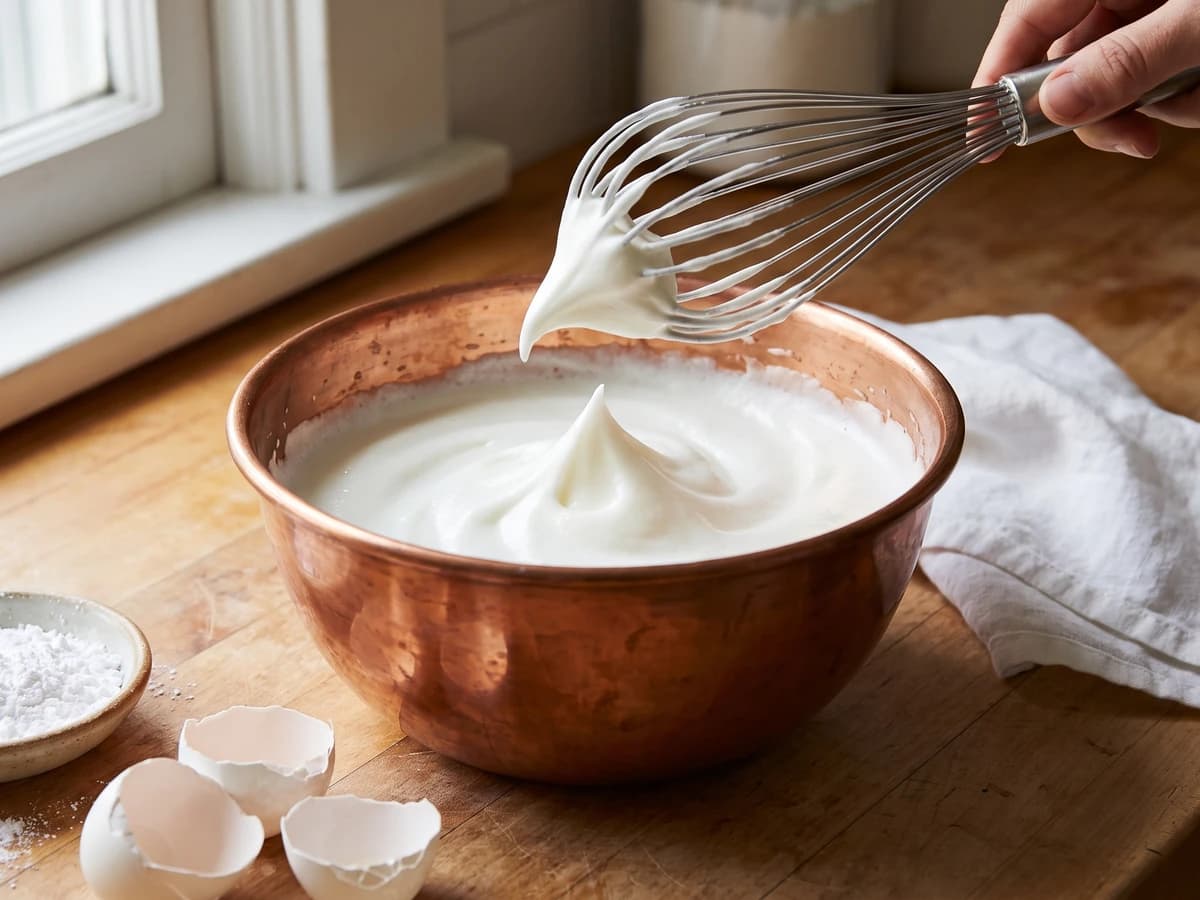
Four whites, one spotless bowl, and a patient change of speed: whisk gently until loosened, then briskly to glossy stiffness, with powdered sugar waiting if the foam begins to granulate.