
Chef Juliette
Flan aux Carottes
A pale short-paste shell holds silken, lightly sweet carrot purée beneath neat glazed half-discs, their butter syrup catching the light: a classical tart poised between vegetable course and sweet.
A cooking platform built around craft, culture, and the stories behind what we eat.

Created by Chef Juliette
Based on No. 2607, Eggs à la Religieuse, from Le Guide Culinaire (1907) by Auguste Escoffier
Œufs à la Religieuse hides milk-poached eggs and pineapple beneath pale custard in a flawn lined with Pralin (No. 2352), where gentle baking protects each tender yolk and keeps the pastry crisp.
Œufs à la Religieuse (soft milk-poached eggs baked in a sweet custard tart) teaches restraint with heat. The eggs cook twice, so the first poach must stop as soon as the whites can hold their shape. The mild second bake then sets the surrounding custard while the yolks remain tender. That contrast is the dish.
This entremets needed neither a saucier nor a stockpot, and no salamander belongs near it. It assumed a pastry cook handing over a deep, pale flawn, a confectionery station with Pralin (No. 2352) ready, and an oven judged by touch. At home, a deep 8-inch tart tin, baking weights, and a low oven do the work. The separate brigade handoffs are scaffolding and can go. The pale shell, dried Pralin lining, sugared-milk poach, pineapple, and yolk-rich custard must stay. One cook, one stove, one evening.
When it is right, the crust is butter-gold but not dark, the almond lining remains distinct, and each slice opens onto a soft yolk surrounded by ivory custard and bright pineapple. Watch the second bake above everything else: pull the flawn while its centre still trembles, because the yolks keep cooking as it rests.
Œufs à la Religieuse belongs to the Parisian classical entremets repertoire, where pastry cases, sweet egg preparations, preserved fruit, and confectionery work met at the dessert course. Its flawn is a deep flan case, while the pineapple and Pralin (No. 2352) reflect the grand-kitchen practice of combining work from several specialized stations in one composed dish. Despite the shared religious name, it is not the familiar stacked choux religieuse, but a separate sweet egg entremets built inside pastry.
Quantity
1½ cups (360 ml / 180 g)
Quantity
2 teaspoons (10 ml / 8 g)
Quantity
¼ teaspoon (1.25 ml / 1.5 g)
Quantity
6 tablespoons (90 ml / 85 g)
cut into small cubes
Quantity
1 large
Quantity
2 to 3 tablespoons (30 to 45 ml / 30 to 45 g)
Quantity
1 teaspoon (5 ml / 5 g)
for the tin
Quantity
⅓ cup (80 ml / 75 g) Pralin (No. 2352)
prepared to the cake-coating consistency
Quantity
2 cups (480 ml / 495 g)
Quantity
¼ cup plus 2 teaspoons (70 ml / 57 g)
Quantity
4 large
preferably pasteurized
Quantity
2 rings (½ cup / 120 ml / 100 g)
drained and cut into 4 cock's-comb pieces
Quantity
2½ large eggs
beat 3 eggs and measure about 125 g, reserving the remainder
Quantity
3 large
| Ingredient | Quantity |
|---|---|
| all-purpose flour | 1½ cups (360 ml / 180 g) |
| superfine sugar | 2 teaspoons (10 ml / 8 g) |
| fine sea salt | ¼ teaspoon (1.25 ml / 1.5 g) |
| cold unsalted buttercut into small cubes | 6 tablespoons (90 ml / 85 g) |
| egg yolk | 1 large |
| ice water | 2 to 3 tablespoons (30 to 45 ml / 30 to 45 g) |
| softened unsalted butterfor the tin | 1 teaspoon (5 ml / 5 g) |
| Pralin (No. 2352)prepared to the cake-coating consistency | ⅓ cup (80 ml / 75 g) Pralin (No. 2352) |
| whole milk | 2 cups (480 ml / 495 g) |
| superfine sugar | ¼ cup plus 2 teaspoons (70 ml / 57 g) |
| fresh eggspreferably pasteurized | 4 large |
| pineapple rings in juicedrained and cut into 4 cock's-comb pieces | 2 rings (½ cup / 120 ml / 100 g) |
| whole eggs for the custardbeat 3 eggs and measure about 125 g, reserving the remainder | 2½ large eggs |
| egg yolks for the custard | 3 large |
Make the pâte à foncer (lining pastry): combine the flour, 2 teaspoons sugar, and salt, then rub in the cold butter until the mixture holds small, flattened flakes. Stir in the egg yolk and 2 tablespoons ice water. Squeeze a handful; if it holds, stop. If it crumbles, add the remaining water a teaspoon at a time. Press the dough together without kneading, reserve a walnut-sized piece for repairs, flatten the rest into a disc, wrap, and chill for 45 minutes. Too much water or handling makes the shell tough.
Heat the oven to 325°F (165°C). Butter a deep 8-inch (20-cm) removable-bottom tart tin with sides at least 1½ inches (4 cm) high. Roll the pastry about ⅛ inch (3 mm) thick, line the tin, and press it firmly into the corners without stretching. Trim the rim, chill for 15 minutes, then line with parchment and fill completely with baking weights. Bake for 18 to 20 minutes, remove the weights, and bake for another 5 to 7 minutes. The shell should look dry and firm but remain ivory rather than browned. If a crack appears, press on a thin smear of the reserved raw dough and bake for 2 more minutes. Ça se rattrape.
Lower the oven to 300°F (150°C). Spread the Pralin (No. 2352) in a thin, even layer across the base and lower sides of the warm flawn. Return it to the oven for 7 to 9 minutes, just until the surface loses its tack and feels set. Do not let it darken beyond pale gold. This dried layer is not decoration; it gives almond flavour and shields the pastry from the milk custard. Cool the shell for 10 minutes.
Put the milk and 57 g sugar in a small, wide saucepan and bring them just to a boil, stirring along the bottom until the sugar dissolves. Lower the heat immediately so the milk barely trembles. Crack one egg into a cup, slip it into the milk, and spoon milk over the top until the white barely holds around the still-loose yolk, about 2 minutes. Lift it with a slotted spoon and drain it over the pan, then repeat with the remaining eggs. If the sugared milk catches, pour the unscorched portion into a clean pan at once without scraping the bottom. Trim any ragged white after draining rather than cooking the yolk harder to neaten it.
Pass the poaching milk through a fine sieve into a heatproof jug and let it cool for 5 minutes. Blot the poached eggs and pineapple thoroughly; water carried into the flawn loosens the custard and softens the shell. Arrange one egg in each quarter of the flawn. Place a cock's-comb piece of pineapple between each pair, notching the curved edge with two or three small V cuts if needed to preserve the source preparation.
Whisk the measured 2½ eggs with the 3 yolks only until blended, without beating in air. Pour in a small ladleful of the warm poaching milk while whisking, then add the rest gradually. The milk must be hot but no longer boiling, or it will scramble the eggs. If a few cooked flecks form, strain the mixture immediately into a cool jug; the custard will still set cleanly. Pass the finished mixture through the sieve once more. The source's instruction to thicken the milk means binding it with these eggs for the oven, not cooking it into a sauce on the stove.
Set the flawn on a rimmed baking sheet and place it on the oven rack before pouring, so a full shell need not travel across the kitchen. Pour the custard slowly around the eggs until they are almost covered. Bake at 300°F (150°C) for 25 to 32 minutes, until the outer custard is set, the centre still trembles softly, and the surface has taken only the faintest biscuit-gold colour. A thermometer inserted into the custard between the eggs should read 162 to 165°F (72 to 74°C). If the top colours before the centre sets, cover it loosely with parchment. Do not use the broiler; fierce top heat firms the yolks before the custard is ready.
Rest the flawn in its tin for 25 minutes. The custard will finish setting from its own warmth while the yolks remain soft. Unmould carefully and cut it into four generous wedges, following the position of the eggs so each guest receives one. Serve barely warm or at room temperature, when the almond layer, pineapple, custard, and tender yolk can all be tasted distinctly. À table!
1 serving (about 320g)
Culinary guides, cultural storytelling, and the editorial depth that makes cooking meaningful.
Discover Culinary ExplorerChef Juliette
A pale short-paste shell holds silken, lightly sweet carrot purée beneath neat glazed half-discs, their butter syrup catching the light: a classical tart poised between vegetable course and sweet.
Chef Juliette
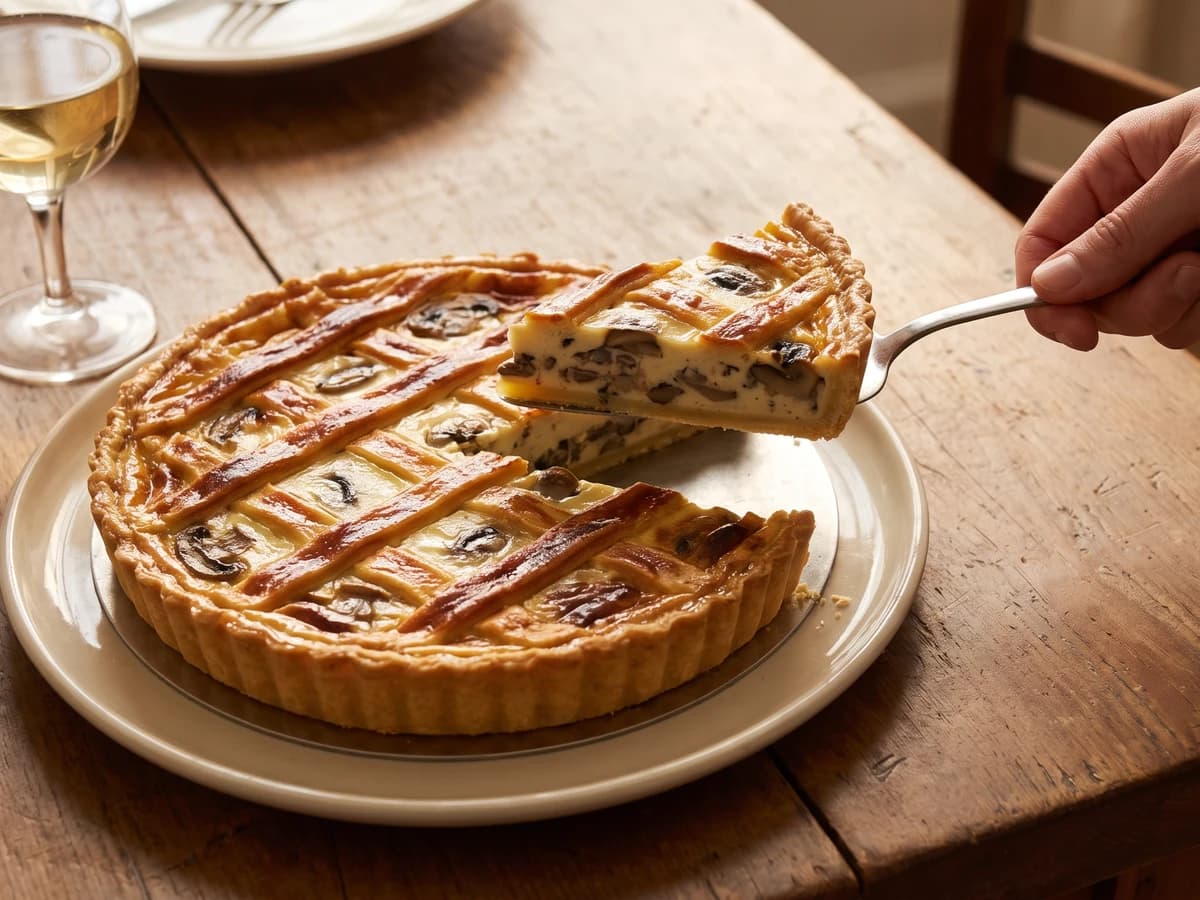
A hot mushroom flan under a butter-gold lattice, with cream reduced close around barely opened caps and a crisp short-paste base protected by one discipline: cool the filling completely.
Chef Juliette
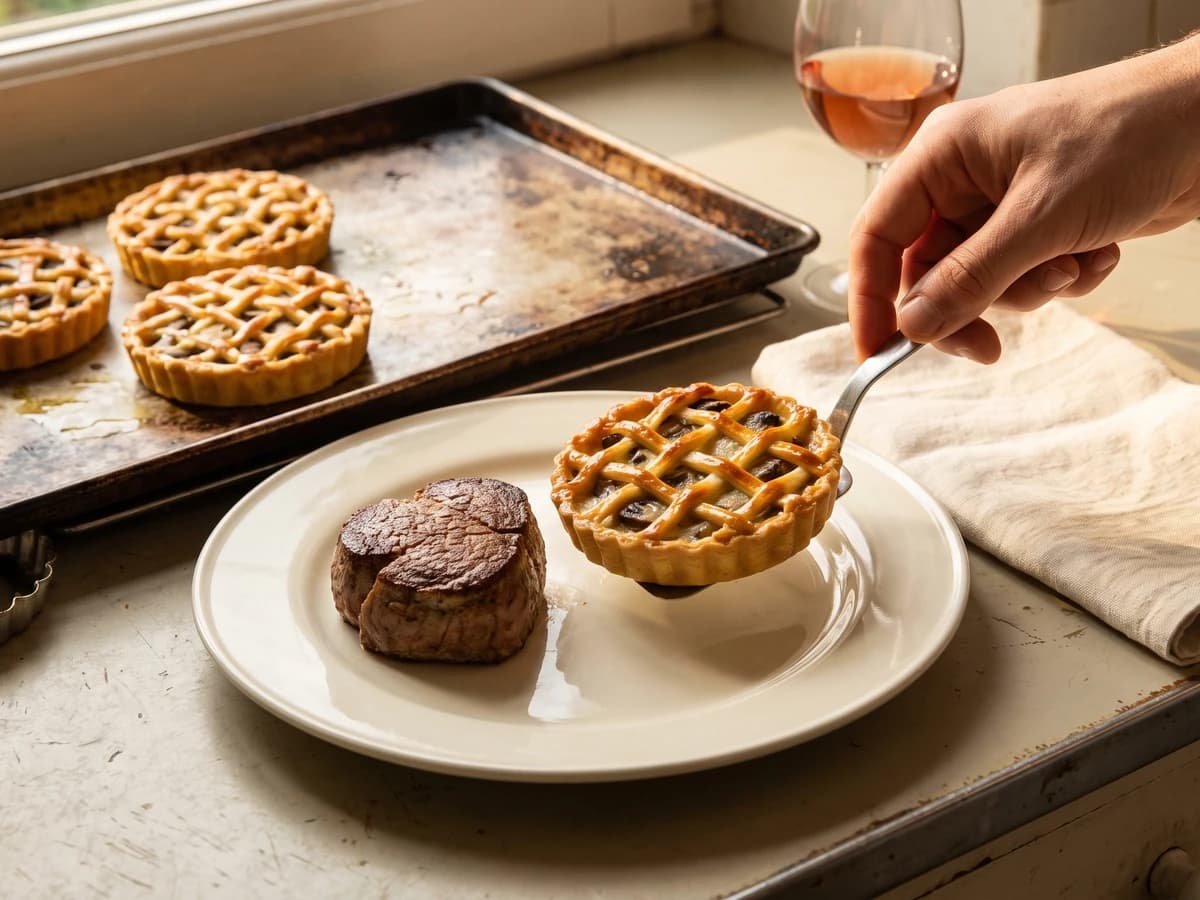
Four little mushroom flans, latticed and gilded, baked hard and fast until butter-gold: a classical garnish scaled to the meat it accompanies and served before its crispness has time to fade.

Chef Juliette
Morels surrender their liquor, then take it back as a glossy cream-and-butter sauce inside burnished puff pastry. The lesson is simple and absolute: reduce with patience, then heat gently and never boil.