
Chef Juliette
Various Almond Preparations
Five almond preparations, one discipline: remove the skins cleanly, dry every kernel through, then cut, toast, or cloak it in pale caramel without letting its fragrant oils escape.
A cooking platform built around craft, culture, and the stories behind what we eat.

Created by Chef Juliette
Based on No. 2470, Surprise Omelet Milady, from Le Guide Culinaire (1907) by Auguste Escoffier
Raspberry ice, vanilla-poached peaches, and maraschino meringue meet in one frozen dome, glazed in a flash so the fruit stays cold and its golden crowns show.
Omelette Surprise Milady (Milady's surprise omelet) teaches command of temperature. The raspberry ice must be frozen hard enough to withstand its brief meeting with fierce heat, because meringue insulates for seconds, not miracles. Get that one truth settled before touching a pan and the finished dish rewards you with firm crimson ice, fragrant peaches, and a pale shell glazed gold at its ridges.
The original assumed a pastry brigade, a sorbetière working beside a freezer chest, Meringue à l’Italienne (No. 2383), Italian meringue, arriving fresh from another station, and a salamander hot enough to color the surface immediately. A small ice cream maker, one chilled mold, and a thoroughly preheated home broiler are the honest equivalents. The referenced meringue remains a finished component from its own entry, while the brigade quantities become one compact dome for six. One cook, one stove, one evening, with the freezer doing most of the waiting.
The relay of molds and extra hands was scaffolding and can go. The firm raspberry ice, vanilla-poached peaches, maraschino-flavored meringue, and deliberately bare fruit crowns are the dish and must stay. Freeze the assembled dome until a firm press leaves no mark before masking it; that final hard freeze is the step that decides everything.
Omelette surprise belongs to the grand pastry kitchens of Paris, where ice was concealed beneath insulating meringue and flashed under a salamander immediately before service. The Milady variation is distinguished by vanilla-poached peaches embedded in firm raspberry ice, their rounded crowns left visible through a maraschino-scented covering. Despite the name, it is not an egg omelet; the title refers to the glazed, domed resemblance and the surprise of finding a frozen center beneath it.
Quantity
5 cups (1.2 L / 600 g)
fresh, or frozen and fully thawed
Quantity
1 cup (240 ml / 200 g)
Quantity
3/4 cup (180 ml / 180 g)
Quantity
1 tablespoon (15 ml / 15 g)
Quantity
3 medium peaches (about 510 g total)
Quantity
3 cups (720 ml / 720 g)
Quantity
1 1/4 cups (300 ml / 250 g)
Quantity
1
split lengthwise and scraped
Quantity
1 round, 8 inches (20 cm) wide and 1/2 inch (1.25 cm) thick, about 7 ounces (200 g)
Quantity
1 batch, about 6 cups (1.4 L / 680 g) Meringue à l’Italienne (No. 2383)
freshly made
Quantity
2 tablespoons (30 ml / 32 g)
Quantity
2 tablespoons (30 ml / 15 g)
| Ingredient | Quantity |
|---|---|
| raspberriesfresh, or frozen and fully thawed | 5 cups (1.2 L / 600 g) |
| granulated sugar for the raspberry ice | 1 cup (240 ml / 200 g) |
| water for the raspberry ice | 3/4 cup (180 ml / 180 g) |
| fresh lemon juice | 1 tablespoon (15 ml / 15 g) |
| firm-ripe yellow peaches | 3 medium peaches (about 510 g total) |
| water for poaching | 3 cups (720 ml / 720 g) |
| granulated sugar for poaching | 1 1/4 cups (300 ml / 250 g) |
| vanilla beansplit lengthwise and scraped | 1 |
| plain génoise round | 1 round, 8 inches (20 cm) wide and 1/2 inch (1.25 cm) thick, about 7 ounces (200 g) |
| Meringue à l’Italiennefreshly made | 1 batch, about 6 cups (1.4 L / 680 g) Meringue à l’Italienne (No. 2383) |
| Maraschino liqueur | 2 tablespoons (30 ml / 32 g) |
| icing sugar | 2 tablespoons (30 ml / 15 g) |
Combine the sugar and water for the raspberry ice in a small saucepan. Bring to a gentle boil, stirring only until the sugar dissolves, then simmer for 2 minutes and cool for 10 minutes. Purée the raspberries with the syrup and lemon juice, then press everything through a fine sieve to remove the seeds. Chill the base thoroughly, at least 3 hours; a warm base churns slowly and grows coarse crystals.
Halve the peaches and remove the stones, leaving the skins on for now. Bring the poaching water, sugar, vanilla seeds, and pod to a bare simmer in a wide saucepan. Add the peach halves and cover them with a round of parchment so they remain beneath the syrup. Poach gently for 4 to 8 minutes, just until a fine knife enters with slight resistance. Lift them out, slip away the skins, and return them to the syrup to cool. If a peach begins softening at its edges, remove it immediately and chill it over an ice bath; ça se rattrape, and a neat trim will restore its shape. Drain the cold halves and blot them very dry.
Line a chilled 1 1/2-quart (1.4 L) stainless steel bowl with two crossed sheets of food-safe film, leaving enough overhang to cover the top. Churn the raspberry base until thick and close-textured. Spread a layer about 1/2 inch (1.25 cm) thick over the bottom and sides of the lined bowl. Arrange the six peach halves in a ring around its widest part, rounded sides against the film and cut sides facing inward. Pack the remaining raspberry ice firmly around and above them, pressing out every hollow, then level the top. Cover and freeze for at least 5 hours, preferably overnight, until a firm press leaves no dent.
Set the génoise on an ovenproof metal serving platter and chill both for 20 minutes. Uncover the mold, invert it onto the center of the cake, and lift away the bowl and film. If it clings, wrap the outside of the bowl with a warm damp towel for 3 seconds, no longer. The peach crowns should form a visible ring around the raspberry dome. Return the whole assembly to the freezer for at least 30 minutes. If any edge has softened, smooth it with a cold spatula and freeze until solid before continuing.
Preheat the broiler at its highest setting for a full 15 minutes, position the rack 7 to 8 inches (18 to 20 cm) below the element, and clear a level space in the freezer. Fold the Maraschino into the freshly made Meringue à l’Italienne (No. 2383), adding it in three small portions so the meringue keeps its body. If it loosens, whisk briefly until the stiff gloss returns. Reserve about one-quarter in a piping bag fitted with a large star tip.
Spread the remaining maraschino meringue over the raspberry ice and the exposed edges of the génoise in an even layer about 3/4 inch (2 cm) thick. Seal every gap between cake and ice, but leave the rounded peach crowns completely bare; that showing fruit is the signature of Milady. Pipe the reserved Meringue à l’Italienne (No. 2383) in close ribs, shells, or rosettes over the masked surface without covering the peaches. Freeze for 20 to 30 minutes. If the meringue slides instead of holding its ridges, stop and return the dish to the freezer. Ça se rattrape.
Dust the meringue lightly and evenly with icing sugar, then brush any stray sugar from the bare peach crowns. Set the platter beneath the fully heated broiler and watch without turning away. Rotate once if needed and remove it after 20 to 45 seconds, when the piped ridges are pale gold with deeper bronze points. If the color is uneven but the ice begins to soften, freeze the dish for 10 minutes before giving it another brief pass. Heat comes second to keeping the center firm.
Let the omelette surprise stand for 3 minutes, no longer. Cut six wedges with a long knife dipped in hot water and wiped dry between every slice, giving each serving one vanilla-poached peach half, raspberry ice, génoise, and glazed meringue. Serve immediately. À table!
1 serving (about 400g)
Culinary guides, cultural storytelling, and the editorial depth that makes cooking meaningful.
Discover Culinary ExplorerChef Juliette
Five almond preparations, one discipline: remove the skins cleanly, dry every kernel through, then cut, toast, or cloak it in pale caramel without letting its fragrant oils escape.

Chef Juliette
A pastry pantry lesson in one tray: filberts warmed only until their red skins release, rubbed clean, cooled, and chopped into a fragrant mise-en-place for cakes, creams, pralines, and petits fours.

Chef Juliette
The smallest pâtisserie discipline decides whether a cake leaves its mould intact: clarified butter in every corner, followed by the lightest veil of dry flour or fécule.
Chef Juliette
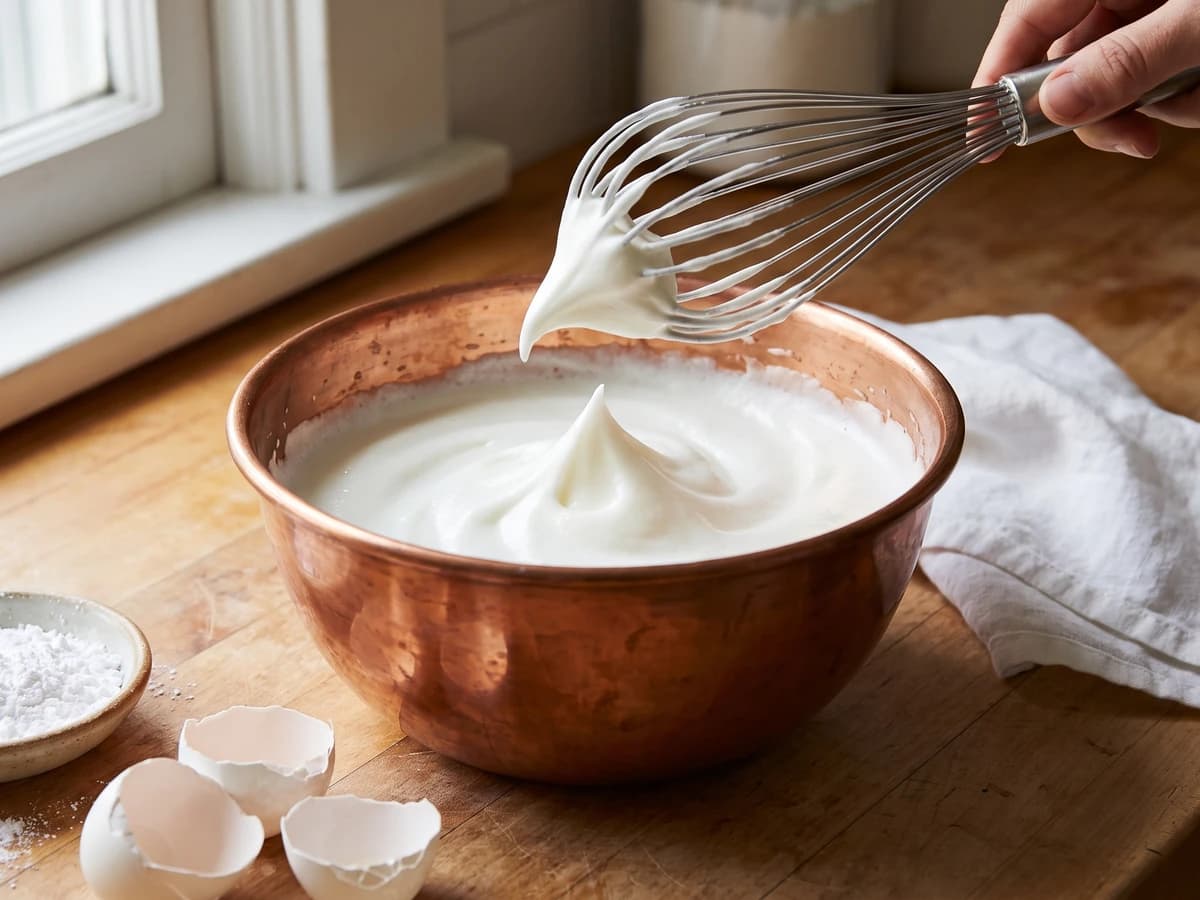
Four whites, one spotless bowl, and a patient change of speed: whisk gently until loosened, then briskly to glossy stiffness, with powdered sugar waiting if the foam begins to granulate.