
Chef Juliette
Flan aux Carottes
A pale short-paste shell holds silken, lightly sweet carrot purée beneath neat glazed half-discs, their butter syrup catching the light: a classical tart poised between vegetable course and sweet.
A cooking platform built around craft, culture, and the stories behind what we eat.
Created by Chef Juliette
Based on No. 2390, Vol-au-Vent Crust, from Le Guide Culinaire (1907) by Auguste Escoffier
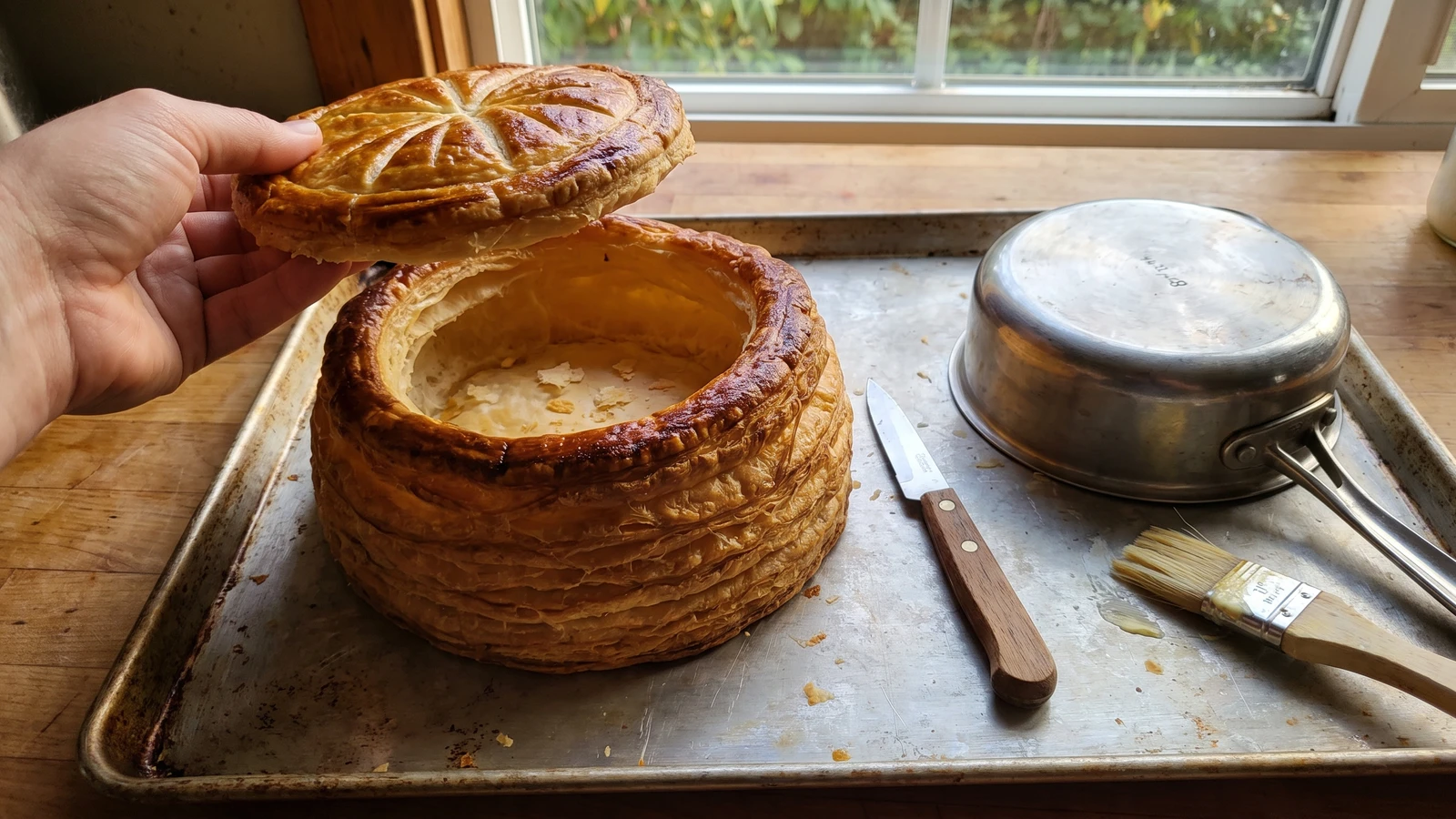
Croûte de vol-au-vent rises on clean, slanted cuts and disciplined handling: a butter-gold puff-pastry case with a removable lid, ready to carry a generous savory filling to the table.
Croûte de vol-au-vent (puff-pastry case) teaches the governing rule of feuilletage: lift begins at the knife. The paste can hold six beautiful turns, but a crushed edge glues those layers together. Cut cleanly on a slight inward slant, turn the round over, and they climb into a high, hollow wall. That is the one true thing to know before you touch the pan.
The original entry assumed a pastry station with Puff-paste (No. 2366) already turned, a broad cool work surface, and a round baking sheet sized for service. Tonight the honest equivalents are one cold portion of paste, an eight-inch saucepan lid, a heavy flat baking sheet, and a properly heated home oven. Brigade quantities and a purpose-made cutter are scaffolding, so they go. The four-fifths-inch thickness, oblique cut, Gild, traced lid, and clearing of the soft interior crumb are the dish, so they stay. One cook, one stove, one evening.
Properly baked, the case stands tall and butter-gold, with crisp leaves visible along every cut edge and a lid that lifts away neatly. Keep the paste cool but pliable, and sharpen the small knife before you begin. The oblique cut is the step that decides the rise.
Vol-au-vent belongs to the Parisian grand-kitchen tradition, where feuilletage was shaped into a large hollow case and filled at the last moment with sauced poultry, sweetbreads, seafood, or mushrooms. Its name evokes flight in the wind and praises the lightness of properly raised pastry, while the filling changes with the table. The large vol-au-vent is often confused with its individual cousin, the bouchée, but the classical distinction is one generous centerpiece to share versus a small case for one guest.
Quantity
2 tablespoons (30 ml / 16 g)
for dusting, used sparingly
Quantity
1 teaspoon (5 ml / 5 g)
for moistening the baking sheet
Quantity
1 large egg (about 3 tablespoons / 45 ml / 50 g without shell)
beaten for Gild
| Ingredient | Quantity |
|---|---|
| prepared Puff-pastecold but pliable | One 2-pound (910 g) portion Puff-paste (No. 2366) |
| all-purpose flourfor dusting, used sparingly | 2 tablespoons (30 ml / 16 g) |
| cold waterfor moistening the baking sheet | 1 teaspoon (5 ml / 5 g) |
| large eggbeaten for Gild | 1 large egg (about 3 tablespoons / 45 ml / 50 g without shell) |
Set a conventional oven to 425°F (220°C) with a rack just below the centre. Wipe the heavy baking sheet with the cold water, leaving only a faint film and no droplets. This slightly moistened metal is the home equivalent of the original round baking sheet and helps the pastry settle without adding another layer beneath it.
Dust the work surface very lightly and roll the Puff-paste (No. 2366) into an even round a little larger than 8 inches (20 cm) and exactly four-fifths inch (2 cm) thick. Work from the centre outward, lifting the paste occasionally without stretching it. Measure in several places because a thin quarter will rise less than the rest. If the paste springs back or the butter begins to feel soft, stop and chill it for 10 to 15 minutes. Ça se rattrape. Forcing warm, elastic paste only makes it shrink in the oven.
Set an overturned 8-inch (20 cm) plate or saucepan lid in the centre. Draw a small, very sharp knife around it once, holding the blade at a slight inward angle so its tip slopes toward the centre beneath the template. Do not saw or press the edge flat. Lift away the trimmings, remove the template, then turn the pastry round completely over. The broader face created by the oblique cut now rests underneath, while the exposed layers are positioned to climb.
Transfer the turned round to the barely moistened baking sheet. Chiqueter the edge, meaning make shallow, evenly spaced grooves around the circumference with the back of the small knife. Gild the top with a thin, even brushing of beaten egg, keeping the brush away from the outer cut edge. Egg running down the side acts like glue; if it drips, wipe it away at once with the corner of a clean cloth.
With the point of the knife, describe a circle exactly 1¼ inches (3.2 cm) inside the outer edge. Cut about halfway through the paste, never through the base, to form the removable cover. Streak the cover in a shallow criss-cross pattern, then continue the same light pattern over the surrounding body. Score without crushing. These marks should decorate the surface, not pin the layers together.
Bake at 425°F (220°C) for 15 minutes without opening the door, then reduce the heat to 400°F (200°C) and continue for 20 to 25 minutes. The case is ready when it stands high, feels firm along the walls, and has gone deep butter-gold rather than merely pale. This stepped heat translates the book's rather hot oven: strong heat begins the lift, then slightly gentler heat cooks the thick centre. If one side rises faster, rotate the sheet only after the first 20 minutes, when the structure has set. If the top colours too quickly, lay foil loosely over the crown without pressing the walls.
While the vol-au-vent is still warm, follow the scored circle with the knife and lift away the cover. Pull the soft crumb from the underside of the lid and clear it carefully from the cavity with a small spoon, leaving the outer walls intact and a base about ⅜ inch (1 cm) thick. If the exposed interior is damp or doughy, do not fill it. Ça se rattrape: return the open case and its lid to a 375°F (190°C) oven for 5 to 8 minutes, until the inside feels dry and delicately crisp.
Move the hollowed case and lid to a wire rack and let them cool for at least 15 minutes. Fill the vol-au-vent close to serving so its walls remain crisp, then replace the lid over the opening. Never apologize at your own table. À table!
1 serving (about 190g)
Culinary guides, cultural storytelling, and the editorial depth that makes cooking meaningful.
Discover Culinary ExplorerChef Juliette
A pale short-paste shell holds silken, lightly sweet carrot purée beneath neat glazed half-discs, their butter syrup catching the light: a classical tart poised between vegetable course and sweet.
Chef Juliette
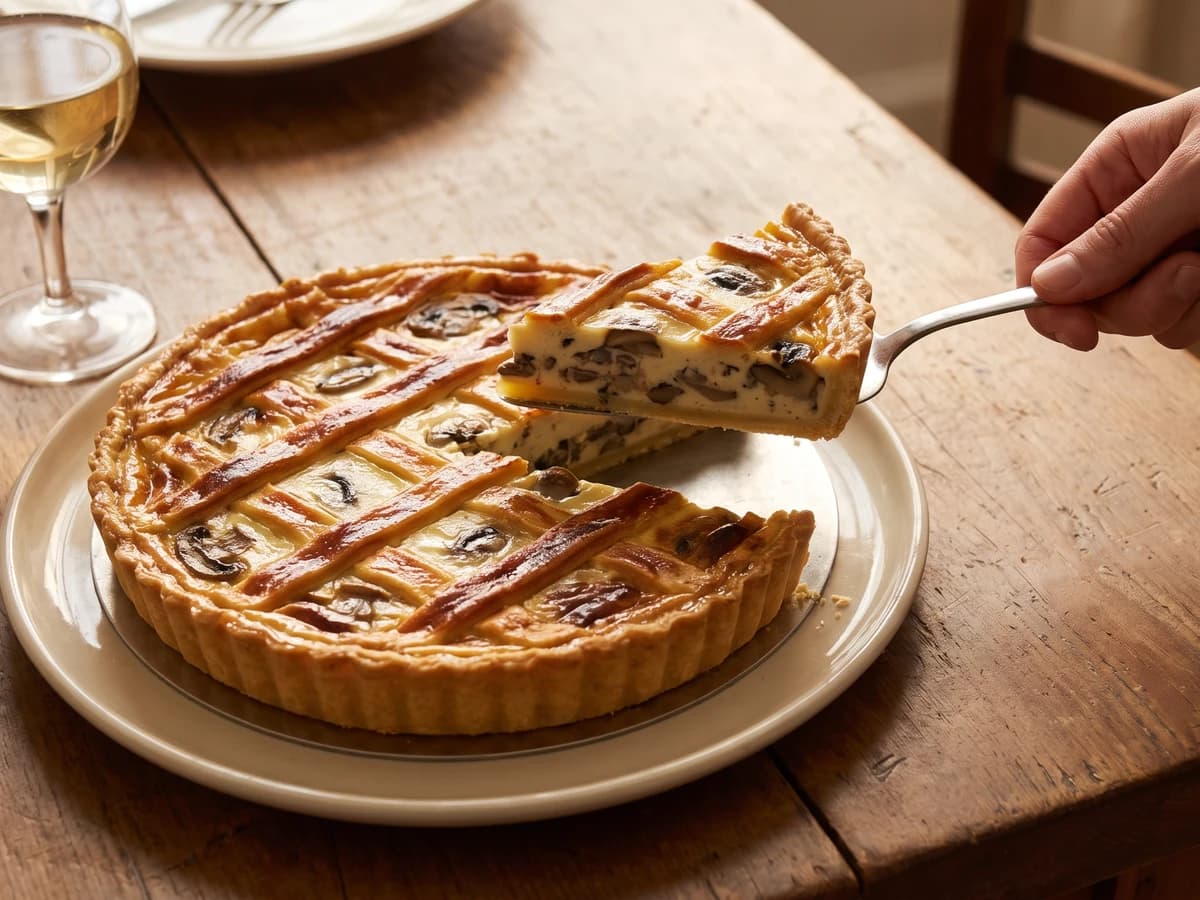
A hot mushroom flan under a butter-gold lattice, with cream reduced close around barely opened caps and a crisp short-paste base protected by one discipline: cool the filling completely.
Chef Juliette
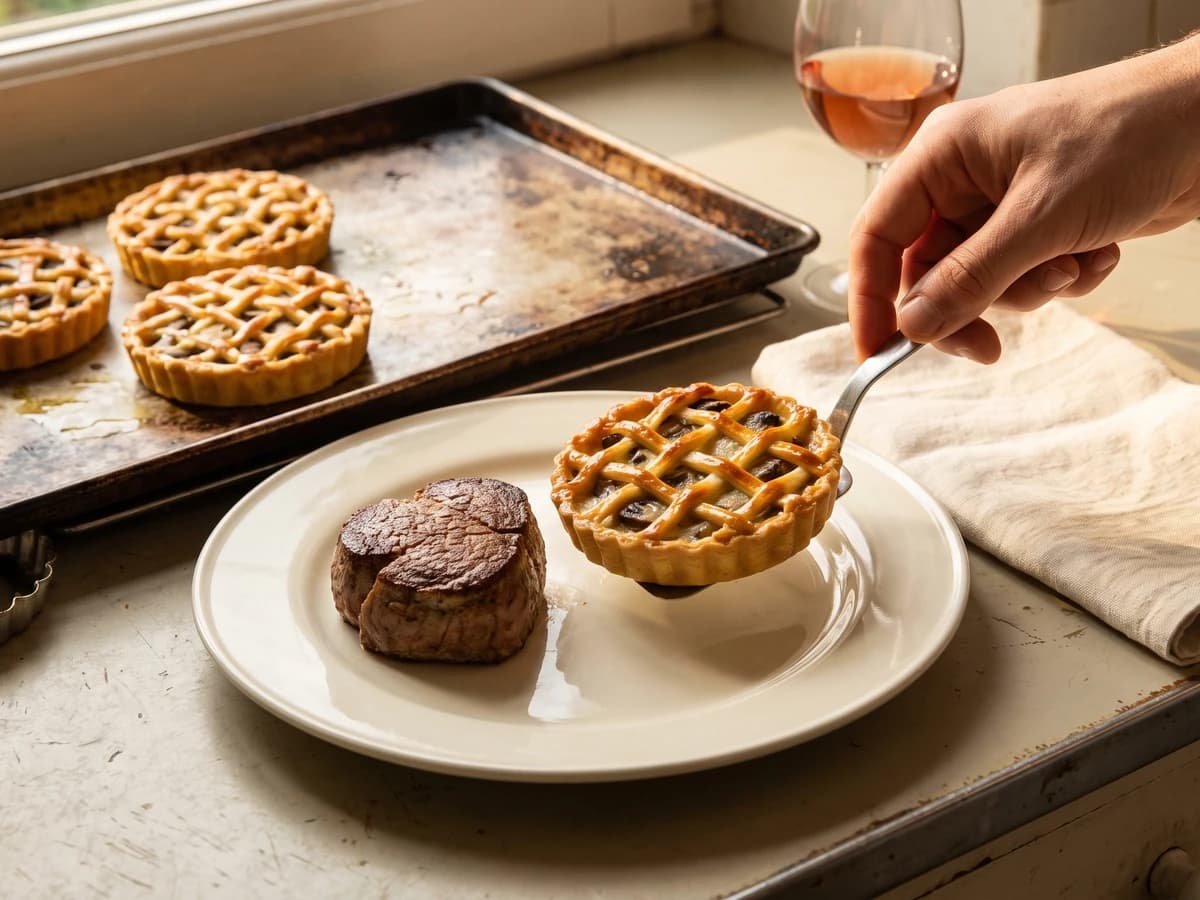
Four little mushroom flans, latticed and gilded, baked hard and fast until butter-gold: a classical garnish scaled to the meat it accompanies and served before its crispness has time to fade.

Chef Juliette
Morels surrender their liquor, then take it back as a glossy cream-and-butter sauce inside burnished puff pastry. The lesson is simple and absolute: reduce with patience, then heat gently and never boil.