
Chef Juliette
Various Almond Preparations
Five almond preparations, one discipline: remove the skins cleanly, dry every kernel through, then cut, toast, or cloak it in pale caramel without letting its fragrant oils escape.
A cooking platform built around craft, culture, and the stories behind what we eat.

Created by Chef Juliette
Based on No. 2384, Meringue à l’Italienne (another recipe), from Le Guide Culinaire (1907) by Auguste Escoffier
Meringue à l’Italienne teaches control: powdered sugar and whites held lukewarm, then whisked until a glossy bridge spans the whisk, with no cooked syrup and no pastry brigade.
Meringue à l’Italienne teaches control with only two ingredients. The one true thing to know is that warmth helps the sugar dissolve and the foam strengthen, but the whites must remain lukewarm. Heat is the support, not the cooking.
The original recipe assumed eight whites, a pound of powdered sugar, an untinned copper basin resting near hot cinders, and a strong arm free to whisk. Here, the brigade quantity becomes a quarter batch for four desserts, while a compact stainless-steel bowl over barely simmering water and an electric hand mixer replace the copper and cinders. Those old arrangements were scaffolding and may go. The proportion, the simultaneous mixing of whites and sugar, and the steady gentle warmth are the dish itself, so they stay exactly as written.
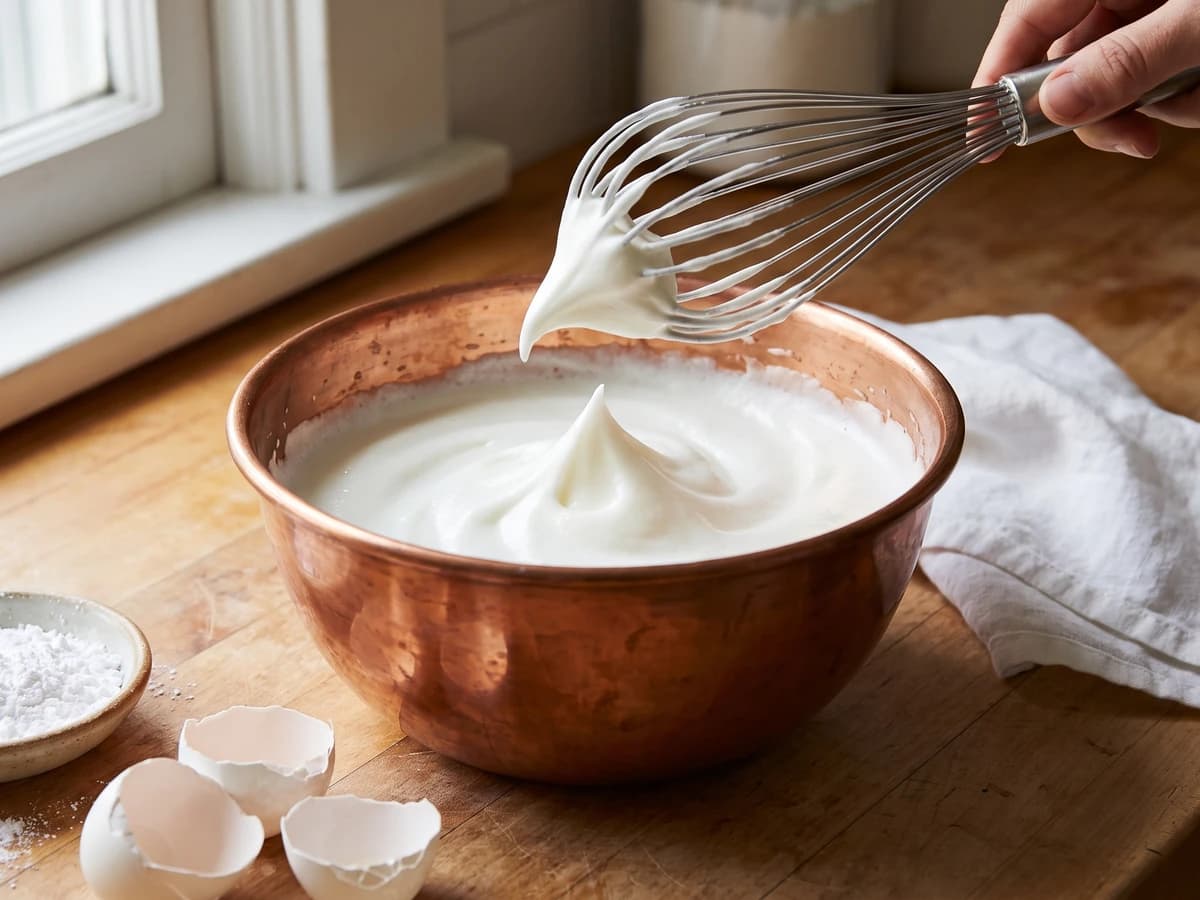
When it is ready, the meringue is dense, glossy, and strong enough to stretch between the wires of the lifted whisk instead of slipping back into the bowl. The one step that matters most is controlling the basin's warmth while you whisk. Lukewarm gives structure; hot gives scrambled edges.
The real home of this preparation is the French pâtisserie workroom, where meringues were distinguished by the way sugar met the whites rather than by a regional table. The vocabulary has never been perfectly fixed: many pastry kitchens call the warm-basin method meringue suisse and reserve meringue italienne for hot syrup, while this entry names its powdered-sugar method Meringue à l’Italienne. It traveled readily from the confectioner's copper basin to the home kitchen because gentle warmth and steady whisking require no sugar pan, only close attention.
Quantity
2 large (about 1/4 cup / 60 ml / 60 g)
pasteurized if the meringue will be served without further cooking
Quantity
1 cup (240 ml / 113 g)
sifted
| Ingredient | Quantity |
|---|---|
| large egg whitespasteurized if the meringue will be served without further cooking | 2 large (about 1/4 cup / 60 ml / 60 g) |
| very fine powdered sugarsifted | 1 cup (240 ml / 113 g) |
Put about 1 inch of water in a medium saucepan and bring it just to a simmer, then lower the heat until the surface barely quivers. Choose a compact heatproof bowl that sits over the pan without touching the water. Wash and dry the bowl, whisk, and mixer beaters thoroughly; even a trace of yolk or grease prevents the whites from building their full volume.
Put the egg whites and sifted powdered sugar into the bowl together, exactly as the source directs. Stir slowly with the switched-off mixer beaters or a balloon whisk until every pocket of dry sugar is moistened. Do not whip the whites separately or add the sugar in stages; their union from the beginning is part of this particular method.
Set the bowl over the barely simmering water and whisk constantly at medium-low speed, turning the bowl so no edge receives more heat than another. Keep the mixture lukewarm, about 95 to 104°F (35 to 40°C), lifting the bowl from the pan whenever it grows hotter than your hand. If opaque flecks appear around the rim, remove the bowl immediately and whisk on the counter; if caught early, pass the mixture through a fine sieve and resume over gentler water. Ça se rattrape. Widespread cooked white, however, cannot make a smooth meringue.
Continue beating, moving the bowl on and off the pan as needed to preserve that lukewarm temperature, until the mixture expands into a dense, satin-glossy meringue, usually 8 to 12 minutes. Lift the beaters. It is ready when a stiff peak stands upright and a firm bridge of meringue remains stretched between neighboring wires for a moment. If it is smooth but slack, keep whisking rather than raising the heat; aeration and patience finish the work.
Use the Meringue à l’Italienne at once for piping, spreading, or folding into a mousse or parfait base. To fold it, first stir one quarter into the heavier mixture to loosen it, then add the remainder with broad strokes that preserve the air. If it must wait, transfer it to a smaller clean bowl, lay a round of parchment directly against the surface as the original recipe instructs, and refrigerate for no more than four hours. Whisk briefly by hand before using if it has settled.
1 serving (about 43g)
Culinary guides, cultural storytelling, and the editorial depth that makes cooking meaningful.
Discover Culinary ExplorerChef Juliette
Five almond preparations, one discipline: remove the skins cleanly, dry every kernel through, then cut, toast, or cloak it in pale caramel without letting its fragrant oils escape.

Chef Juliette
A pastry pantry lesson in one tray: filberts warmed only until their red skins release, rubbed clean, cooled, and chopped into a fragrant mise-en-place for cakes, creams, pralines, and petits fours.

Chef Juliette
The smallest pâtisserie discipline decides whether a cake leaves its mould intact: clarified butter in every corner, followed by the lightest veil of dry flour or fécule.
Chef Juliette
Four whites, one spotless bowl, and a patient change of speed: whisk gently until loosened, then briskly to glossy stiffness, with powdered sugar waiting if the foam begins to granulate.