
Chef Juliette
Flan aux Carottes
A pale short-paste shell holds silken, lightly sweet carrot purée beneath neat glazed half-discs, their butter syrup catching the light: a classical tart poised between vegetable course and sweet.
A cooking platform built around craft, culture, and the stories behind what we eat.

Created by Chef Juliette
Based on No. 2365, Galette Paste, from Le Guide Culinaire (1907) by Auguste Escoffier
Pâte à galette proves that tenderness comes from restraint: butter at half the flour's weight, a full cool rest, and three measured turns that build fine layers without making the dough elastic.
Pâte à galette teaches restraint in dough. The one true thing to know before your hands touch the flour is that rest does more work than force: knead only until the ingredients become one smooth paste, then leave it alone for the full hour. Rush that rest and the dough fights the pin; honor it and the pastry rolls quietly, with butter carried evenly from edge to edge.
The source formula assumed a cool pastry room, a broad bench, and a pastry cook able to time three turns while other hands kept the kitchen moving. Here the brigade quantity is halved exactly, keeping flour, butter, sugar, salt, and water in their original proportions. One bowl, one rolling pin, and the refrigerator provide the honest home equivalent. One cook, one stove, one evening.
When it is right, the dough is pale butter-gold, supple without stickiness, and faintly layered at the folded edge. The hour of cooling is not idle time, and the eight-minute intervals are not ceremony; they let the gluten settle between turns, just as they do in puff-paste, while the softened butter remains evenly dispersed. Give the dough its full first rest before the pin touches it. That is the step that decides everything.
This turned pâte à galette belongs to the classical French pastry bench, particularly the Parisian repertoire that gathered working formulas for flat cakes and filled tarts rather than assigning the paste to one regional galette. It should not be confused with Breton buckwheat batter, nor is it pâte feuilletée: its butter is kneaded directly into the dough instead of enclosed as a separate slab. Three rested tours organize that butter into a tender, lightly layered paste that moved readily from professional pastry kitchens to the home table.
Quantity
1⅞ cups (450 ml / 227 g)
sifted
Quantity
¾ teaspoon (3.75 ml / 4.7 g)
Quantity
¼ cup (60 ml / 28 g)
Quantity
¼ cup plus 2 teaspoons (70 ml / 70 g)
Quantity
½ cup (120 ml / 113 g)
softened but still cool
| Ingredient | Quantity |
|---|---|
| all-purpose floursifted | 1⅞ cups (450 ml / 227 g) |
| fine sea salt | ¾ teaspoon (3.75 ml / 4.7 g) |
| powdered sugar | ¼ cup (60 ml / 28 g) |
| cool water | ¼ cup plus 2 teaspoons (70 ml / 70 g) |
| unsalted buttersoftened but still cool | ½ cup (120 ml / 113 g) |
Put the sifted flour in a wide bowl and hollow out the center, leaving a sturdy wall around it. Place the salt, powdered sugar, cool water, and softened butter in the hollow. The butter should accept a fingertip without looking oily; melted or greasy butter will disappear into the flour and spoil the fine structure made by the later turns.
Work the butter, water, sugar, and salt together with your fingertips or a flexible scraper until they form a thick, uneven cream. Draw flour from the inner wall into the center a little at a time, mixing each addition before taking more. This gradual incorporation is the principle inside the method: it distributes the water and butter evenly without forcing the dough into elasticity.
Turn the rough mass onto an unfloured surface. Press it away with the heel of your hand, fold it back, and repeat for 3 to 4 minutes, only until the butter is fully combined and the dough looks smooth and uniform. Thoroughly combined does not mean springy. Stop before the dough begins snapping back under your hand. If it becomes greasy or leaves butter streaks, stop and cool it for 10 minutes before continuing. Ça se rattrape. Do not bury the problem under more flour.
Shape the dough into a flat rectangle, wrap it closely, and leave it in a cool place for at least 1 hour, using the refrigerator if the kitchen is warm. This rest relaxes the gluten and firms the butter already kneaded through the paste. If refrigerated dough is hard, leave it out for 5 minutes before rolling; if it still fights the pin or shrinks back, cover it and wait another 10 minutes. Force makes toughness, while rest does the work cleanly.
Dust the work surface and rolling pin very lightly with flour. Roll the dough into a neat rectangle about 14 by 7 inches (35 by 18 cm), keeping the thickness even and the corners square. Brush off loose flour, fold the top third down and the bottom third over it like a letter, then rotate the packet one-quarter turn. This is the first tour, a roll-and-fold turn. Cover and rest it in the cool for exactly 8 minutes. If the edges crack, the butter is too cold, so wait 2 or 3 minutes; if the surface smears, cool the packet for 10 minutes before proceeding.
Roll and fold the dough in the same manner for a second tour, keeping the long side in front of you and using only enough flour to prevent sticking. Cover and rest it for another 8 minutes, then give it the third and final tour. The broad marble bench and a pastry cook timing this work around a brigade were scaffolding. A rolling pin, a cool counter, and a kitchen timer replace them honestly, but the full first rest and all three tours remain because they are the paste itself. After the third fold, wrap the pâte à galette and use it while cool and pliable, or refrigerate it until required.
1 serving (about 440g)
Culinary guides, cultural storytelling, and the editorial depth that makes cooking meaningful.
Discover Culinary ExplorerChef Juliette
A pale short-paste shell holds silken, lightly sweet carrot purée beneath neat glazed half-discs, their butter syrup catching the light: a classical tart poised between vegetable course and sweet.
Chef Juliette
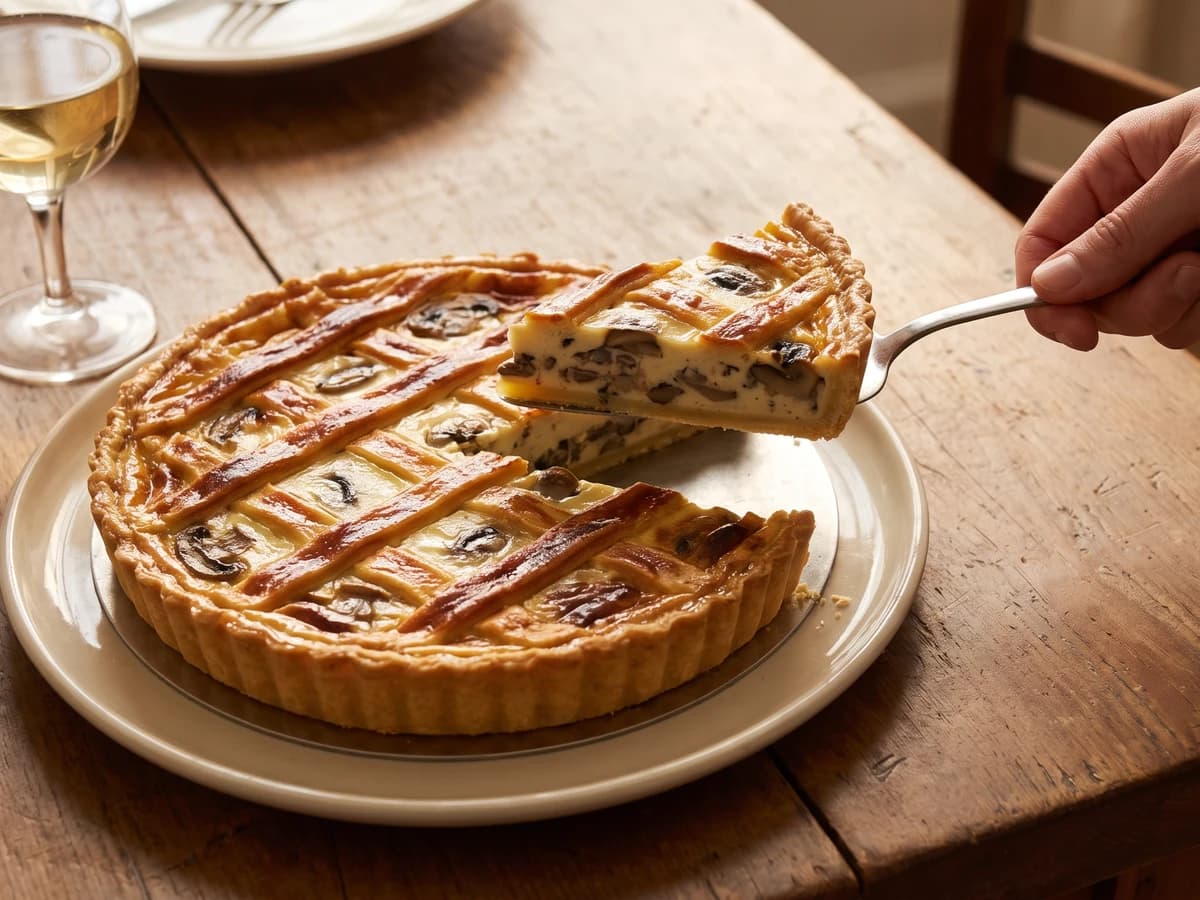
A hot mushroom flan under a butter-gold lattice, with cream reduced close around barely opened caps and a crisp short-paste base protected by one discipline: cool the filling completely.
Chef Juliette
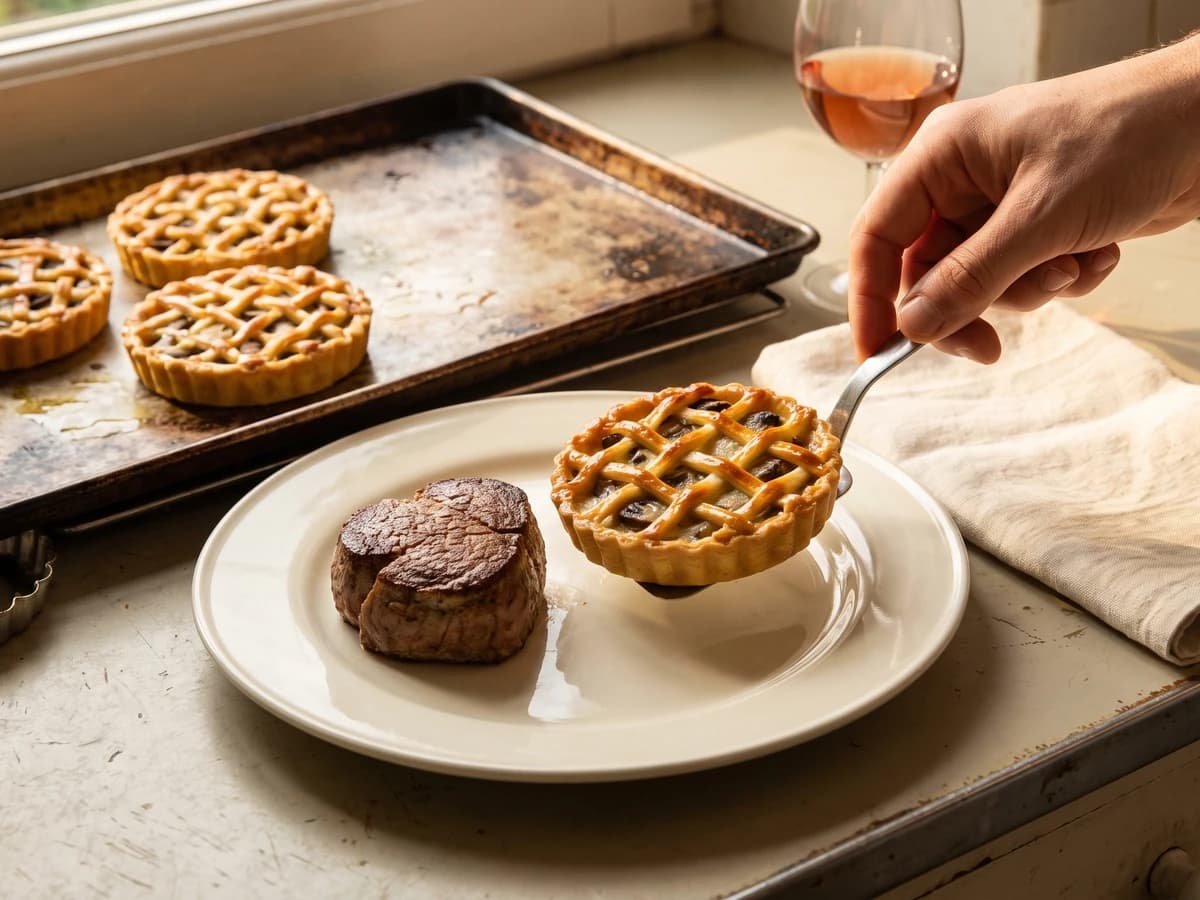
Four little mushroom flans, latticed and gilded, baked hard and fast until butter-gold: a classical garnish scaled to the meat it accompanies and served before its crispness has time to fade.

Chef Juliette
Morels surrender their liquor, then take it back as a glossy cream-and-butter sauce inside burnished puff pastry. The lesson is simple and absolute: reduce with patience, then heat gently and never boil.