Chef Juliette
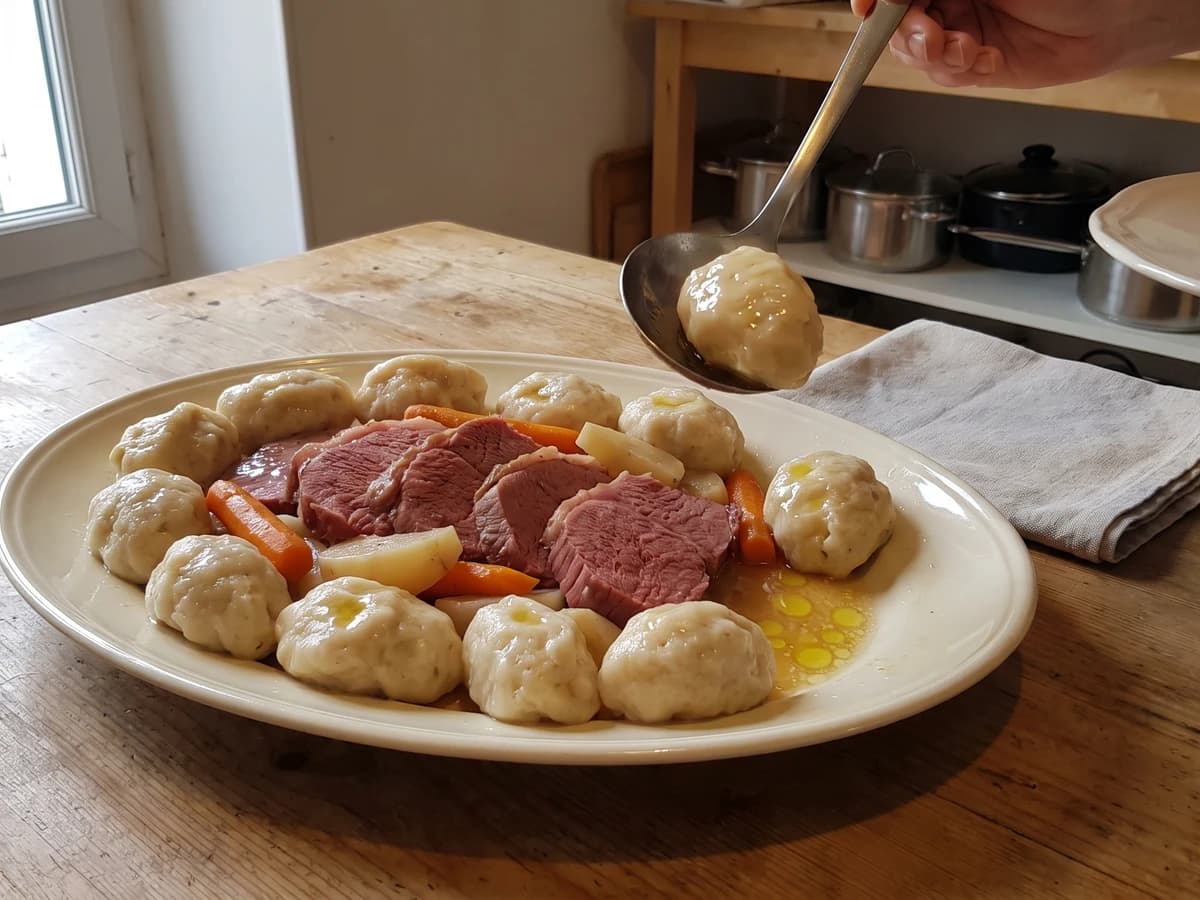
Suet Dumpling
Boulettes au suif, poached beside salt beef, turn equal weights of flour and finely chopped suet into tender, rich dumplings. Keep the beef liquor at a bare tremble and the old garnish works beautifully at home.
A cooking platform built around craft, culture, and the stories behind what we eat.

Created by Chef Juliette
Based on No. 2293, Kache de Sarrasin pour Potages, from Le Guide Culinaire (1907) by Auguste Escoffier
Buckwheat baked until tender, stripped of its crust, buttered while hot, chilled, stamped into small roundels, and browned in clarified butter: a modest garnish with real spine for the soup bowl.
Kache de sarrasin pour potages (buckwheat roundels for soups) teaches the discipline of texture. The buckwheat must begin as a stiff paste, not a pourable batter, because everything that follows depends on its holding a clean edge once cold. That is the one true thing to know before touching a pan.
The original stood inside a brigade: a saucier and a stockpot supplied the potage, while another cook filled a large Charlotte-mould, cooled a tray, and stamped a service batch. Your honest equivalent is a 3-cup straight-sided baking dish, one small tray, and three-eighths of the original pound of grain. The large mould and brigade quantity are scaffolding, so they go. The long bake, the sacrificial crust, the butter worked into the hot centre, and the final colouring in clarified butter are the dish, so they stay. One cook, one stove, one evening.
When it is right, each roundel has a nutty, tender middle enclosed by a thin bronze skin, sturdy enough to sit in a potage without immediately surrendering. Guard the stiffness of the first paste; the rest is patient work.
The French name kache preserves a form of the Russian word kasha, the broad family of cooked grain dishes central to Russian and neighboring Slavic tables, with buckwheat among its most characteristic grains. French classical kitchens drew that familiar porridge into the potage repertoire, baking it in a mould and turning the buttered interior into neat fried garnishes. The crust was never the prize: it served as a protective shell, while the tender centre became the refined element placed in the soup bowl.
Quantity
1 cup (240 ml / 170 g)
roughly broken rather than ground
Quantity
1¼ to 1½ cups (300 to 360 ml / 300 to 360 g)
Quantity
¾ teaspoon (3.75 ml / 4 g)
Quantity
2 tablespoons (30 ml / 20 g)
for correcting a loose paste
Quantity
2 teaspoons (10 ml / 9 g)
for the mould and tray
Quantity
1½ tablespoons (22.5 ml / 21 g)
for mixing into the hot kache
Quantity
¼ cup (60 ml / 30 g)
for rolling
Quantity
3 tablespoons (45 ml / 42 g)
for colouring
| Ingredient | Quantity |
|---|---|
| concassé buckwheat groatsroughly broken rather than ground | 1 cup (240 ml / 170 g) |
| tepid water | 1¼ to 1½ cups (300 to 360 ml / 300 to 360 g) |
| fine salt | ¾ teaspoon (3.75 ml / 4 g) |
| extra concassé buckwheat groats (optional)for correcting a loose paste | 2 tablespoons (30 ml / 20 g) |
| softened unsalted butterfor the mould and tray | 2 teaspoons (10 ml / 9 g) |
| unsalted butterfor mixing into the hot kache | 1½ tablespoons (22.5 ml / 21 g) |
| plain flourfor rolling | ¼ cup (60 ml / 30 g) |
| clarified butterfor colouring | 3 tablespoons (45 ml / 42 g) |
Heat the oven to 400°F (200°C). Examine the concassé, meaning the roughly broken buckwheat: the pieces should resemble coarse grits, with no whole groats and very little powder. If starting with whole groats, pulse them briefly in a food processor, stopping well before they become flour.
Mix the buckwheat and salt in a bowl. Work in 1¼ cups (300 ml) of the tepid water, then add the remainder a tablespoon at a time only if dry grain remains. The mixture should be thick enough for a spoon drawn through it to leave a trench; it must mound rather than flow. If it loosens too far, let it stand for 10 minutes so the grain can drink, then beat in the extra concassé a spoonful at a time. Ça se rattrape.
Use half the softened butter to coat a 3-cup (700 to 750 ml) straight-sided baking dish. Pack in the paste, press out any air pockets, and level the top. Bake on the middle rack for 2 hours. A thick, firm crust should form over the top and around the sides while the centre becomes fully tender; that crust is a shield, not the finished food.
Break through the top and remove the entire thick crust, then spoon the tender interior into a warm mixing bowl. Taste a little. If the centre still has a raw crunch, return it to the mould, cover, and bake for another 15 minutes before continuing. Do not confuse the buckwheat's natural graininess with undercooking; it should be textured but yielding.
While the kache is still very hot, work in the 1½ tablespoons (21 g) unsalted butter until it disappears and the mixture takes on a gentle sheen. Butter a small rimmed metal tray with the remaining softened butter, then spread the kache into an even layer about ⅜ inch (1 cm) thick. Press firmly enough to remove gaps without crushing it into paste. Cool, then refrigerate for 45 to 60 minutes, until completely firm.
Stamp out roundels with a 1-inch (2.5 cm) cutter, dipping the cutter in flour whenever it begins to drag. Gather the scraps, press them together once, and cut again. Roll each roundel lightly in the remaining flour and shake off every loose patch; excess flour burns before the buckwheat colours.
Heat the clarified butter in a heavy skillet over medium-high heat until it runs freely and gleams. Add the roundels in one uncrowded layer and colour them for 2 to 3 minutes on each side, until bronze and lightly crisp outside. If they cling, do not scrape: leave them another 20 seconds, because a properly formed crust releases itself. Fry in batches as needed, then set the hot roundels directly into the waiting potage or carry them separately to the table. À table!
1 serving (about 135g)
Culinary guides, cultural storytelling, and the editorial depth that makes cooking meaningful.
Discover Culinary ExplorerChef Juliette
Boulettes au suif, poached beside salt beef, turn equal weights of flour and finely chopped suet into tender, rich dumplings. Keep the beef liquor at a bare tremble and the old garnish works beautifully at home.

Chef Juliette
Bread, flour, frangipane, and rice become four cool, supple panades for binding forcemeats, each changing body and flavor while preserving tenderness. The finest Mousselines need none, and knowing that distinction is the lesson.

Chef Juliette
Panade au pain is bread, milk, salt, heat, and attention: stir until the paste releases cleanly, butter it against a skin, and you have the quiet binder behind tender French farces.

Chef Juliette
Panade de farine teaches the drying stroke behind pâte à choux: flour meets boiling buttered water, then stays over the fire until the paste gathers, smooths, and quits the pan cleanly.