Chef Juliette
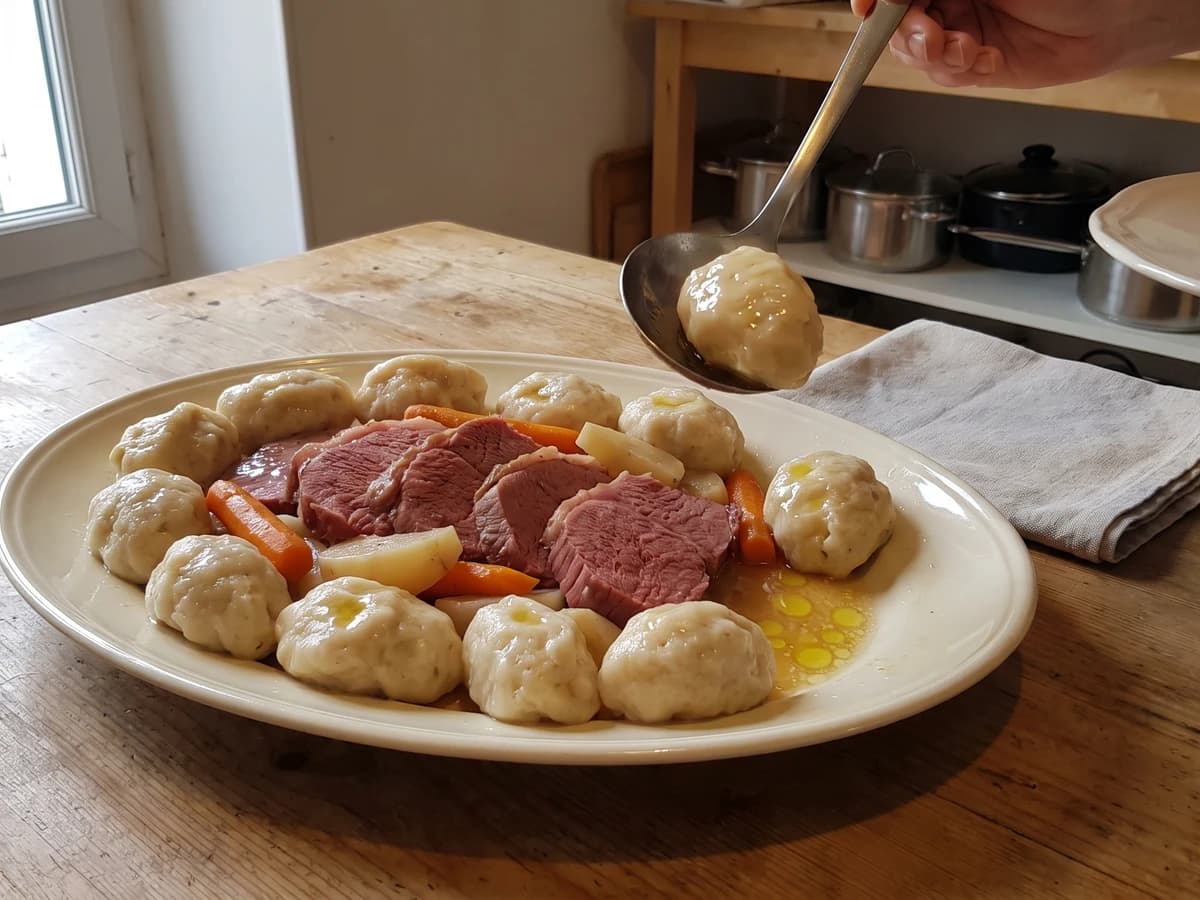
Suet Dumpling
Boulettes au suif, poached beside salt beef, turn equal weights of flour and finely chopped suet into tender, rich dumplings. Keep the beef liquor at a bare tremble and the old garnish works beautifully at home.
A cooking platform built around craft, culture, and the stories behind what we eat.

Created by Chef Juliette
Based on No. 2292, Kache de Semoule pour Coulibiac, from Le Guide Culinaire (1907) by Auguste Escoffier
The quiet layer that keeps coulibiac crisp: coarse yellow semolina swelled in consommé, dried without browning, then passed through a coarse sieve until every grain lies loose and ready for the pastry.
Kache de Semoule pour Coulibiac (separated semolina for coulibiac) teaches moisture management. The one true thing to know before touching the pan is that the kache must enter the pastry completely dry. Its purpose is not merely to stretch the filling. It absorbs the juices released inside the coulibiac without surrendering the crust to them.
The source assumed what a brigade kept close at hand: a stockpot of consommé never off the fire, broad service trays, and a coarse tamis for separating large quantities. For one cook, one stove, one evening, that becomes one cup of coarse semolina, three cups of finished consommé, a quarter-sheet pan, and an ordinary coarse sieve. The brigade quantity and dedicated equipment are scaffolding and can go. The three-to-one proportion, twenty-five-minute cooking, draining, oven-drying, and final sieving are the dish, and each remains intact.
You are looking for loose, durum-gold granules with no damp paste between them. The drying decides everything: do not stop when the surface merely looks dry; stop when a pinched clump breaks apart cleanly and leaves your fingertips free of starch.
The parent dish, kulebyaka, belongs to the Russian table; French classical kitchens in Paris adopted it as coulibiac and organized its fish, grains, eggs, and pastry into disciplined layers. Kache reflects kasha, the broad Russian family of cooked grains, but this semolina version performs a structural office by absorbing juices inside the pastry. It is not simply porridge used as bulk, and its dryness matters more than richness.
Quantity
1 cup (240 ml / 170 g)
Quantity
3 cups (720 ml / 720 g)
well flavored but not heavily salted
| Ingredient | Quantity |
|---|---|
| coarse yellow semolina | 1 cup (240 ml / 170 g) |
| finished chicken or beef consomméwell flavored but not heavily salted | 3 cups (720 ml / 720 g) |
Heat the oven to 325°F (160°C), or 300°F (150°C) with a fan. Set an ungreased 13 by 9-inch (33 by 23 cm) rimmed metal tray nearby. A broad metal surface lets moisture escape quickly and evenly; a deep baking dish traps it.
Bring the consommé to a full boil in a heavy saucepan. Whisk steadily while scattering in the semolina in a thin, continuous rain, never dumping it into one spot. Keep whisking until every grain is wet and the mixture returns to a gentle bubble. If small lumps form, pull the pan from the heat and whisk vigorously before they set. Ça se rattrape.
Lower the heat and cook for 25 minutes at the gentlest simmer, stirring frequently with a wooden spoon and scraping the corners of the pan. The semolina will swell and become thick, but it must not scorch. If it catches lightly, transfer the clean upper portion immediately to another saucepan without scraping up the browned layer, then continue over lower heat.
Turn the cooked semolina into a fine-mesh strainer and leave it to drain for 5 minutes. Do not mash or press it through the mesh. You are removing loose consommé while keeping the swollen semolina above, ready to dry into separate granules.
Spread the drained semolina over the metal tray in a layer no deeper than 1/4 inch (6 mm). Dry it in the oven for 25 to 35 minutes, scraping, turning, and breaking up the layer every 10 minutes. It is ready when the color remains yellow, the surface feels dry throughout, and a pinched clump crumbles without coating your fingers. If it remains tacky, spread it more thinly and return it for 5-minute intervals. Ça se rattrape. If the edges begin to brown, lower the oven by 25°F (15°C) and move the tray to a lower shelf.
While the kache is still slightly warm, rub it lightly through a coarse sieve with openings around 1/8 inch (3 mm), using your fingertips or the back of a spoon. Let the granules fall loosely onto a clean tray. If they smear rather than fall, they are still wet; stop and dry them for another 5 to 10 minutes before trying again. Cool completely before storing or layering into the coulibiac. Never enclose warm or damp kache in pastry.
1 serving (about 125g)
Culinary guides, cultural storytelling, and the editorial depth that makes cooking meaningful.
Discover Culinary ExplorerChef Juliette
Boulettes au suif, poached beside salt beef, turn equal weights of flour and finely chopped suet into tender, rich dumplings. Keep the beef liquor at a bare tremble and the old garnish works beautifully at home.

Chef Juliette
Bread, flour, frangipane, and rice become four cool, supple panades for binding forcemeats, each changing body and flavor while preserving tenderness. The finest Mousselines need none, and knowing that distinction is the lesson.

Chef Juliette
Panade au pain is bread, milk, salt, heat, and attention: stir until the paste releases cleanly, butter it against a skin, and you have the quiet binder behind tender French farces.

Chef Juliette
Panade de farine teaches the drying stroke behind pâte à choux: flour meets boiling buttered water, then stays over the fire until the paste gathers, smooths, and quits the pan cleanly.