Chef Juliette
Suet Dumpling
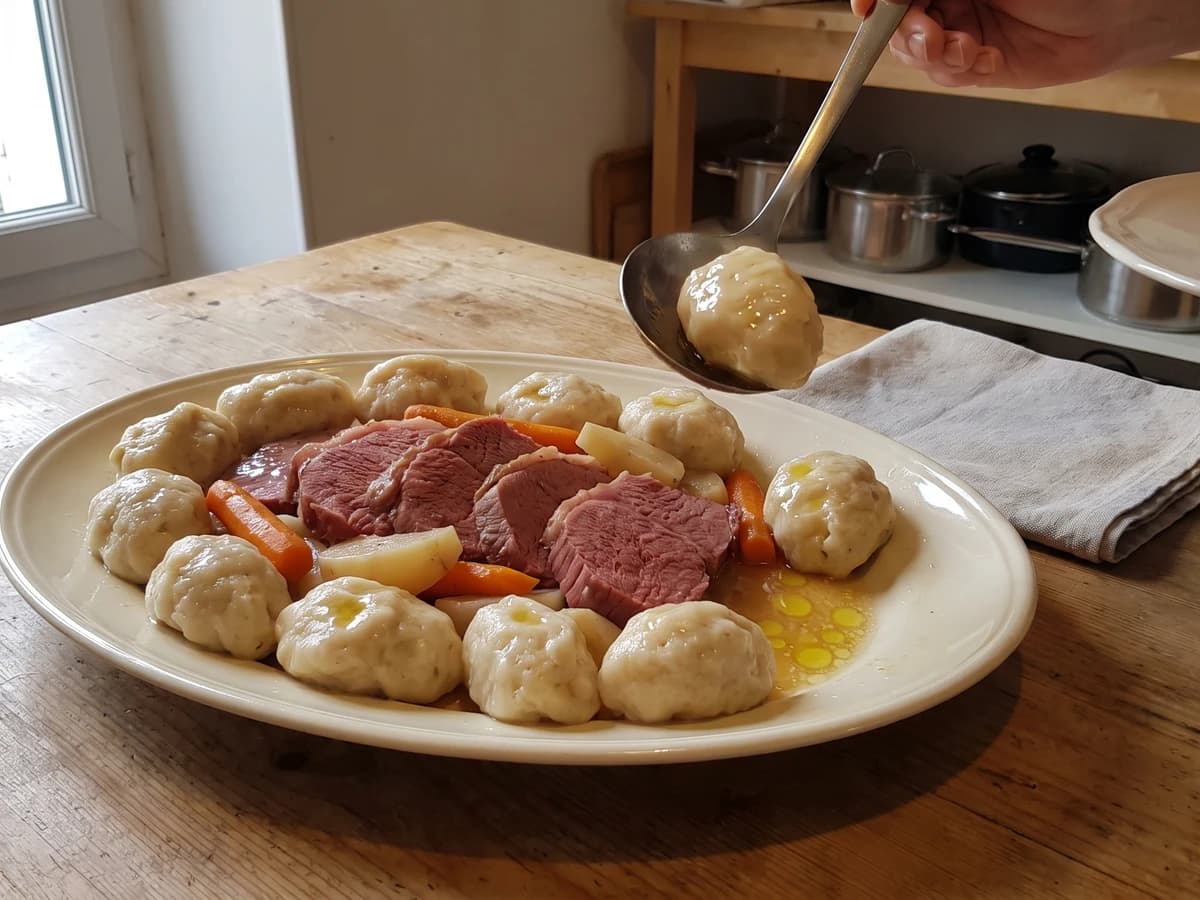
Boulettes au suif, poached beside salt beef, turn equal weights of flour and finely chopped suet into tender, rich dumplings. Keep the beef liquor at a bare tremble and the old garnish works beautifully at home.
A cooking platform built around craft, culture, and the stories behind what we eat.

Created by Chef Juliette
Based on No. 2271, Topinambours à l’Anglaise, from Le Guide Culinaire (1907) by Auguste Escoffier
Topinambours à l’Anglaise prove that gentle heat is a technique, not an absence of action: butter-cooked Jerusalem artichokes held pale and tender, then just cohered with thin Béchamel.
Topinambours à l’Anglaise (Jerusalem artichokes gently cooked in butter and bound with thin Béchamel) teaches étuver, the quiet art of cooking a vegetable under cover in butter and its own moisture. The one true thing is this: keep the heat low. Colour is not merely unwanted here; fierce heat toughens the outside before the centre grows tender, while patient heat leaves each topinambour pale, supple, and still shaped like a large olive.
The terse original assumed a cook turning roots by the dozen and a saucier on staff with thin Béchamel held ready. No stockpot or salamander is called for, so none is invented. The home translation uses a sharp paring knife, a lidded sauté pan, and a small saucepan, making only the spoonful of sauce needed for four. Perfect symmetry is brigade scaffolding and can go; the large-olive shape, pale butter cooking, and final light bind are the dish and stay. One cook, one stove, one evening.
Finished properly, the topinambours taste gently nutty and sweet, with a thin ivory veil that gleams but never smothers them. The covered butter cooking decides everything. Listen for a quiet murmur rather than a fry, and keep the rescue spoonful of water beside the stove.
Topinambours à l’Anglaise belongs to the Parisian classical table rather than a provincial larder, where uniformly turned roots appeared as vegetable entremets and garnitures. The tuber traveled from North America into French market and bourgeois kitchens; its French name was attached when the visiting Tupinambá people caught Paris’s imagination, though they had no connection to the plant. Across most of the canon, à l’Anglaise means a vegetable boiled in salted water and served with butter, so this entry is a pointed exception: the topinambours cook directly in butter and receive a thin Béchamel at the finish.
Quantity
about 5 cups (1.2 L / 800 g), yielding about 3½ cups (840 ml / 600 g) trimmed
scrubbed, peeled, and turned into large olive shapes
Quantity
2½ tablespoons (37.5 ml / 35 g)
Quantity
1½ teaspoons (7.5 ml / 7 g)
Quantity
2 teaspoons (10 ml / 5 g)
Quantity
½ cup (120 ml / 124 g)
warmed
Quantity
½ teaspoon (2.5 ml / 3 g)
Quantity
⅛ teaspoon (0.6 ml / 0.3 g)
Quantity
up to 2 tablespoons (30 ml / 30 g)
for controlling the cooking heat
| Ingredient | Quantity |
|---|---|
| Jerusalem artichokesscrubbed, peeled, and turned into large olive shapes | about 5 cups (1.2 L / 800 g), yielding about 3½ cups (840 ml / 600 g) trimmed |
| unsalted butter for the topinambours | 2½ tablespoons (37.5 ml / 35 g) |
| unsalted butter for the Béchamel | 1½ teaspoons (7.5 ml / 7 g) |
| all-purpose flour | 2 teaspoons (10 ml / 5 g) |
| whole milkwarmed | ½ cup (120 ml / 124 g) |
| fine sea salt | ½ teaspoon (2.5 ml / 3 g) |
| ground white pepper | ⅛ teaspoon (0.6 ml / 0.3 g) |
| water (optional)for controlling the cooking heat | up to 2 tablespoons (30 ml / 30 g) |
Scrub and peel the topinambours, then pare them into blunt-ended ovals about 1½ to 2 inches (4 to 5 cm) long, the shape of large olives. Aim for even thickness rather than ornamental perfection, because matching size gives matching tenderness. Drop each finished piece into cold water to slow discolouration, but leave none soaking longer than 30 minutes. Drain and dry them thoroughly before they meet the butter. Keep the clean trimmings for a soup or purée.
Reserve 1 tablespoon (15 ml / 15 g) of the warm milk. Melt the 1½ teaspoons (7.5 ml / 7 g) butter in a small heavy saucepan over low heat, stir in the flour, and cook for 90 seconds without allowing it to colour. This is a roux blanc (white roux), and cooking it gently removes the raw flour taste while keeping the sauce ivory. Whisk in the remaining milk little by little, then simmer softly for 3 to 4 minutes, stirring, until the Béchamel lightly coats a spoon but runs off readily. If small lumps remain, whisk firmly off the heat or pass the sauce through a fine sieve. Cover its surface directly and set it aside.
Melt the 2½ tablespoons (37.5 ml / 35 g) butter in a 10-inch (25 cm) heavy sauté pan over the lowest heat. Add the dried topinambours in one layer and roll them through the butter. Lay a parchment cartouche directly over them, cover the pan, and cook for 18 to 25 minutes, turning the pieces every 4 to 5 minutes. Listen for a quiet, moist murmur. If the butter begins to smell nutty or a surface shows its first gold mark, lift the pan from the heat, add 1 tablespoon (15 ml / 15 g) water around the edge, and cover it immediately. Ça se rattrape: the mark will not vanish, but the cooler, moist pan saves the texture and keeps the remaining surfaces pale. Return it to a lower burner setting and continue gently.
Pierce the thickest topinambour through the side with the tip of a paring knife. It should enter with gentle resistance, like a boiled potato that still holds its shape. If the centre remains firm, add the remaining tablespoon (15 ml / 15 g) water, cover, and continue at the lowest heat for 5 to 8 minutes. Once tender, uncover the pan and let any visible water disappear over low heat, rolling the pieces carefully and never chasing colour. Only now season with the salt and white pepper, preserving the source entry’s sequence.
Warm the Béchamel gently, then spoon it over the topinambours in two or three additions, rolling the pan and folding carefully so the olive shapes stay whole. Use just enough to cohere them: every surface should wear a thin ivory veil, with no heavy pool beneath. If the coating sits thickly, loosen it with the reserved warm milk, one teaspoon at a time; if it runs too freely, hold the pan at a bare simmer for one minute. Transfer immediately to a warmed shallow serving dish. À table!
1 serving (about 180g)
Culinary guides, cultural storytelling, and the editorial depth that makes cooking meaningful.
Discover Culinary ExplorerChef Juliette
Boulettes au suif, poached beside salt beef, turn equal weights of flour and finely chopped suet into tender, rich dumplings. Keep the beef liquor at a bare tremble and the old garnish works beautifully at home.

Chef Juliette
Bread, flour, frangipane, and rice become four cool, supple panades for binding forcemeats, each changing body and flavor while preserving tenderness. The finest Mousselines need none, and knowing that distinction is the lesson.

Chef Juliette
Panade au pain is bread, milk, salt, heat, and attention: stir until the paste releases cleanly, butter it against a skin, and you have the quiet binder behind tender French farces.

Chef Juliette
Panade de farine teaches the drying stroke behind pâte à choux: flour meets boiling buttered water, then stays over the fire until the paste gathers, smooths, and quits the pan cleanly.