Chef Juliette
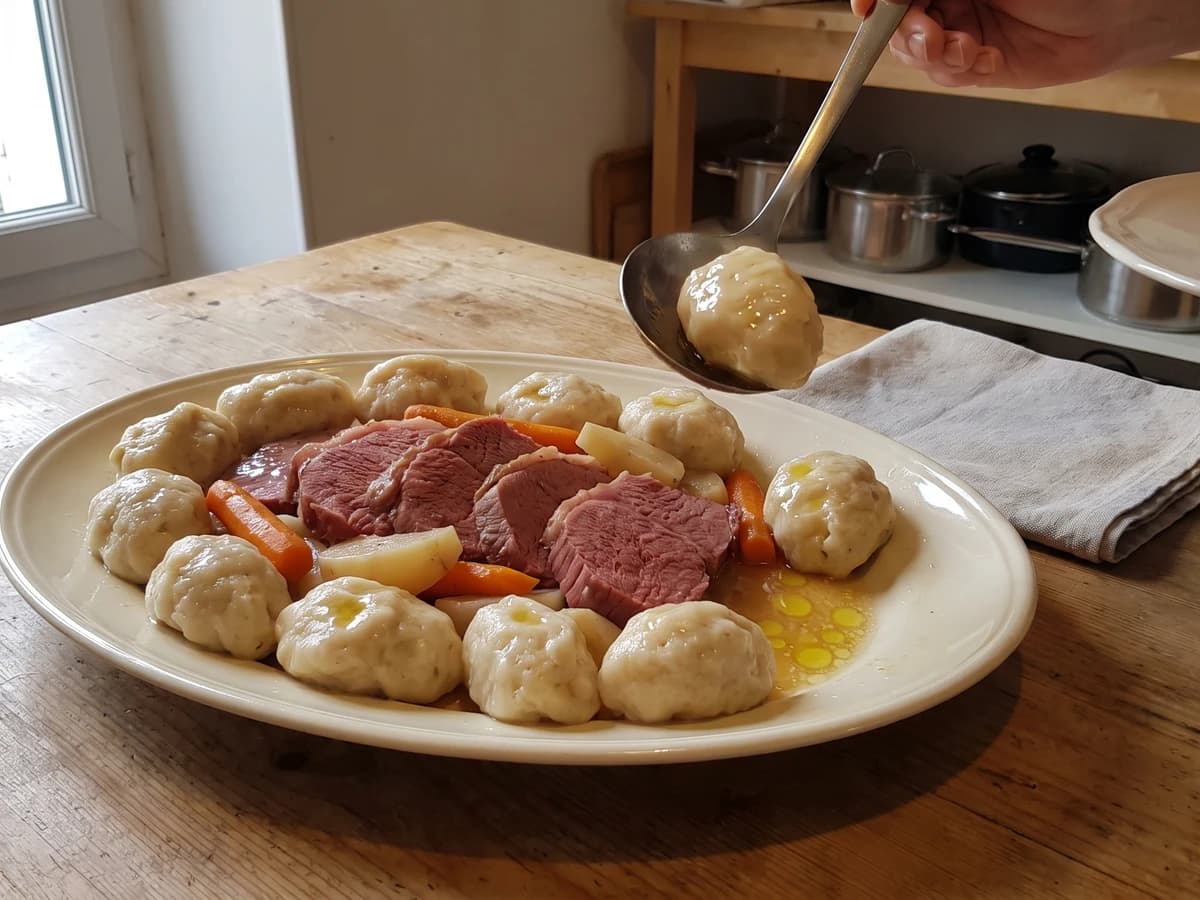
Suet Dumpling
Boulettes au suif, poached beside salt beef, turn equal weights of flour and finely chopped suet into tender, rich dumplings. Keep the beef liquor at a bare tremble and the old garnish works beautifully at home.
A cooking platform built around craft, culture, and the stories behind what we eat.

Created by Chef Juliette
Based on No. 2259, Salsify or Oyster Plant (Salsifis), from Le Guide Culinaire (1907) by Auguste Escoffier
Salsifis teaches a quiet discipline: prepare the blanc before cutting, cook the roots until tender without letting them darken, then finish them in real butter until golden at the edges.
Salsifis teaches a small, decisive discipline: prepare the blanc, a flour-and-lemon cooking bath, before the knife touches the root. Cut salsify oxidizes with astonishing speed; once exposed, it can go from ivory to brown while you are still looking for the lemon. The bath is defence, not fuss, and it protects the mild, faintly nutty flesh as much as its colour.
The original entry gives technique rather than quantities and assumes a vegetable cook scraping brigade batches into a waiting blanc, then passing the cooked roots to another station. Here the bath fits one 4-quart saucepan and 2 pounds of roots, enough for four, while a wide skillet replaces that second pair of hands. One cook, one stove, one evening.
The brigade handoff is scaffolding and can go. Cooking in the blanc cannot; that is the preparation the source insists upon for both white salsify and black scorzonera. This version carries the tender roots into the simplest complete service, dried well and sautéed in butter until their edges are gold and their centers stay delicate. The step that matters most is simple: make the blanc before you cut the first root.
Salsifis belongs to cuisine bourgeoise across France rather than to a single province, appearing at winter tables first as a pale cooked root and then au beurre, fried, gratinéed, or under sauce. From household kitchens it passed into the classical repertoire as an adaptable vegetable garnish, and the blanc became the standard defence against oxidation. White salsify and black scorzonera are botanically different plants despite being grouped together by cooks; the English name oyster plant belongs chiefly to the white root, whose seafood resemblance is delicate and much debated.
Quantity
8 to 12 medium roots (2 lb / 900 g)
washed, scraped, and cut into 3-inch pieces
Quantity
8 cups plus up to 1 cup (1.9 to 2.1 L / 1.9 to 2.1 kg)
divided
Quantity
¼ cup (60 ml / 30 g)
Quantity
¼ cup (60 ml / 60 g)
freshly squeezed, from about 2 lemons
Quantity
1 tablespoon plus ½ teaspoon (17.5 ml / 20 g)
divided
Quantity
5 tablespoons (75 ml / 71 g)
divided
| Ingredient | Quantity |
|---|---|
| white salsify or black scorzonera rootswashed, scraped, and cut into 3-inch pieces | 8 to 12 medium roots (2 lb / 900 g) |
| cold waterdivided | 8 cups plus up to 1 cup (1.9 to 2.1 L / 1.9 to 2.1 kg) |
| all-purpose flour | ¼ cup (60 ml / 30 g) |
| fresh lemon juicefreshly squeezed, from about 2 lemons | ¼ cup (60 ml / 60 g) |
| fine sea saltdivided | 1 tablespoon plus ½ teaspoon (17.5 ml / 20 g) |
| unsalted butterdivided | 5 tablespoons (75 ml / 71 g) |
In a 4-quart nonreactive saucepan, whisk the flour with 1 cup (240 ml / 240 g) of the cold water until perfectly smooth. Whisk in the remaining 7 cups (1.65 L / 1.65 kg) water, the lemon juice, and 1 tablespoon (15 ml / 17 g) salt. Cut a cartouche, a round of baking parchment, to fit inside the saucepan and set it beside the stove. Keep the cold blanc beside your cutting board before you touch the roots.
Wash away every trace of soil, then work with one root at a time. Trim the ends and scrape white salsify firmly, removing its thin outer skin; peel only the black skin from scorzonera. Cut each root into 3-inch (7.5 cm) lengths, halving very thick pieces lengthwise, and drop every piece directly into the cold blanc. The sticky white sap is normal. If a piece turns beige, don't discard it. Put it into the blanc at once and continue. Ça se rattrape: its flavor is unchanged, and the later butter bronzing will make slight discoloration inconspicuous. A deeply browned surface will not return to ivory, so never scrape the whole pile before submerging it.
Whisk the blanc once more, then bring it gradually to a gentle simmer over medium heat, stirring along the bottom as the flour warms. Lay the cartouche directly on the liquid to keep the roots submerged. Cook at the barest tremble for 20 to 30 minutes, checking thinner pieces first. A paring knife should enter with faint resistance, and a piece should flex without collapsing. If the blanc thickens around the roots like paste, the heat is too high; add ½ cup (120 ml / 120 g) hot water, lower the heat, and continue gently. Don't boil them into softness. The finished roots must remain firm enough to face the skillet.
Lift the tender roots into a colander with a slotted spoon. Rinse them briefly under warm water to remove the floury coating, then spread them over a clean kitchen towel and blot every surface dry. Leave them uncovered for 5 minutes. This drying is part of the sauté, not an idle pause: wet salsifis spits, steams, and refuses to take color.
Melt 2 tablespoons (30 ml / 28 g) butter in a 12-inch heavy skillet over medium-high heat. When the foam subsides, add half the roots in one uncrowded layer. Leave them untouched for 2 minutes, then roll them gently and continue cooking for 5 to 7 minutes, until several sides are butter-gold. Transfer them to a warm serving dish and repeat with another 2 tablespoons (30 ml / 28 g) butter and the remaining roots. The butter may approach beurre noisette, hazelnut-brown butter, but it must not develop black specks. If it smells bitter, lift out the roots, wipe the skillet clean, lower the heat, and restart with the reserved butter. Ça se rattrape. Burnt butter does not improve through bravery.
Return all the salsifis to the skillet. If the final tablespoon (15 ml / 14 g) butter was not needed for rescue, add it now and roll the roots through it for 30 seconds, just until they gleam. Season gradually with the remaining ½ teaspoon (2.5 ml / 3 g) salt, tasting before using it all because the blanc has already seasoned the centers. Bring the salsifis to the table while the edges are golden, the centers tender, and a little butter still pools beneath them. À table!
1 serving (about 215g)
Culinary guides, cultural storytelling, and the editorial depth that makes cooking meaningful.
Discover Culinary ExplorerChef Juliette
Boulettes au suif, poached beside salt beef, turn equal weights of flour and finely chopped suet into tender, rich dumplings. Keep the beef liquor at a bare tremble and the old garnish works beautifully at home.

Chef Juliette
Bread, flour, frangipane, and rice become four cool, supple panades for binding forcemeats, each changing body and flavor while preserving tenderness. The finest Mousselines need none, and knowing that distinction is the lesson.

Chef Juliette
Panade au pain is bread, milk, salt, heat, and attention: stir until the paste releases cleanly, butter it against a skin, and you have the quiet binder behind tender French farces.

Chef Juliette
Panade de farine teaches the drying stroke behind pâte à choux: flour meets boiling buttered water, then stays over the fire until the paste gathers, smooths, and quits the pan cleanly.