Chef Juliette
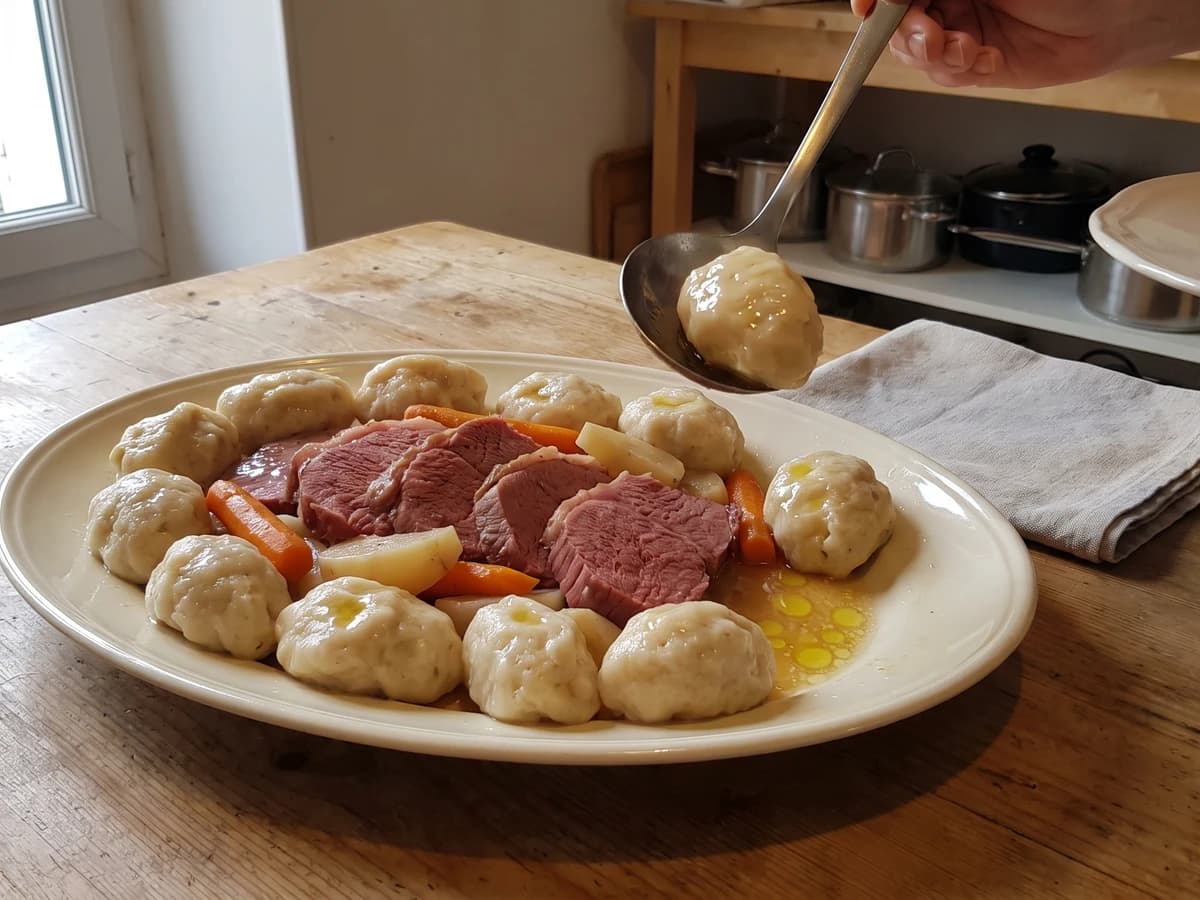
Suet Dumpling
Boulettes au suif, poached beside salt beef, turn equal weights of flour and finely chopped suet into tender, rich dumplings. Keep the beef liquor at a bare tremble and the old garnish works beautifully at home.
A cooking platform built around craft, culture, and the stories behind what we eat.

Created by Chef Juliette
Based on No. 2234, Pommes de Terre Mirette, from Le Guide Culinaire (1907) by Auguste Escoffier
Fine potato matchsticks cook gently in butter, meet black truffle and glossy meat glaze, then take Parmesan and a fierce broiler: a luxurious gratin whose success depends on tenderness without collapse.
Pommes de Terre Mirette (creamy butter-cooked potato julienne with truffle and meat glaze) teaches that the cut governs the cooking. Before a pan is touched, know this: every potato rod must be about 1/8 inch (3 mm) square, because fine, even julienne softens together and stays creamy, while mixed sizes give you raw cores beside mash.
The original formula assumed a saucier on staff, a stock never off the fire to become glace de viande (meat glaze), and a salamander waiting to color the top in moments. At home, a true prepared glace de viande and a hot broiler are the honest equivalents. The day-long reduction and brigade holding are scaffolding and can go; the exact julienne, the source ratio of two ounces of truffle and three tablespoons of glaze to one pound of potato, gentle butter cooking, and the swift Parmesan finish are the dish and must stay.
The book already gives its working proportions per pound, so one pound becomes four generous side servings. Because it leaves the butter and Parmesan to professional judgment, this home version fixes only those amounts, enough to coat and glaze without swamping the potatoes. One cook, one stove, one evening. The whole recipe turns on the knife work: cut the julienne evenly before the butter ever warms.
Pommes de Terre Mirette belongs to the named potato garnitures of the Paris-centered classical dining room, not to a regional farmhouse tradition. Mirette is a codified finish rather than a potato variety: raw julienne cooked creamy in butter, enriched with black truffle and meat glaze, then quickly colored beneath a salamander. As this repertoire passed into cuisine bourgeoise, the home broiler replaced the overhead grill, but the rapid final glaze remained because lingering heat destroys the delicate cut.
Quantity
3 loosely packed cups (710 ml / 454 g; 1 lb)
peeled and cut julienne-fashion into 1/8-inch (3 mm) rods
Quantity
5 tablespoons (75 ml / 71 g)
4 tablespoons for cooking and 1 tablespoon melted for finishing
Quantity
about 1/2 cup (120 ml / 57 g; 2 oz)
cut into fine julienne
Quantity
3 tablespoons (45 ml / 58 g)
melted
Quantity
1/4 cup (60 ml / 22 g)
finely grated
Quantity
1/4 teaspoon (1.25 ml / 1.5 g)
plus only if needed
| Ingredient | Quantity |
|---|---|
| Yukon Gold potatoespeeled and cut julienne-fashion into 1/8-inch (3 mm) rods | 3 loosely packed cups (710 ml / 454 g; 1 lb) |
| unsalted butter4 tablespoons for cooking and 1 tablespoon melted for finishing | 5 tablespoons (75 ml / 71 g) |
| black trufflecut into fine julienne | about 1/2 cup (120 ml / 57 g; 2 oz) |
| glace de viandemelted | 3 tablespoons (45 ml / 58 g) |
| Parmesanfinely grated | 1/4 cup (60 ml / 22 g) |
| fine sea saltplus only if needed | 1/4 teaspoon (1.25 ml / 1.5 g) |
Cut the peeled potatoes julienne-fashion, into match-shaped rods about 1/8 inch (3 mm) square. Use a sharp knife or a mandoline fitted with its hand guard, and reject thick wedges or papery strands; mixed sizes cannot finish together. Do not rinse the cut potatoes. Their surface starch helps the butter cling and gives Mirette its creamy cohesion, so cut them immediately before cooking.
Melt 4 tablespoons of the butter in a 10-inch (25 cm) heavy skillet over medium-low heat. When it foams without coloring, add the potatoes and the measured salt, then fold gently until every rod gleams. Cover for 4 minutes so their own moisture begins the cooking, then uncover and continue for 8 to 12 minutes, turning carefully every few minutes. The pan should murmur, not fry. Taste one rod: it should yield without a chalky center yet remain recognizably a rod. If the butter begins to brown before the potatoes are tender, lift the pan from the heat and add 1 tablespoon (15 ml) cold water around the edge, then lower the heat. Ça se rattrape.
Set the broiler to high with a rack 4 to 5 inches (10 to 13 cm) beneath the heat. Warm the glace de viande only until fluid, then add it to the tender potatoes with the truffle julienne. Fold with a flexible spatula over low heat for 60 to 90 seconds, just until the glaze coats the potatoes and the truffle perfume opens. Do not stir hard or let the mixture fry. If the glaze gathers into sticky patches, fold in 1 teaspoon (5 ml) warm water; it should return to a soft, glossy coating.
Transfer the potatoes immediately to a warm 1-quart (1-liter) broiler-safe porcelain timbale or shallow round baking dish. Settle them lightly with the back of a spoon without compacting the julienne. Scatter the Parmesan evenly across the surface, then drizzle over the remaining 1 tablespoon of melted butter.
Broil for 1 to 3 minutes, watching continuously, until the Parmesan is flecked with bronze, the butter gleams across the top, and the rim bubbles. This must be a swift glaze, not another bake; lingering heat turns the creamy julienne into mash. If one patch darkens too quickly, rotate the dish or shield that spot with a scrap of foil. Rest for 2 minutes, then serve directly from the timbale. À table!
1 serving (about 140g)
Culinary guides, cultural storytelling, and the editorial depth that makes cooking meaningful.
Discover Culinary ExplorerChef Juliette
Boulettes au suif, poached beside salt beef, turn equal weights of flour and finely chopped suet into tender, rich dumplings. Keep the beef liquor at a bare tremble and the old garnish works beautifully at home.

Chef Juliette
Bread, flour, frangipane, and rice become four cool, supple panades for binding forcemeats, each changing body and flavor while preserving tenderness. The finest Mousselines need none, and knowing that distinction is the lesson.

Chef Juliette
Panade au pain is bread, milk, salt, heat, and attention: stir until the paste releases cleanly, butter it against a skin, and you have the quiet binder behind tender French farces.

Chef Juliette
Panade de farine teaches the drying stroke behind pâte à choux: flour meets boiling buttered water, then stays over the fire until the paste gathers, smooths, and quits the pan cleanly.