Chef Juliette
Suet Dumpling
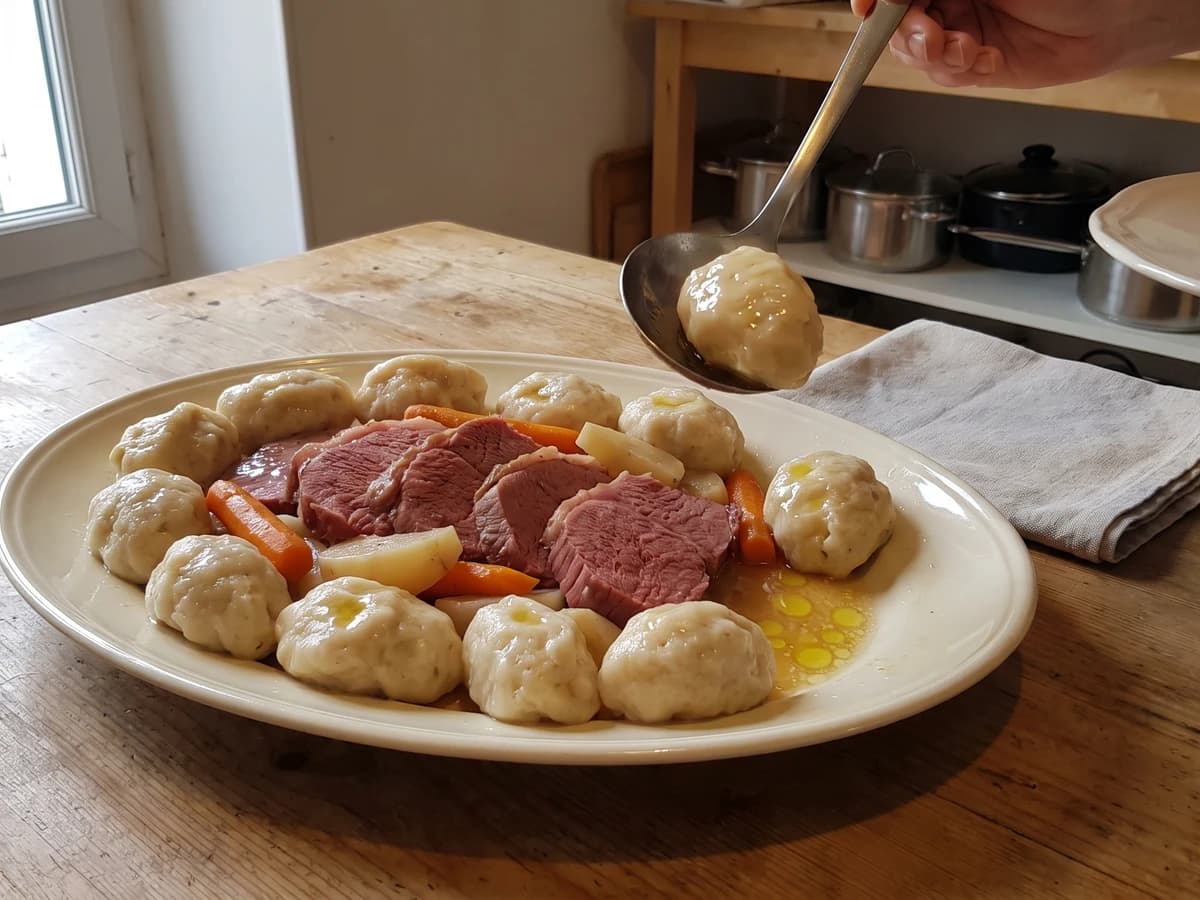
Boulettes au suif, poached beside salt beef, turn equal weights of flour and finely chopped suet into tender, rich dumplings. Keep the beef liquor at a bare tremble and the old garnish works beautifully at home.
A cooking platform built around craft, culture, and the stories behind what we eat.

Created by Chef Juliette
Based on No. 2228, Pommes de Terre Macaire, from Le Guide Culinaire (1907) by Auguste Escoffier
Pommes de Terre Macaire turns baked potato and butter into one broad, deeply bronzed galette. Fork the pulp, never sieve it, because the craggy tenderness inside is the dish.
Pommes de Terre Macaire (a forked baked-potato galette) teaches a severe little truth: texture is the dish. Bake the potatoes until their pulp is dry and fluffy, work it with a fork and 1½ ounces of butter for each pound of pulp, then stop while it still holds ridges and small irregular crumbs. Sieve it and you lose Macaire before the pan ever gets hot.
The classical entry assumes Dutch potatoes understood by the market, hot baked potatoes arriving for service, clarified butter already waiting, and an omelet pan in practiced hands. At home, floury russets give the same dry pulp, while a 10-inch skillet and a flat plate handle the turn. Having a cook hold potatoes and butter for service is brigade scaffolding and can go; baking them now, keeping the exact butter ratio, working by fork, and browning in clarified butter are the dish and must stay. One cook, one stove, one evening.
Done properly, the galette arrives butter-gold at its edges and deeply bronzed across both faces, with a tender middle that still tastes unmistakably of baked potato. The turn is the only dramatic moment, and even a crack can be pressed together in the hot pan. Before you touch the pan, remember the step that decides everything: fork it, never sieve it.
Pommes de terre Macaire belongs to the Parisian classical repertoire, where potato preparations were distinguished by their shape, texture, and finishing method before traveling from grand dining rooms into bistros and home kitchens. Its name is generally linked to Robert Macaire, the celebrated theatrical rogue, following a Parisian habit of attaching stage names to dishes, although no single kitchen holds an uncontested claim to the naming. Unlike a grated potato cake, Macaire begins with baked pulp, worked by fork and browned as one broad galette.
Quantity
4 large, about 2½ lb (1.15 kg) total, to yield 2 lb (900 g) baked pulp
scrubbed and dried
Quantity
6 tablespoons (90 ml / 85 g)
softened and cut into small pieces
Quantity
3 tablespoons (45 ml / 42 g)
divided
Quantity
1½ teaspoons (7.5 ml / 9 g)
Quantity
¼ teaspoon (1.25 ml / 0.6 g)
| Ingredient | Quantity |
|---|---|
| floury baking potatoes, such as russetsscrubbed and dried | 4 large, about 2½ lb (1.15 kg) total, to yield 2 lb (900 g) baked pulp |
| unsalted buttersoftened and cut into small pieces | 6 tablespoons (90 ml / 85 g) |
| clarified butterdivided | 3 tablespoons (45 ml / 42 g) |
| fine sea salt | 1½ teaspoons (7.5 ml / 9 g) |
| freshly ground black pepper | ¼ teaspoon (1.25 ml / 0.6 g) |
Heat the oven to 425°F (220°C). Prick the potatoes once or twice, set them directly on the center rack with a baking sheet beneath, and bake for 60 to 70 minutes. They are ready when the skins feel dry, the potatoes yield completely under gentle pressure, and a skewer passes through without resistance. Do not wrap them in foil; trapped moisture gives you damp pulp, and damp pulp cannot form the tender, craggy middle Macaire requires.
Split the potatoes as soon as they can be handled safely and scoop the hot pulp into a wide bowl. Measure 2 lb (900 g) of pulp. If your yield differs, keep the source ratio exactly: 3 tablespoons (45 ml / 42 g) softened butter for every 1 lb (450 g) pulp. Season with the salt and pepper, break the pulp apart with a fork, then lift and turn in the butter a few pieces at a time until absorbed. Leave ridges, soft lumps, and loose flakes. If the mixture begins smearing against the bowl, stop and spread it out for a minute so excess heat and moisture can escape; then fold it only once or twice more. Ça se rattrape before it turns gluey, not after.
Heat a 10-inch (25 cm) sloping-sided skillet over medium-high heat. Add half the clarified butter and swirl until it runs freely and shimmers, without smoking. Distribute the potato by forkfuls across the pan, then spread it into an even galette about ¾ inch (2 cm) thick. Level the surface gently but do not pack it hard. Cook for 8 to 10 minutes, lowering the heat to medium once the edges begin coloring, until the underside forms a deep golden crust and the galette slides when the pan is shaken. If it clings, do not scrape at it; give the crust another minute to set, then loosen only the rim with a thin spatula.
Take the skillet off the heat and lay a flat heatproof plate, slightly wider than the pan, over the galette. Holding pan and plate firmly with dry towels, invert them together. Return the empty skillet to the heat, add the remaining clarified butter, and slide the galette back with its browned face upward. If it cracks during the turn, do not surrender it. Ça se rattrape: slide every piece into the pan, draw the seams together with the spatula, and press lightly while the potato is hot; the second crust will bind it. Brown for another 7 to 9 minutes, until the galette moves freely and both faces are richly bronzed.
Slide the Macaire onto a warm platter and let it stand for 2 minutes, just long enough for the crust to settle. Cut it into generous wedges and serve immediately beside roast chicken, a pork chop, or a simple pan-seared steak. Add no garnish and no sauce to the potato itself; butter, pepper, baked pulp, and a proper crust have finished the work. À table!
1 serving (about 245g)
Culinary guides, cultural storytelling, and the editorial depth that makes cooking meaningful.
Discover Culinary ExplorerChef Juliette
Boulettes au suif, poached beside salt beef, turn equal weights of flour and finely chopped suet into tender, rich dumplings. Keep the beef liquor at a bare tremble and the old garnish works beautifully at home.

Chef Juliette
Bread, flour, frangipane, and rice become four cool, supple panades for binding forcemeats, each changing body and flavor while preserving tenderness. The finest Mousselines need none, and knowing that distinction is the lesson.

Chef Juliette
Panade au pain is bread, milk, salt, heat, and attention: stir until the paste releases cleanly, butter it against a skin, and you have the quiet binder behind tender French farces.

Chef Juliette
Panade de farine teaches the drying stroke behind pâte à choux: flour meets boiling buttered water, then stays over the fire until the paste gathers, smooths, and quits the pan cleanly.