Chef Juliette
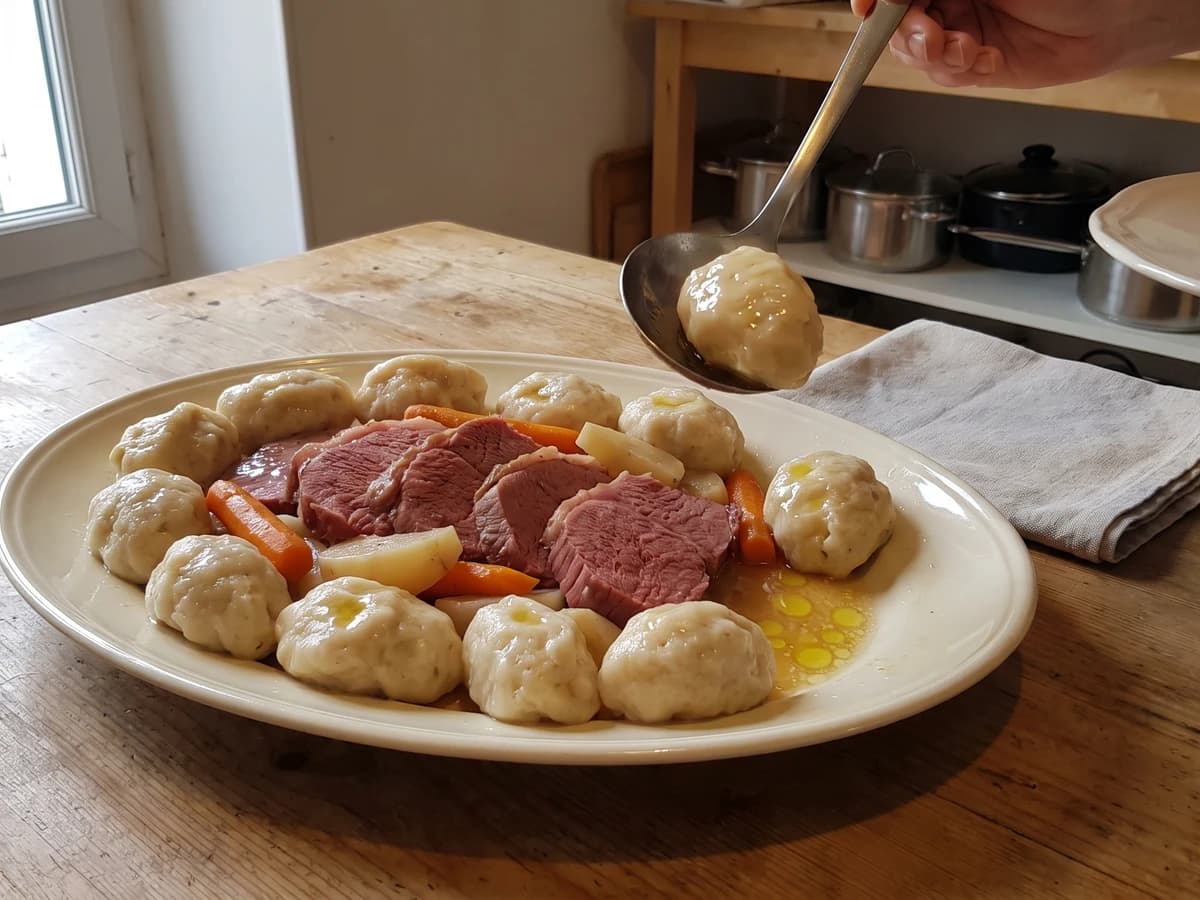
Suet Dumpling
Boulettes au suif, poached beside salt beef, turn equal weights of flour and finely chopped suet into tender, rich dumplings. Keep the beef liquor at a bare tremble and the old garnish works beautifully at home.
A cooking platform built around craft, culture, and the stories behind what we eat.

Created by Chef Juliette
Based on No. 2205, Pommes de Terre Berny, from Le Guide Culinaire (1907) by Auguste Escoffier
Truffled potato paste, shaped like apricots and wrapped in fine almond splinters, becomes a crisp, golden dinner-party side whose elegance depends on one plain discipline: cold filling, secure crust, properly hot fat.
Pommes de Terre Berny (truffled potato croquettes in an almond crust) teach the discipline behind every good croquette: the filling must be cold, dry, and firmly enclosed before it meets hot fat. The almonds are not decoration. They are the crust, and every bare patch is a place where the potato can escape.
The brigade formula did not need a saucier, a stockpot, or a salamander. What it assumed was just as useful: cold croquette paste from Potato Croquettes (No. 219), Anglaise (for Egg-and-bread-crumbing) (No. 174) kept ready, cooks portioning a service batch, and a fryer already holding its temperature. At home, we scale the pound of paste down to 200 grams, preserve its exact proportion of two ounces of truffle per pound, and make four generous two-ounce croquettes in one heavy saucepan. Quantity and equipment changed. The formula did not.
Keeping tubs of egg coating ready all day was brigade scaffolding and can go. The dry paste, chopped truffle, apricot shape, egg film, almond splinters, and last-minute frying are the dish and must stay. Before you touch the oil, press the almond coat firmly around every croquette; that complete shell is the step that decides everything.
Pommes de Terre Berny belong to the Parisian grand-kitchen repertoire, where named potato garnitures were distinguished by their shape, enrichment, and coating. Berny takes the croquette family into formal service with chopped truffle, an apricot form, and an almond shell in place of ordinary crumbs. It is not a regional farmhouse potato dish that entered the grand kitchen; it traveled in the other direction, through service manuals and teaching kitchens to home tables, with the almond splinters remaining its defining mark.
Quantity
¾ cup plus 1 tablespoon (195 ml / 200 g) from Potato Croquettes (No. 219)
Quantity
2 tablespoons (30 ml / 25 g)
finely chopped
Quantity
⅓ cup (80 ml / 80 g) Anglaise (for Egg-and-bread-crumbing) (No. 174)
cold and whisked smooth
Quantity
¾ cup (180 ml / 80 g)
cut into the thinnest possible splinters
Quantity
6 cups (1.4 liters / 1.3 kilograms)
| Ingredient | Quantity |
|---|---|
| cold croquette paste | ¾ cup plus 1 tablespoon (195 ml / 200 g) from Potato Croquettes (No. 219) |
| fresh black trufflefinely chopped | 2 tablespoons (30 ml / 25 g) |
| Anglaise (for Egg-and-bread-crumbing)cold and whisked smooth | ⅓ cup (80 ml / 80 g) Anglaise (for Egg-and-bread-crumbing) (No. 174) |
| blanched almondscut into the thinnest possible splinters | ¾ cup (180 ml / 80 g) |
| neutral high-heat frying oil | 6 cups (1.4 liters / 1.3 kilograms) |
Put the cold croquette paste from Potato Croquettes (No. 219) in a wide bowl. Scatter over the chopped truffle and fold with a flexible spatula just until the black flecks are evenly distributed; overworking potatoes makes them gluey. The paste should hold a sharp ridge without slumping. If it has softened, spread it about ¾ inch (2 cm) deep on a cold plate and refrigerate it for 15 minutes. Ça se rattrape. Do not knead in flour, which would make the croquettes heavy; if the chilled paste still slumps, its drying must be corrected in its own preparation before you continue.
Weigh the truffled paste and divide it into four portions of about 2 ounces (56 g) each. With cool, dry hands, roll each portion into a seamless ball, then make it slightly plump and oval with a shallow dimple at one end, like a small apricot. Close every crack with your fingertips, because a fissure can open in the oil. Set the shapes on parchment and chill them for 10 minutes if your hands have warmed the paste.
Spread the almond splinters in a shallow tray and pour the Anglaise (for Egg-and-bread-crumbing) (No. 174) into a second shallow dish. Dip one croquette into the Anglaise, turn it until completely coated, then lift it with a fork and let the excess fall away for several seconds. Roll it in the almonds and cup it gently between your palms, pressing the splinters into a complete, even shell without flattening the apricot shape. Repeat with the remaining croquettes, then chill them uncovered for 15 minutes so the coating settles. If the almonds slide, the egg layer is too heavy; drain the croquette again, return it to the almond tray, and patch any bare places. Ça se rattrape.
Set a wire rack over a sheet pan. Pour the oil into a heavy 4-quart (4-liter) saucepan, where it should stand about 1¾ inches (4.5 cm) deep while leaving the pot well under half full. Heat it steadily to 350°F (175°C). A thermometer is the honest home equivalent of the brigade fryer: properly hot fat sets the egg coating immediately, while lukewarm fat soaks into the potatoes. Keep the pot handle turned inward, never move the pot once the oil is hot, and keep water far away.
Begin frying five or six minutes before serving, exactly as the formula directs. Lower the four croquettes into the oil one at a time with a spider, keeping them apart until the crust sets. Hold the oil between 340°F and 350°F (170°C and 175°C), and fry for 3 to 4 minutes, turning gently, until the almond shell is crisp and evenly hazelnut-gold. The five or six minutes are a service cue, not an instruction to leave the croquettes in the fat for six full minutes. If the almonds race past gold during the first minute, lower the heat immediately; if necessary, lift the croquettes briefly to the rack while the oil settles, then return them.
Lift the Pommes de Terre Berny onto the wire rack and let them drain for 60 to 90 seconds. A rack keeps the whole almond shell crisp; paper traps oil against the underside. Arrange them on a warm serving platter and bring them straight to the table. If they accompany a roast, keep its juices beside them rather than pouring the liquid over their crust. À table!
1 serving (about 95g)
Culinary guides, cultural storytelling, and the editorial depth that makes cooking meaningful.
Discover Culinary ExplorerChef Juliette
Boulettes au suif, poached beside salt beef, turn equal weights of flour and finely chopped suet into tender, rich dumplings. Keep the beef liquor at a bare tremble and the old garnish works beautifully at home.

Chef Juliette
Bread, flour, frangipane, and rice become four cool, supple panades for binding forcemeats, each changing body and flavor while preserving tenderness. The finest Mousselines need none, and knowing that distinction is the lesson.

Chef Juliette
Panade au pain is bread, milk, salt, heat, and attention: stir until the paste releases cleanly, butter it against a skin, and you have the quiet binder behind tender French farces.

Chef Juliette
Panade de farine teaches the drying stroke behind pâte à choux: flour meets boiling buttered water, then stays over the fire until the paste gathers, smooths, and quits the pan cleanly.