Chef Juliette
Suet Dumpling
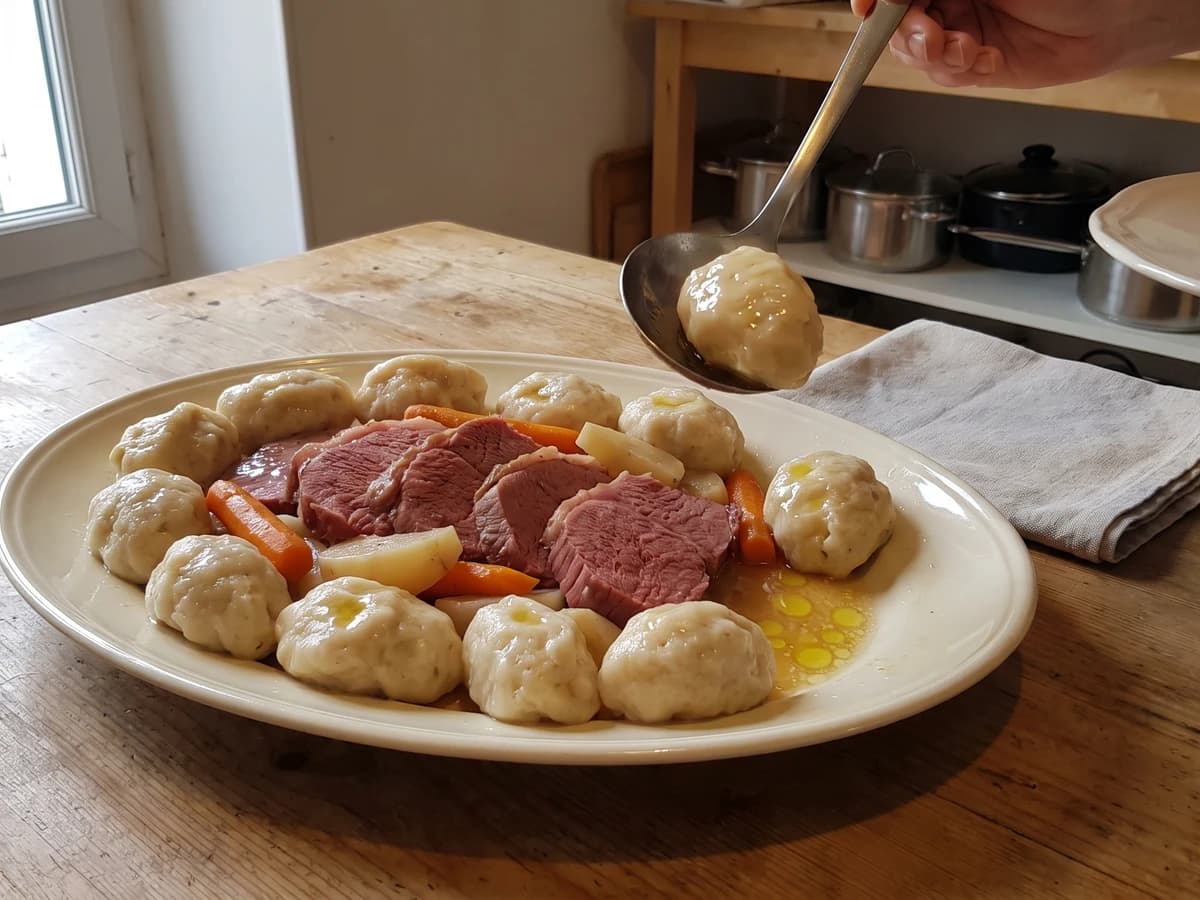
Boulettes au suif, poached beside salt beef, turn equal weights of flour and finely chopped suet into tender, rich dumplings. Keep the beef liquor at a bare tremble and the old garnish works beautifully at home.
A cooking platform built around craft, culture, and the stories behind what we eat.

Created by Chef Juliette
Based on No. 2202, Pommes de Terre à l’Anglaise, from Le Guide Culinaire (1907) by Auguste Escoffier
Turn potatoes into generous garlic-clove shapes, then cook them with such restraint that every piece stays whole, tender, and plainly itself, ready for the quiet work of accompanying poached fish.
Pommes de terre à l’anglaise (potatoes in the English manner) teaches restraint through precision. The one true thing to know before touching the pan is this: every turned piece must have roughly the same thickness, or the narrow ones crumble while the broad ones remain firm. Plain is not unfinished here. Plain is the point.
There is no saucier, stockpot, or salamander behind this recipe, because no sauce, stock, or browning belongs in it. The original kitchen did assume a commis turning whole trays of potatoes with a dedicated knife. At home, twelve small potatoes and an ordinary paring knife do the work. The brigade quantity and perfect banquet uniformity are scaffolding and can go; the generous garlic-clove shape and gentle cooking are the dish, and they must stay.
The finished potatoes should be pale ivory, smooth-sided, and tender through the centre, with enough structure to reach the platter intact. No butter glaze, no parsley, no last-minute decoration. The decisive moment comes when the water first boils: lower the heat immediately, because a bare simmer cooks the centre while preserving the carefully turned surface.
Pommes de terre à l’anglaise belongs not to one French region but to the national classical service table, where it sits especially beside boiled or poached fish. The designation à l’anglaise records the French kitchen’s idea of English plainness: potatoes carefully turned, then boiled or cooked by vapeur, with no sauce or garnish to compete with the fish. The source’s pointed distinction, that French cooks salt the cooking water while the English method omits salt, shows that the name describes a style seen through French eyes rather than a single British household recipe.
Quantity
12 small (about 1¾ lb / 800 g)
similar in size
Quantity
8½ cups (2 L / 2 kg), or enough to cover by 1 inch / 2.5 cm
Quantity
3½ level teaspoons (17 ml / 20 g)
omit only for the salt-free English method noted in the source
| Ingredient | Quantity |
|---|---|
| small waxy yellow potatoessimilar in size | 12 small (about 1¾ lb / 800 g) |
| cold water | 8½ cups (2 L / 2 kg), or enough to cover by 1 inch / 2.5 cm |
| fine sea saltomit only for the salt-free English method noted in the source | 3½ level teaspoons (17 ml / 20 g) |
Peel the potatoes and trim a thin slice from each end, leaving one end slightly fuller than the other. Set each potato securely on the board and make six or seven shallow, curving lengthwise cuts, rotating it after every cut and always cutting away from your fingers. Aim for a smooth garlic-clove shape about 2 to 2¼ inches / 5 to 5.5 cm long, with a broad base, a gently tapered point, and an even thickness through the middle. Place each finished piece in cool water while you work. If one becomes noticeably smaller, stop cutting; add that piece to the cooking pan two or three minutes after the others rather than whittling the whole batch down to match it. Ça se rattrape.
Drain and rinse the turned potatoes to remove the loose starch and tiny fragments left by the knife. Arrange them in a single layer in a 3-quart / 3-liter saucepan, add enough of the measured cold water to cover them by 1 inch / 2.5 cm, and hold back any remainder. Add the salt and stir gently to dissolve it. For the salt-free English method recorded in the source, omit the salt and change nothing else.
Set the uncovered pan over medium heat and bring the water just to a boil. The moment full bubbles appear, lower the heat and maintain the barest simmer, with only a lazy movement across the surface. Cook for 10 to 14 minutes from that point, testing early if the potatoes are small. A hard boil knocks the turned edges against one another and makes them feather. If the pan runs away from you, lift it off the heat, add a splash of the reserved cold water, and return it over the lowest heat once the bubbling settles. Ça se rattrape.
Pierce the thickest part of a potato with the point of the paring knife. It should enter cleanly to the centre without a hard, crunchy core, while the potato remains whole when lifted. Remove each piece with a slotted spoon as it becomes tender rather than making the entire pan wait for one stubborn potato. Empty the saucepan, return the drained potatoes to it, and roll them once over the lowest heat for 20 to 30 seconds. This removes clinging water without browning or roughening their surfaces.
Transfer the potatoes gently to a warmed serving platter and bring them straight to the table beside boiled or poached fish. Leave them unglazed and ungarnished. Butter, herbs, and pepper can make excellent potatoes, but they make another preparation; the quiet, clean taste of the potato is what à l’anglaise contributes here. À table!
1 serving (about 150g)
Culinary guides, cultural storytelling, and the editorial depth that makes cooking meaningful.
Discover Culinary ExplorerChef Juliette
Boulettes au suif, poached beside salt beef, turn equal weights of flour and finely chopped suet into tender, rich dumplings. Keep the beef liquor at a bare tremble and the old garnish works beautifully at home.

Chef Juliette
Bread, flour, frangipane, and rice become four cool, supple panades for binding forcemeats, each changing body and flavor while preserving tenderness. The finest Mousselines need none, and knowing that distinction is the lesson.

Chef Juliette
Panade au pain is bread, milk, salt, heat, and attention: stir until the paste releases cleanly, butter it against a skin, and you have the quiet binder behind tender French farces.

Chef Juliette
Panade de farine teaches the drying stroke behind pâte à choux: flour meets boiling buttered water, then stays over the fire until the paste gathers, smooths, and quits the pan cleanly.