Chef Juliette
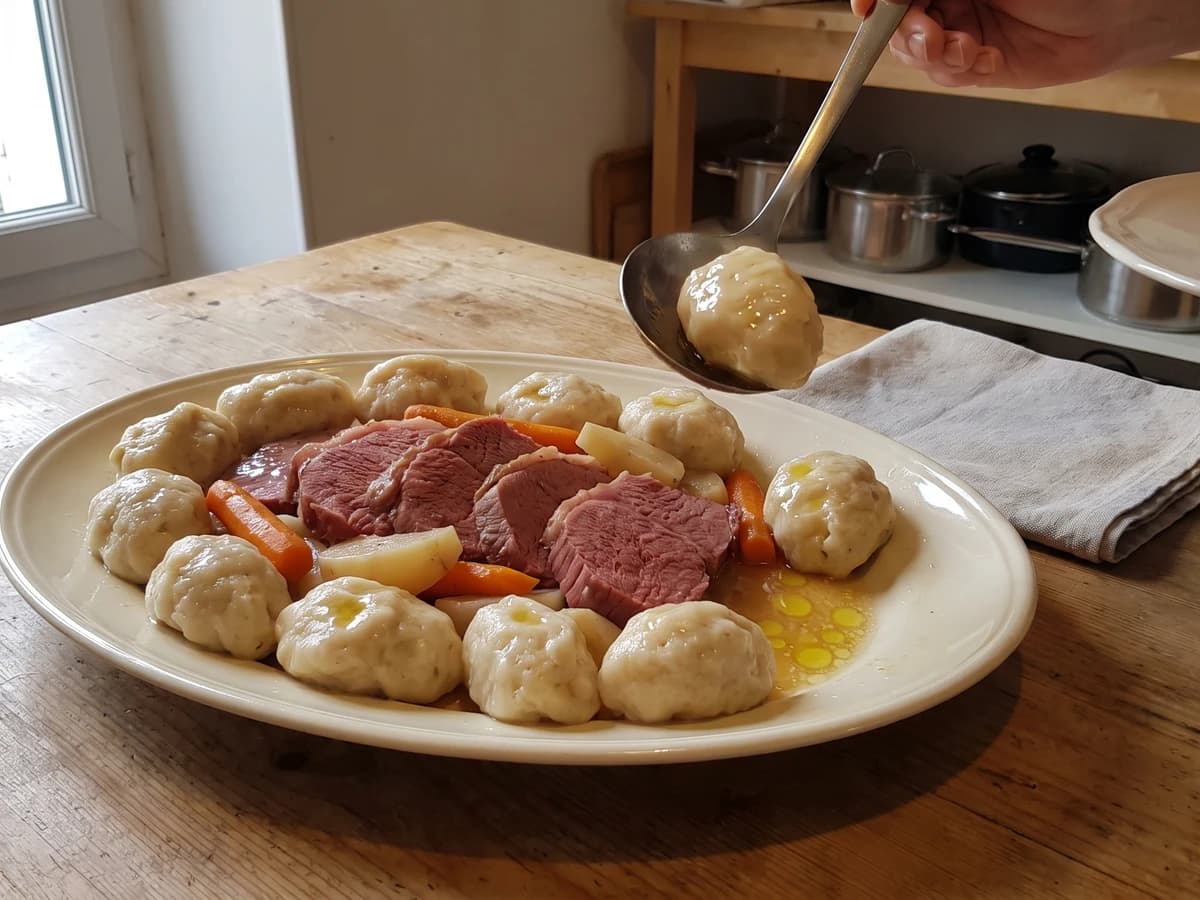
Suet Dumpling
Boulettes au suif, poached beside salt beef, turn equal weights of flour and finely chopped suet into tender, rich dumplings. Keep the beef liquor at a bare tremble and the old garnish works beautifully at home.
A cooking platform built around craft, culture, and the stories behind what we eat.

Created by Chef Juliette
Based on No. 2121, Cucumber and Vegetable Marrow (Concombres et Courgettes), from Le Guide Culinaire (1907) by Auguste Escoffier
Concombres and courgettes meet the same disciplined sequence: even shaping, a brief parboil, thorough drying, and a gentle butter finish that leaves every piece tender, distinct, and ready beside supper.
Concombres et courgettes teach one clean principle: vegetables carrying this much water must be cooked in stages. One true thing before you touch a pan: wet vegetables cannot glaze. Shape them evenly, parboil them only until nearly tender, dry them without mercy, then finish them gently in butter.
The source entry assumed a grand kitchen with a garnish cook performing tournage, the knife-work that turns dozens of vegetables into identical ovals, and pans of salted water always ready. At home, elaborate tournage is brigade scaffolding, so regular batons take its place and one saucepan serves both vegetables in sequence. What stays is the dish itself: even shaping, brief parboiling, careful draining, and real butter. Equal trimmed weights make four generous portions for one cook, one stove, one evening.
Watch the parboil above all. Each piece should bend slightly while retaining a firm heart; once it slumps, no skillet can restore its shape. Lift it into cold water at the first sign of softness, then shorten the butter finish. The final dish should glisten, not swim.
Concombres et courgettes belong less to one province than to the classical Parisian kitchen, where uniformly cut vegetables were prepared as garnitures for poached fish, veal, poultry, and composed entrées. Cooked cucumber was never a contradiction in that canon: blanching softens its raw edge, while a final turn in butter gives it the same quiet usefulness as young courgette. The method passed easily from grand service to cuisine bourgeoise because its essential equipment is only a saucepan, a skillet, and a cook willing to drain well.
Quantity
2 (about 1 lb / 450 g)
peeled, halved lengthwise, and seeds removed if large
Quantity
4 (about 1 lb / 450 g)
trimmed
Quantity
2 quarts (8 cups / 1.9 L / 1.9 kg)
for parboiling
Quantity
1 tablespoon (15 ml / 18 g), plus ¼ teaspoon (1.25 ml / 1.5 g)
divided between the parboiling water and finishing
Quantity
3 tablespoons (45 ml / 42 g)
divided
| Ingredient | Quantity |
|---|---|
| medium seedless cucumberspeeled, halved lengthwise, and seeds removed if large | 2 (about 1 lb / 450 g) |
| small courgettestrimmed | 4 (about 1 lb / 450 g) |
| waterfor parboiling | 2 quarts (8 cups / 1.9 L / 1.9 kg) |
| fine sea saltdivided between the parboiling water and finishing | 1 tablespoon (15 ml / 18 g), plus ¼ teaspoon (1.25 ml / 1.5 g) |
| unsalted butterdivided | 3 tablespoons (45 ml / 42 g) |
Cut the prepared cucumbers into batons about 2 inches (5 cm) long and ½ inch (1.25 cm) thick. Cut the courgettes to the same dimensions, leaving their green skin in place. Uniformity matters more than ornament: pieces of one size reach tenderness together, which is the practical purpose behind classical tournage.
Bring the measured water and 1 tablespoon of salt to a full boil. Add the concombres and cook for about 2 minutes after the water returns to the boil, until a baton bends slightly but still resists at its center. Lift them immediately into a bowl of cold water. Return the saucepan to the boil, add the courgettes, and cook for about 90 seconds before cooling them the same way. If the edges begin to soften or slump, get the vegetables into cold water at once and shorten their later butter finish; the cooling stops the damage before it travels inward.
Drain the vegetables thoroughly, spread them over a clean kitchen towel in one layer, and blot the tops with a second towel. Leave them for 5 minutes if time permits. This drying is not brigade fussiness; it is the hinge of the dish. Water left on the surface dilutes the butter and turns the skillet into a poaching pan.
Melt 2 tablespoons of the butter in a wide skillet over medium-low heat. When it foams, add the vegetables in one uncrowded layer and turn them gently for 2 to 3 minutes, just until heated through and coated with a thin butter glaze. They are already nearly cooked, so this stage is for gloss, not browning. If liquid collects in the skillet, lift the vegetables onto a plate and let the water cook away until only butter remains, then return them for 30 seconds. Ça se rattrape.
Take the skillet off the heat and roll in the remaining tablespoon of cold butter, turning the vegetables carefully so it melts into a fresh, even sheen. Season with the remaining ¼ teaspoon salt, taste, and transfer immediately to a warm serving dish. Serve beside poached fish, roast chicken, veal, or a plain omelette. Cooking well is not cooking fancy. À table!
1 serving (about 200g)
Culinary guides, cultural storytelling, and the editorial depth that makes cooking meaningful.
Discover Culinary ExplorerChef Juliette
Boulettes au suif, poached beside salt beef, turn equal weights of flour and finely chopped suet into tender, rich dumplings. Keep the beef liquor at a bare tremble and the old garnish works beautifully at home.

Chef Juliette
Bread, flour, frangipane, and rice become four cool, supple panades for binding forcemeats, each changing body and flavor while preserving tenderness. The finest Mousselines need none, and knowing that distinction is the lesson.

Chef Juliette
Panade au pain is bread, milk, salt, heat, and attention: stir until the paste releases cleanly, butter it against a skin, and you have the quiet binder behind tender French farces.

Chef Juliette
Panade de farine teaches the drying stroke behind pâte à choux: flour meets boiling buttered water, then stays over the fire until the paste gathers, smooths, and quits the pan cleanly.