Chef Juliette
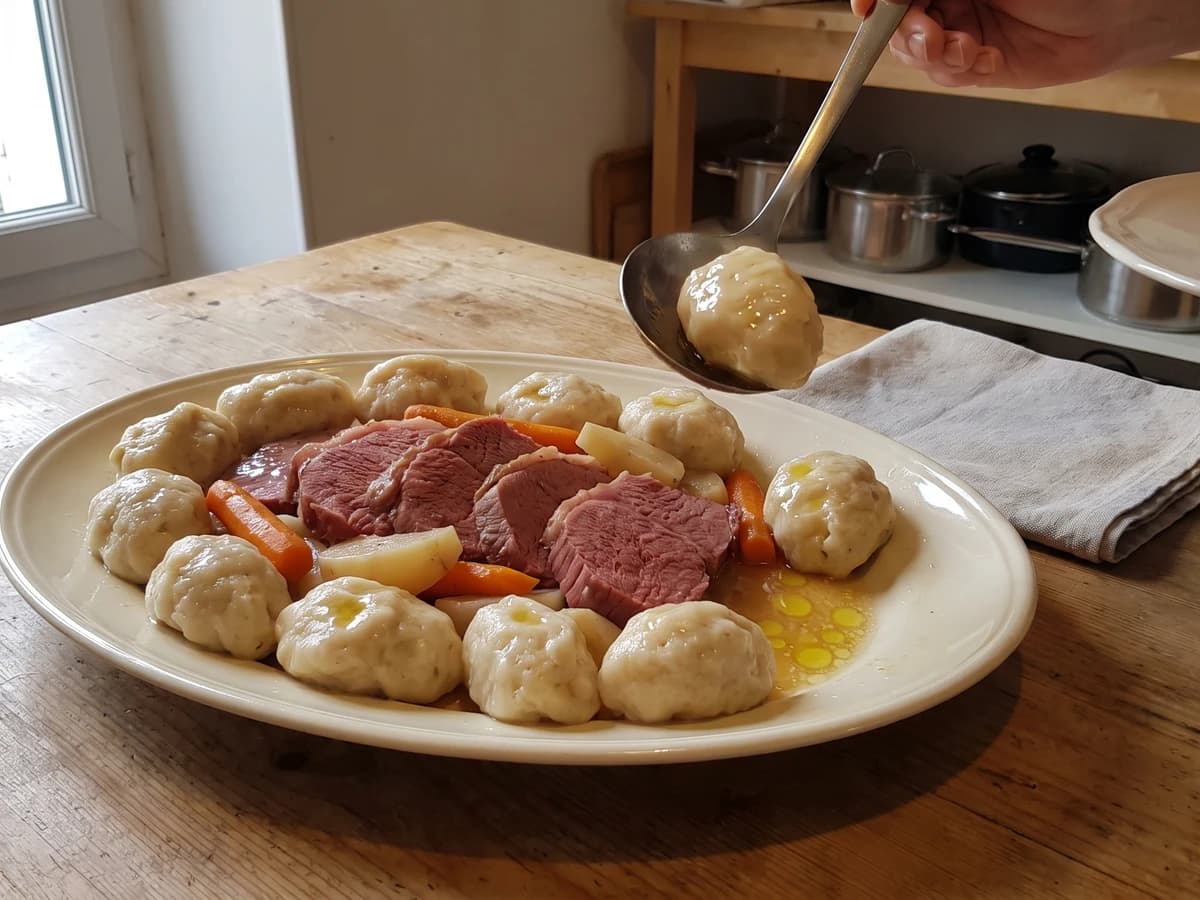
Suet Dumpling
Boulettes au suif, poached beside salt beef, turn equal weights of flour and finely chopped suet into tender, rich dumplings. Keep the beef liquor at a bare tremble and the old garnish works beautifully at home.
A cooking platform built around craft, culture, and the stories behind what we eat.

Created by Chef Juliette
Based on No. 2119, Purée de Choux de Bruxelles dite Flamande, from Le Guide Culinaire (1907) by Auguste Escoffier
Brussels sprouts stewed tender in butter and passed smooth meet exactly one-third their volume of potato before a final off-heat finish with butter gives the purée its quiet richness.
Purée de Choux de Bruxelles dite Flamande (Brussels sprout purée, Flemish style) teaches one very precise lesson: the final butter goes into a hot purée away from the fire. On the heat it melts into grease; off the heat it binds with the vegetables and gives them a soft, even gloss.
The original entry assumed mashed potato already waiting beside the stove, a tamis stretched on its frame, and a brigade hand free to push the sprouts through it. Your honest equivalents are a small saucepan for a plain potato mash and a sturdy fine-mesh sieve. The basin of ready-made potato was brigade scaffolding, so it goes. The three-quarter cook, the butter stew, the sieve, the one-third ratio, and the final off-heat butter are the dish, so they stay. One cook, one stove, one evening.
Done properly, the purée is pale green, smooth but substantial, and rich without losing the faint brassica bitterness that makes Brussels sprouts themselves. Measure the potato only after the sprouts have been sieved, because the promised one-third is their finished bulk, not their raw weight. When the finishing butter is ready, take the pan entirely off the fire before the first cube goes in.
In the French classical repertoire, dite Flamande places this purée within the northern larder associated with Flanders and neighboring Belgium, where potatoes and small cabbages were natural companions. The title does not prove an origin in one Flemish household; it records how the grand kitchen classified that regional pairing and fixed its character with a precise measure of one-third mashed potato.
Quantity
9 cups (2.1 L / 800 g)
trimmed; halve only those larger than a walnut
Quantity
1 large, about 1½ cups (350 ml / 250 g) diced
peeled and cut into 1-inch pieces
Quantity
6 tablespoons (90 ml / 85 g)
divided; 2 tablespoons for stewing and 4 tablespoons chilled and cubed for finishing
Quantity
1 tablespoon plus 1 teaspoon (20 ml / 24 g)
divided
| Ingredient | Quantity |
|---|---|
| Brussels sproutstrimmed; halve only those larger than a walnut | 9 cups (2.1 L / 800 g) |
| floury potato, such as russetpeeled and cut into 1-inch pieces | 1 large, about 1½ cups (350 ml / 250 g) diced |
| unsalted butterdivided; 2 tablespoons for stewing and 4 tablespoons chilled and cubed for finishing | 6 tablespoons (90 ml / 85 g) |
| fine sea saltdivided | 1 tablespoon plus 1 teaspoon (20 ml / 24 g) |
Put the potato in a small saucepan, cover generously with cold water, and add ½ teaspoon of the salt. Bring to a gentle simmer and cook for 12 to 15 minutes, until a piece crushes without resistance. Drain thoroughly, return it to the dry pan over low heat for one minute, then pass it through a ricer or mash it perfectly smooth. Add neither milk nor butter. Cover and keep warm while you cook the sprouts.
Bring a large saucepan of water to a vigorous boil and add 1 tablespoon of the salt. Add the sprouts and cook for 6 to 8 minutes. A knife should pass easily through the outer leaves but meet slight resistance at the heart. This is the source entry's three-quarter cook: tender enough to begin yielding, not yet fully done. Drain immediately and shake the colander hard. Do not rinse or cool them, because their retained heat carries them directly into the butter.
Melt 2 tablespoons of the butter in a wide sauté pan over medium-low heat without letting it color. Add the hot sprouts, turn them through the butter, cover, and cook for 7 to 10 minutes, stirring twice, until they crush readily against the pan. Keep them green and buttery, never browned. If the butter begins to color before the sprouts soften, lower the heat and add 1 tablespoon of hot water. Ça se rattrape. Uncover for the final minute so no loose water remains.
While the sprouts are still hot, press them through a sturdy fine-mesh sieve with a flexible spatula or the back of a ladle, working in small batches. Scrape the smooth purée from the underside after each batch and discard the dry fibrous residue left above. The tamis removes the tough leaf fibres rather than merely chopping them, which is why this step stays.
Measure the sieved sprout purée by volume, then measure warm mashed potato equal to exactly one-third that volume. For 2¼ cups of sprout purée, for example, use ¾ cup potato. The raw vegetables vary, so measure the finished purées rather than guessing from their starting weights. Fold them together in the sauté pan and warm over low heat for 3 to 4 minutes, stirring steadily, until a spoon drawn across the bottom leaves a clean path. If the mixture looks wet, continue heating gently before adding any finishing butter.
Take the pan completely off the heat. Beurrer hors du feu means finishing with butter away from the fire, and here it decides the dish. Beat in the chilled butter a few cubes at a time, waiting until each addition disappears before adding the next. The purée should become supple and evenly glossy, not oily. If butter beads on the surface, stop adding it, rest the bottom of the pan in a shallow bowl of cool water for 20 seconds, then beat firmly until the sheen turns creamy again. Ça se rattrape. Taste and add up to the remaining ½ teaspoon salt as needed.
Warm a deep serving bowl with hot water, dry it, and spoon in the purée. Shape it generously with the back of the spoon, leaving broad swirls to catch the butter's sheen. Serve at once beside roast pork, ham, duck, or a plainly roasted bird. À table!
1 serving (about 240g)
Culinary guides, cultural storytelling, and the editorial depth that makes cooking meaningful.
Discover Culinary ExplorerChef Juliette
Boulettes au suif, poached beside salt beef, turn equal weights of flour and finely chopped suet into tender, rich dumplings. Keep the beef liquor at a bare tremble and the old garnish works beautifully at home.

Chef Juliette
Bread, flour, frangipane, and rice become four cool, supple panades for binding forcemeats, each changing body and flavor while preserving tenderness. The finest Mousselines need none, and knowing that distinction is the lesson.

Chef Juliette
Panade au pain is bread, milk, salt, heat, and attention: stir until the paste releases cleanly, butter it against a skin, and you have the quiet binder behind tender French farces.

Chef Juliette
Panade de farine teaches the drying stroke behind pâte à choux: flour meets boiling buttered water, then stays over the fire until the paste gathers, smooths, and quits the pan cleanly.