Chef Juliette
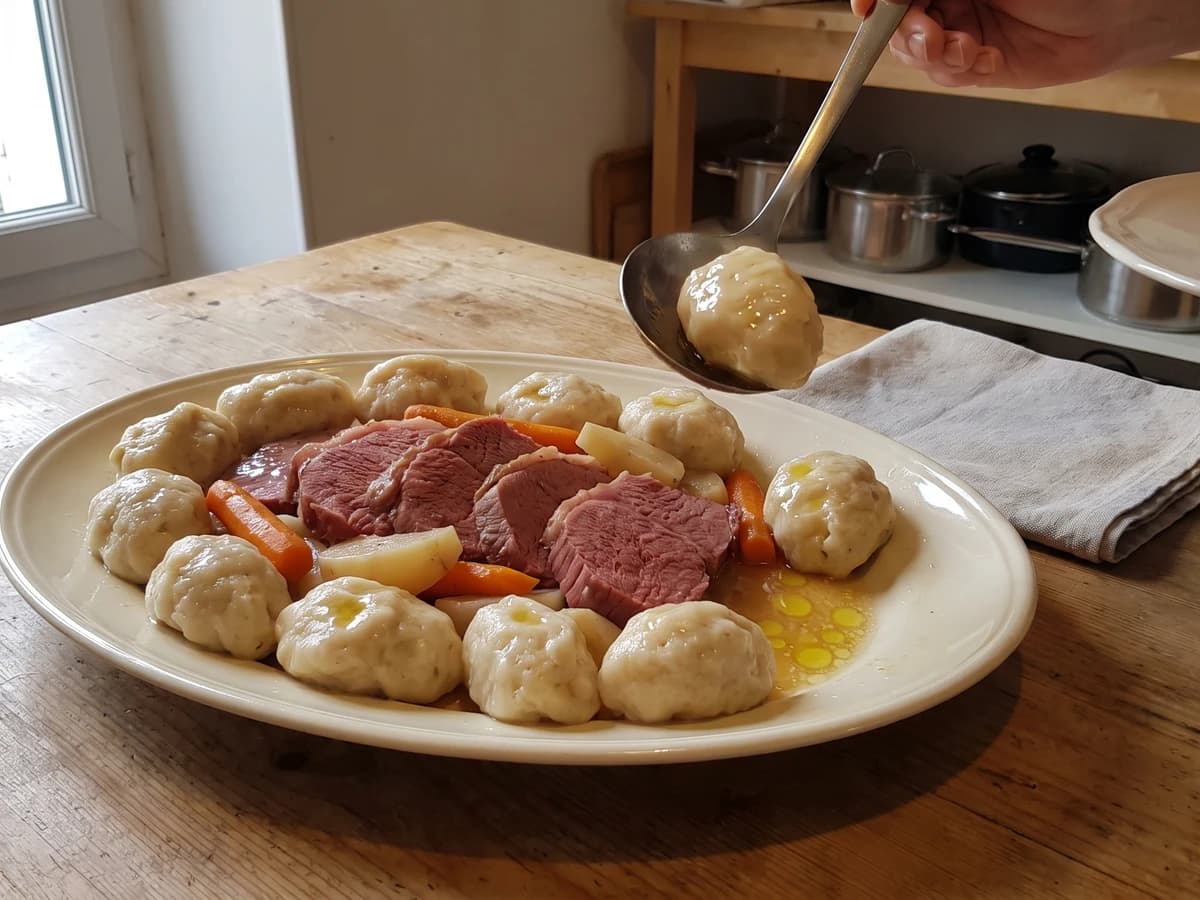
Suet Dumpling
Boulettes au suif, poached beside salt beef, turn equal weights of flour and finely chopped suet into tender, rich dumplings. Keep the beef liquor at a bare tremble and the old garnish works beautifully at home.
A cooking platform built around craft, culture, and the stories behind what we eat.

Created by Chef Juliette
Based on No. 2057, Cardons à la Moelle, from Le Guide Culinaire (1907) by Auguste Escoffier
Tender cardoons rise beneath glossy sauce moelle, while crisp little puff-paste patties hold poached marrow dice. The lesson is gentle heat: poach the marrow barely, or richness becomes grease.
Cardons à la Moelle (cardoons with marrow) teaches the discipline behind rich food: fat must be handled lightly. Tender, faintly bitter cardoons make the architecture, Marrow Sauce (No. 45) supplies wine-dark depth, and crisp patties carry pearly dice of marrow. Before you touch a pan, know the one true thing: marrow poaches below a simmer. Let the water boil and it simply becomes fat in the water.
The classical formula assumed a saucier with stock never off the fire, a pastry station turning out tiny patties, and a hot cupboard holding every part for service. Its first presentation requires no salamander because nothing is gratinéed. At home, you reach for one prepared batch of the referenced sauce, one sheet of bought all-butter puff pastry, and an ordinary oven. Making pastry through all its turns for eight little patties is brigade scaffolding and can go; the pyramid, the sauce, the patties, and the poached marrow dice are the dish and must stay. One cook, one stove, one evening.
The cardoons need a cuisson au blanc, a pale acidulated poach, until completely tender, then a brief turn in butter before they meet the sauce. Chill the marrow firmly enough to cut clean cubes and reserve a few raw ones against trouble. Your decisive step is the marrow poach, gentle enough that every cube reaches the table intact.
Cardoons have a particular home at the Christmas table around Lyon, supported by the market gardens of Vaulx-en-Velin and other communities along the Rhône. The Lyonnais pairing of cardoon and beef marrow entered the national classical repertoire in grand-kitchen dress, here as a pyramid under sauce with a ring of tiny puff-paste patties rather than the more familiar family gratin. Although its stalks resemble celery, cardoon is an artichoke cousin, and its gentle bitterness is precisely what gives marrow somewhere useful to go.
Quantity
2 large heads (about 3 pounds / 1.36 kg)
Quantity
4 1/2 quarts (4.25 L / 4.25 kg)
divided
Quantity
1/4 cup (60 ml / 60 g)
divided
Quantity
2 tablespoons (30 ml / 16 g)
Quantity
2 teaspoons (10 ml / 12 g), plus more as needed
divided
Quantity
1 sheet (10 ounces / 280 g)
thawed but still cold
Quantity
1
Quantity
1 tablespoon (15 ml / 15 g)
Quantity
1/2 cup (120 ml / 100 g)
removed from the bones and chilled very firm
Quantity
2 tablespoons (30 ml / 28 g)
Quantity
1/4 teaspoon (1.25 ml / 0.6 g)
| Ingredient | Quantity |
|---|---|
| fresh cardoons | 2 large heads (about 3 pounds / 1.36 kg) |
| cold waterdivided | 4 1/2 quarts (4.25 L / 4.25 kg) |
| fresh lemon juicedivided | 1/4 cup (60 ml / 60 g) |
| all-purpose flour | 2 tablespoons (30 ml / 16 g) |
| fine sea saltdivided | 2 teaspoons (10 ml / 12 g), plus more as needed |
| all-butter puff pastrythawed but still cold | 1 sheet (10 ounces / 280 g) |
| large egg | 1 |
| cold water for the egg wash | 1 tablespoon (15 ml / 15 g) |
| raw beef marrowremoved from the bones and chilled very firm | 1/2 cup (120 ml / 100 g) |
| unsalted butter | 2 tablespoons (30 ml / 28 g) |
| ground white pepper | 1/4 teaspoon (1.25 ml / 0.6 g) |
| Marrow Sauceprepared and warm | 1 1/2 cups (360 ml / 375 g) Marrow Sauce (No. 45) |
Fill a wide bowl with 2 quarts of the cold water and half the lemon juice. Separate the cardoon stalks, discard the leaves and dry or hollow pieces, then pare away the prickly edges and pull off the coarse strings with a vegetable peeler. Cut the cleaned stalks into pieces about 4 inches long and 1/2 inch wide, dropping each immediately into the acidulated water. Work carefully but without fuss. Any pale inner stalks that need little peeling are a gift.
Whisk the flour into the remaining 2 quarts cold water in a wide saucepan, then add the remaining lemon juice and 1 teaspoon of the salt. Bring this cuisson au blanc, the pale acidulated poaching liquid, to a gentle simmer. Drain the cardoons, add them, and press a round of parchment directly onto the surface so every piece stays submerged. Cook for 35 to 50 minutes, until a knife passes through the thickest stalk with almost no resistance. Cardoon served al dente is simply undercooked; if the fibers still resist, give it another ten minutes. Drain well and let the surface moisture evaporate.
While the cardoons cook, heat the oven to 400°F (200°C) and line a baking sheet with parchment. Cut sixteen 2-inch rounds from the cold puff pastry. Cut a 1-inch center from eight rounds to make rings. Beat the egg with the tablespoon of cold water, brush the whole rounds very lightly, and place a ring on each. Brush only the tops, keeping egg from the cut edges because it seals the layers. Chill for 15 minutes, then bake for 15 to 18 minutes, until high, crisp, and deep butter-gold. If a center balloons and leaves no hollow, press it down gently with the handle of a wooden spoon while the pastry is warm. Ça se rattrape.
Melt the butter in a wide sauté pan over medium heat. Add the drained cardoons, 1/2 teaspoon of the salt, and the white pepper. Turn them gently for 6 to 8 minutes, until hot throughout and coated with butter but not browned hard. The brief sauté drives off the last water from the poach; wet cardoons would thin the sauce and leave it sliding around the platter.
Warm the Marrow Sauce (No. 45) over low heat until it flows heavily from a spoon and coats its back. Do not let it boil. If reheating has made it too tight, lift out any visible marrow dice with a slotted spoon, whisk in hot water one teaspoon at a time, then return the dice. Keep the sauce just warm while you poach the additional marrow for the patties.
Cut the cold marrow into neat 1/4-inch dice and hold one quarter of them in reserve. Heat the remaining 2 cups water with the final 1/2 teaspoon salt to 165 to 175°F (74 to 79°C), below a simmer, with no rolling movement. Lower in the first batch of marrow for 30 to 45 seconds, just until the outside turns opaque and the cubes soften while keeping their shape, then lift them onto a clean towel with a small slotted spoon. If their corners begin to feather, the water is too hot. Lift them immediately onto a chilled plate, lower the heat, and poach the reserved dice in the corrected water. Ça se rattrape.
Arrange the hot cardoons in a compact pyramid on a warmed 12-inch round serving platter. Spoon the Marrow Sauce (No. 45) over them generously, letting it follow the shape without flooding the rim. Set the eight puff-paste patties in a close ring around the cardoons and divide the poached marrow dice among their hollows. Carry the platter straight to the table while the pastry is crisp and the marrow still holds its pearly shape. À table!
1 serving (about 400g)
Culinary guides, cultural storytelling, and the editorial depth that makes cooking meaningful.
Discover Culinary ExplorerChef Juliette
Boulettes au suif, poached beside salt beef, turn equal weights of flour and finely chopped suet into tender, rich dumplings. Keep the beef liquor at a bare tremble and the old garnish works beautifully at home.

Chef Juliette
Bread, flour, frangipane, and rice become four cool, supple panades for binding forcemeats, each changing body and flavor while preserving tenderness. The finest Mousselines need none, and knowing that distinction is the lesson.

Chef Juliette
Panade au pain is bread, milk, salt, heat, and attention: stir until the paste releases cleanly, butter it against a skin, and you have the quiet binder behind tender French farces.

Chef Juliette
Panade de farine teaches the drying stroke behind pâte à choux: flour meets boiling buttered water, then stays over the fire until the paste gathers, smooths, and quits the pan cleanly.