Chef Juliette
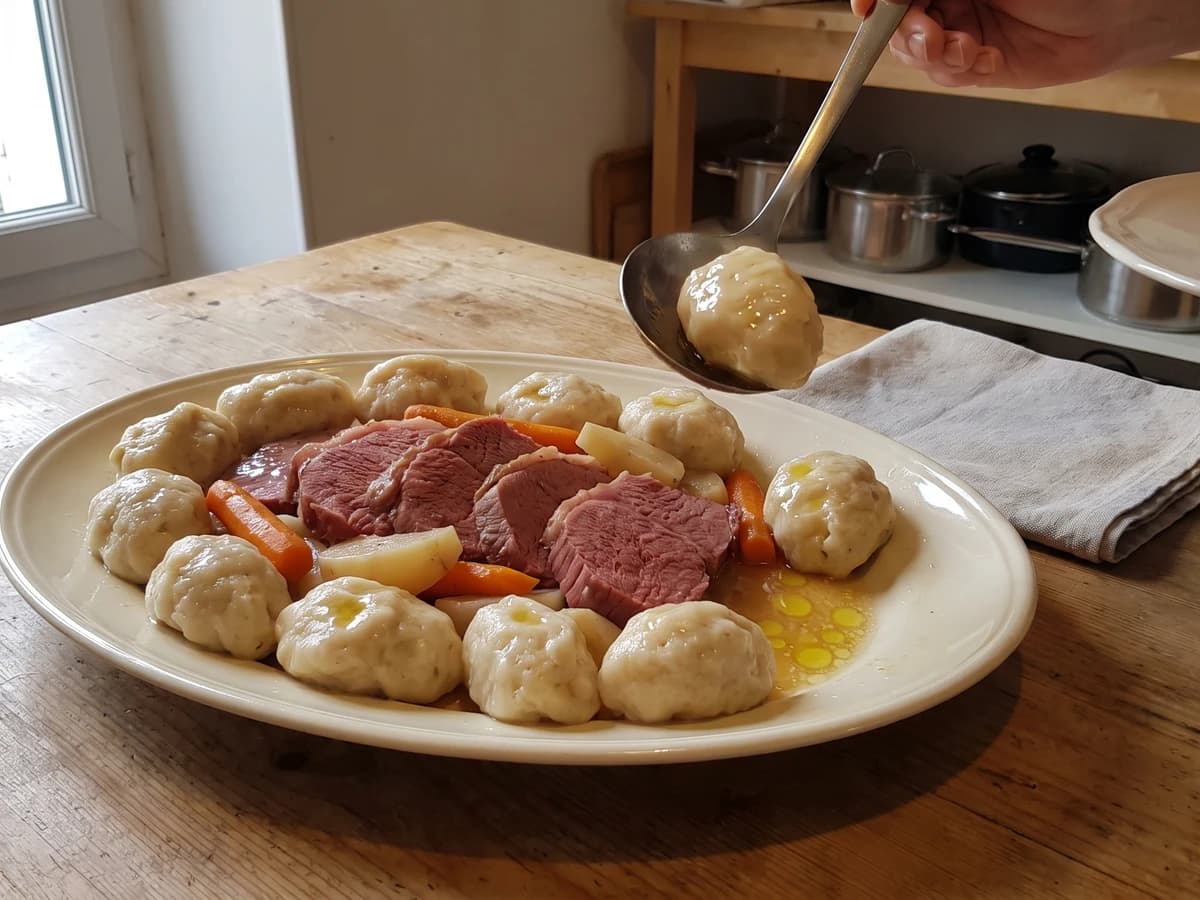
Suet Dumpling
Boulettes au suif, poached beside salt beef, turn equal weights of flour and finely chopped suet into tender, rich dumplings. Keep the beef liquor at a bare tremble and the old garnish works beautifully at home.
A cooking platform built around craft, culture, and the stories behind what we eat.

Created by Chef Juliette
Based on No. 1944, Sage and Onions Stuffing (for Turkeys, Ducks and Geese), from Le Guide Culinaire (1907) by Auguste Escoffier
Whole-baked onions are the lesson: sweet before they meet the pan, never acrid, then joined with butter, dried sage, milk-softened breadcrumbs, and veal fat in the classical 2:2:1 proportion.
Farce aux oignons et à la sauge (sage and onions stuffing) teaches one decisive thing: the onions must become sweet before they ever meet the pan. Bake them whole in their skins until their centers surrender completely, then fry them in butter. Begin with raw onion and the long poultry roast concentrates its sulfur into acridity rather than sweetness.
The book's formula treats four large onions, butcher-prepared veal fat, and ample bench space as ordinary kitchen conditions. For one home bird, the quantity becomes two onions, while every relationship travels intact: baked onion and milk-soaked, pressed bread in equal weights, with chopped veal fat at half that weight. The brigade bulk was scaffolding and can go. A sheet pan, a skillet, and a kitchen scale give one cook the honest equivalent. The only procedural addition is a brief cooling pause before the fat goes in, because a hot home skillet would melt the very pockets meant to baste the crumb. One cook, one stove, one evening.
Keep the skin-on bake and the 2:2:1 proportion. Those are the dish. Before chopping an onion, push a thin knife through its center; if you feel resistance, it isn't ready, and the method shows you how to rescue it.
Farce aux oignons et à la sauge belongs first to England's roast table, where sage and onion are customary partners for rich poultry, but French classical kitchens adopted it as a named farce for turkey, duck, and goose. The French repertory's contribution was not a change of character but a precise proportion: baked onion and milk-soaked, pressed bread in equal weights, with chopped veal fat at half that weight. Baking the onions in their skins distinguishes this formula from raw-onion dressings, because their sweetness suits fatty birds while raw sulfur turns acrid during a long roast.
Quantity
2 large (about 14 oz / 400 g total; expect about 10½ oz / 300 g baked and peeled)
Quantity
About 3½ cups (830 ml / 200 g), or enough to equal the baked onion weight after soaking and pressing
Quantity
2 cups (475 ml / 490 g)
for soaking; not all will be absorbed
Quantity
¾ cup (180 ml / 150 g), or exactly half the baked onion weight
finely chopped
Quantity
2 tablespoons (30 ml / 28 g)
Quantity
½ teaspoon (2.5 ml / 0.4 g)
finely crumbled
Quantity
½ teaspoon (2.5 ml / 3 g), or to taste
| Ingredient | Quantity |
|---|---|
| large yellow onions | 2 large (about 14 oz / 400 g total; expect about 10½ oz / 300 g baked and peeled) |
| fresh white breadcrumbs from day-old crustless bread | About 3½ cups (830 ml / 200 g), or enough to equal the baked onion weight after soaking and pressing |
| whole milkfor soaking; not all will be absorbed | 2 cups (475 ml / 490 g) |
| chilled raw veal fat, preferably kidney fatfinely chopped | ¾ cup (180 ml / 150 g), or exactly half the baked onion weight |
| unsalted butter | 2 tablespoons (30 ml / 28 g) |
| dried green sage leavesfinely crumbled | ½ teaspoon (2.5 ml / 0.4 g) |
| fine sea salt | ½ teaspoon (2.5 ml / 3 g), or to taste |
Heat the oven to 375°F (190°C). Set the unpeeled onions in a small roasting tray and bake for 55 to 70 minutes, turning once, until the skins are papery, the onions slump under gentle pressure, and a thin knife passes through each center without resistance. Let them stand for 10 minutes. If a center is still firm after peeling, chop the onion, cover it in the skillet with 2 tablespoons of the measured milk, and cook gently until completely soft; uncover and evaporate every trace of liquid before proceeding.
Peel away the skins, trim the root ends, and finely chop the soft onions. Set a bowl on the scale, tare it, and weigh the onion. About 10½ ounces (300 g) is expected, but the actual number governs the farce: prepare exactly the same weight of soaked, pressed breadcrumbs and half that weight of chopped veal fat.
Cover the breadcrumbs with the remaining milk and leave them for 5 minutes, turning them once so every crumb softens. Gather the bread in a clean kitchen towel or cheesecloth and press firmly until it remains moist and cohesive but releases no milk when squeezed. Weigh out exactly as much pressed bread as cooked onion. If it drips or leaves milk beneath it, press it again. Ça se rattrape. If the portion weighs too little, soak and press another handful rather than guessing.
Reserve 1 teaspoon of the butter for the baking dish, if using one, and melt the remainder in a 10-inch (25 cm) skillet over medium heat. Add the chopped onions, crumbled dried sage, and half the salt. Fry for 8 to 10 minutes, stirring often, until the surface moisture has gone, the onions gleam with butter, and a pale golden fond begins to form on the pan floor. Do not take them dark. If they catch too quickly, lower the heat and loosen the fond with a spoonful of the soaking milk.
Take the skillet off the heat and fold in the measured pressed breadcrumbs, scraping the buttery fond through the mixture. Taste now, before the raw fat enters, and add the remaining salt only if needed. Spread the mixture on a tray and cool it for about 15 minutes, until no warmth remains. Fold in the chilled chopped veal fat without crushing or smearing it. The finished farce should hold a loose mound, with distinct pale pieces of fat throughout; if those pieces begin to soften, chill the mixture for 15 minutes before filling the bird.
To cook the farce inside poultry, fill the neck and body cavities loosely, never more than three-quarters full, immediately before the bird goes into the oven. Roast according to the bird's method until the center of the farce reaches 165°F (74°C). If the poultry reaches its proper doneness first, spoon the farce into a shallow dish and finish it separately rather than drying the bird; ça se rattrape. For dressing served beside the roast, spread the farce in a buttered 1½-quart (1.4 L) gratin dish, cover tightly, and bake at 375°F (190°C) for 25 minutes. Uncover and bake for another 15 to 20 minutes, until the center reaches 165°F (74°C) and the edges are butter-gold and lightly bronzed.
Let separately baked dressing settle for 10 minutes before serving. For a stuffed bird, allow the roast to rest for 20 minutes, then spoon the farce into a warm serving dish so it doesn't remain hidden in the carcass. Serve generously beside turkey, duck, or goose, with its crisp edges and butter-soft center both on the spoon. À table!
1 serving (about 98g)
Culinary guides, cultural storytelling, and the editorial depth that makes cooking meaningful.
Discover Culinary ExplorerChef Juliette
Boulettes au suif, poached beside salt beef, turn equal weights of flour and finely chopped suet into tender, rich dumplings. Keep the beef liquor at a bare tremble and the old garnish works beautifully at home.

Chef Juliette
Bread, flour, frangipane, and rice become four cool, supple panades for binding forcemeats, each changing body and flavor while preserving tenderness. The finest Mousselines need none, and knowing that distinction is the lesson.

Chef Juliette
Panade au pain is bread, milk, salt, heat, and attention: stir until the paste releases cleanly, butter it against a skin, and you have the quiet binder behind tender French farces.

Chef Juliette
Panade de farine teaches the drying stroke behind pâte à choux: flour meets boiling buttered water, then stays over the fire until the paste gathers, smooths, and quits the pan cleanly.