Chef Juliette
Suet Dumpling
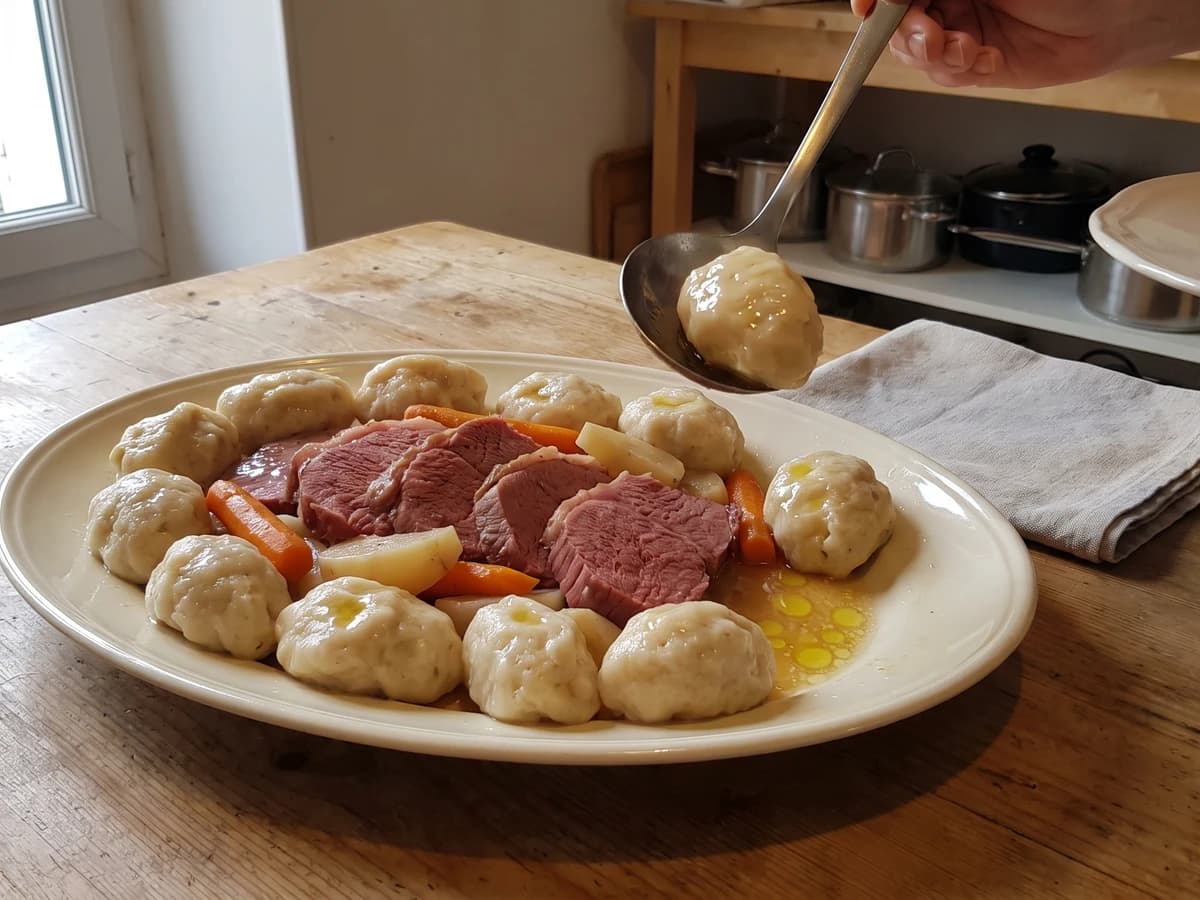
Boulettes au suif, poached beside salt beef, turn equal weights of flour and finely chopped suet into tender, rich dumplings. Keep the beef liquor at a bare tremble and the old garnish works beautifully at home.
A cooking platform built around craft, culture, and the stories behind what we eat.

Created by Chef Juliette
Based on No. 1942, Accompaniment of Roasts, from Le Guide Culinaire (1907) by Auguste Escoffier
The roast keeps its sauce and gains its proper escort: lofty Yorkshire pudding for beef, sage and onion dressing for birds, or veal stuffing for pork and veal, each scaled for four.
Garnitures de rôtis à l’anglaise (English accompaniments for roasts) teach one clean rule: the roast chooses its escort, and the escort is not the sauce. Beef calls for Yorkshire pudding, birds for sage and onion, pork or veal for the gentler veal stuffing. Choose one. Cooking well is not cooking fancy, and piling all three beside every joint only blurs what each does best.
The original entry is an umbrella, not a single mixed preparation. It assumed a roast cook with fresh drippings, a saucier elsewhere attending to sauces, and enough oven space to bake each garniture around service. At home, the honest equivalent is the roast’s resting time: Yorkshire pudding rises in a fiercely preheated metal tin, while either stuffing bakes in a shallow dish rather than inside the meat. The separate dish is the modernization, chosen for even roasting, safe doneness, and a batch for four. The rested batter, softened onions, real butter, and careful seasoning stay, because they are the dish.
Done properly, Yorkshire pudding stands tall with crisp bronze edges; sage and onion dressing is buttery and loose beneath its crust; veal stuffing is tender, herb-scented, and firm enough to slice. Before touching a pan, choose the garniture by the meat. That single decision keeps every flavor in its proper register.
Yorkshire pudding belongs to the northern English beef table, where batter baked in the roast’s falling drippings, while sage and onion stuffing became the familiar companion of birds across England. Veal stuffing came through the more formal roast service, its mild forcemeat matched to veal or pork rather than beef. French classical books grouped these preparations under one heading to explain English service, but they were alternatives chosen for the meat, not a trio served together, and the roast’s sauces remained a separate matter.
Quantity
1 cup (240 ml / 125 g)
Quantity
4
Quantity
¾ cup plus 1 tablespoon (195 ml / 200 g)
Quantity
½ teaspoon (2.5 ml / 3 g)
Quantity
2 tablespoons (30 ml / 28 g)
Quantity
2 medium (about 2½ cups / 300 g)
finely chopped
Quantity
3 tablespoons (45 ml / 43 g)
divided
Quantity
2 cups (480 ml / 120 g)
Quantity
1 tablespoon (15 ml / 4 g)
finely chopped
Quantity
1
Quantity
½ teaspoon (2.5 ml / 3 g)
Quantity
¼ teaspoon (1.25 ml / 0.6 g)
Quantity
2 to 4 tablespoons (30 to 60 ml / 30 to 60 g)
only as needed
Quantity
½ pound (225 g)
Quantity
3 tablespoons (45 ml / 43 g)
softened and divided
Quantity
1 cup (240 ml / 60 g)
Quantity
1
Quantity
2 tablespoons (30 ml / 30 g)
Quantity
2 tablespoons (30 ml / 8 g)
finely chopped
Quantity
1 teaspoon (5 ml / 1 g)
Quantity
1 teaspoon (5 ml / 2 g)
finely grated
Quantity
⅛ teaspoon (0.6 ml / 0.25 g)
Quantity
¾ teaspoon (3.75 ml / 4.5 g)
Quantity
¼ teaspoon (1.25 ml / 0.6 g)
| Ingredient | Quantity |
|---|---|
| all-purpose flour, for Yorkshire pudding | 1 cup (240 ml / 125 g) |
| large eggs, for Yorkshire pudding | 4 |
| whole milk, for Yorkshire pudding | ¾ cup plus 1 tablespoon (195 ml / 200 g) |
| fine salt, for Yorkshire pudding | ½ teaspoon (2.5 ml / 3 g) |
| rendered beef dripping, or neutral high-heat oil if needed | 2 tablespoons (30 ml / 28 g) |
| yellow onions, for sage and onion dressingfinely chopped | 2 medium (about 2½ cups / 300 g) |
| unsalted butter, for sage and onion dressingdivided | 3 tablespoons (45 ml / 43 g) |
| fresh white breadcrumbs, for sage and onion dressing | 2 cups (480 ml / 120 g) |
| fresh sage, for sage and onion dressingfinely chopped | 1 tablespoon (15 ml / 4 g) |
| large egg, for sage and onion dressing | 1 |
| fine salt, for sage and onion dressing | ½ teaspoon (2.5 ml / 3 g) |
| freshly ground black pepper, for sage and onion dressing | ¼ teaspoon (1.25 ml / 0.6 g) |
| water, for sage and onion dressing (optional)only as needed | 2 to 4 tablespoons (30 to 60 ml / 30 to 60 g) |
| ground veal, for veal stuffing | ½ pound (225 g) |
| unsalted butter, for veal stuffingsoftened and divided | 3 tablespoons (45 ml / 43 g) |
| fresh white breadcrumbs, for veal stuffing | 1 cup (240 ml / 60 g) |
| large egg, for veal stuffing | 1 |
| heavy cream, for veal stuffing | 2 tablespoons (30 ml / 30 g) |
| flat-leaf parsley, for veal stuffingfinely chopped | 2 tablespoons (30 ml / 8 g) |
| fresh thyme leaves, for veal stuffing | 1 teaspoon (5 ml / 1 g) |
| lemon zest, for veal stuffingfinely grated | 1 teaspoon (5 ml / 2 g) |
| freshly grated nutmeg, for veal stuffing | ⅛ teaspoon (0.6 ml / 0.25 g) |
| fine salt, for veal stuffing | ¾ teaspoon (3.75 ml / 4.5 g) |
| freshly ground black pepper, for veal stuffing | ¼ teaspoon (1.25 ml / 0.6 g) |
Make one accompaniment according to the roast: Yorkshire pudding for beef, sage and onion dressing for a bird, or veal stuffing for pork or veal. Keep the roast’s sauce separate, just as the source entry does. If you are serving a great crowd, you may double one preparation; making all three for four people defeats the useful logic of the entry.
For Yorkshire pudding, whisk the flour and salt together and make a well in the center. Add the eggs, whisk in half the milk until smooth, then add the remainder to make a batter that pours like light cream. Rest it for 30 minutes at room temperature while the beef finishes roasting. If small lumps remain, pass the batter through a sieve rather than beating it furiously. Ça se rattrape.
When the beef comes out to rest, raise the oven to 450°F (230°C). Divide the dripping among eight wells of a heavy metal muffin tin and heat it for 8 to 10 minutes, until the fat shimmers and the tin is fiercely hot. The old arrangement caught dripping beneath the roasting joint; the preheated tin is its honest home equivalent. This heat is the dish, not brigade scaffolding.
Whisk the rested batter once, then pour it swiftly into the hot wells, filling each about halfway. The first spoonful must hiss; if it does not, stop and return the tin to the oven until the fat is properly hot before filling the rest. Bake for 20 to 25 minutes without opening the door for the first 18 minutes, until the puddings stand high, deep bronze, and crisp at their edges. If they are risen but pale, give them another 3 to 5 minutes. Serve immediately beside the beef.
For sage and onion dressing, heat the oven to 375°F (190°C) and butter a 1-quart (950 ml) shallow baking dish with 1 tablespoon of the measured butter. Melt the remaining 2 tablespoons in a skillet, add the onions with a pinch of the measured salt, and cook gently for 12 to 15 minutes until completely soft and translucent, not browned. If they begin catching, lower the heat and add a tablespoon of the measured water; the browned patch will lift and the onions will finish softly.
Cool the onions for 10 minutes, then combine them with the breadcrumbs, sage, egg, remaining salt, and pepper. Add only enough water for the mixture to hold when squeezed yet crumble when nudged with a fork. If it becomes pasty, add another handful of breadcrumbs; if it will not hold, add water one teaspoon at a time. Never pack it hard, because a compressed dressing bakes into a doorstop.
Spoon the sage and onion dressing loosely into the prepared dish and roughen the top with a fork so the ridges can brown. Bake for 25 to 30 minutes, until the surface is butter-gold with darker edges and the center reaches 160°F (71°C). Let it settle for 5 minutes, then bring the dish straight to the table.
For veal stuffing, heat the oven to 375°F (190°C) and butter a 1-quart (950 ml) shallow baking dish with 1 tablespoon of the measured butter. Reserve 2 tablespoons of breadcrumbs and 1 tablespoon of cream for correcting the texture. Mix the veal lightly with the remaining butter, breadcrumbs, cream, egg, parsley, thyme, lemon zest, nutmeg, salt, and pepper. Stop as soon as the mixture is even; overworking makes the farce springy rather than tender.
Fry a teaspoonful of the veal mixture in a dry skillet until completely cooked, then taste it. Correct the salt or pepper now, while you still can. The raw farce should hold softly without slumping; if loose, work in the reserved breadcrumbs, and if stiff, fold in the reserved cream a teaspoon at a time. This small test replaces the brigade cook’s practiced eye and saves an entire dish.
Pack the veal stuffing gently into the prepared dish without compressing it, smooth the top, and cover loosely with foil. Bake for 20 minutes, uncover, and continue for 10 to 15 minutes, until the top is bronzed and the center reaches 165°F (74°C). If the surface colors before the center is ready, cover it again. Rest for 10 minutes before spooning or slicing; if it has gone a little too far, moisten each serving with a spoonful of the roast’s resting juices. À table!
1 serving (about 105g)
Culinary guides, cultural storytelling, and the editorial depth that makes cooking meaningful.
Discover Culinary ExplorerChef Juliette
Boulettes au suif, poached beside salt beef, turn equal weights of flour and finely chopped suet into tender, rich dumplings. Keep the beef liquor at a bare tremble and the old garnish works beautifully at home.

Chef Juliette
Bread, flour, frangipane, and rice become four cool, supple panades for binding forcemeats, each changing body and flavor while preserving tenderness. The finest Mousselines need none, and knowing that distinction is the lesson.

Chef Juliette
Panade au pain is bread, milk, salt, heat, and attention: stir until the paste releases cleanly, butter it against a skin, and you have the quiet binder behind tender French farces.

Chef Juliette
Panade de farine teaches the drying stroke behind pâte à choux: flour meets boiling buttered water, then stays over the fire until the paste gathers, smooths, and quits the pan cleanly.