Chef Fai
Isan Beef Larb (Larb Nua)
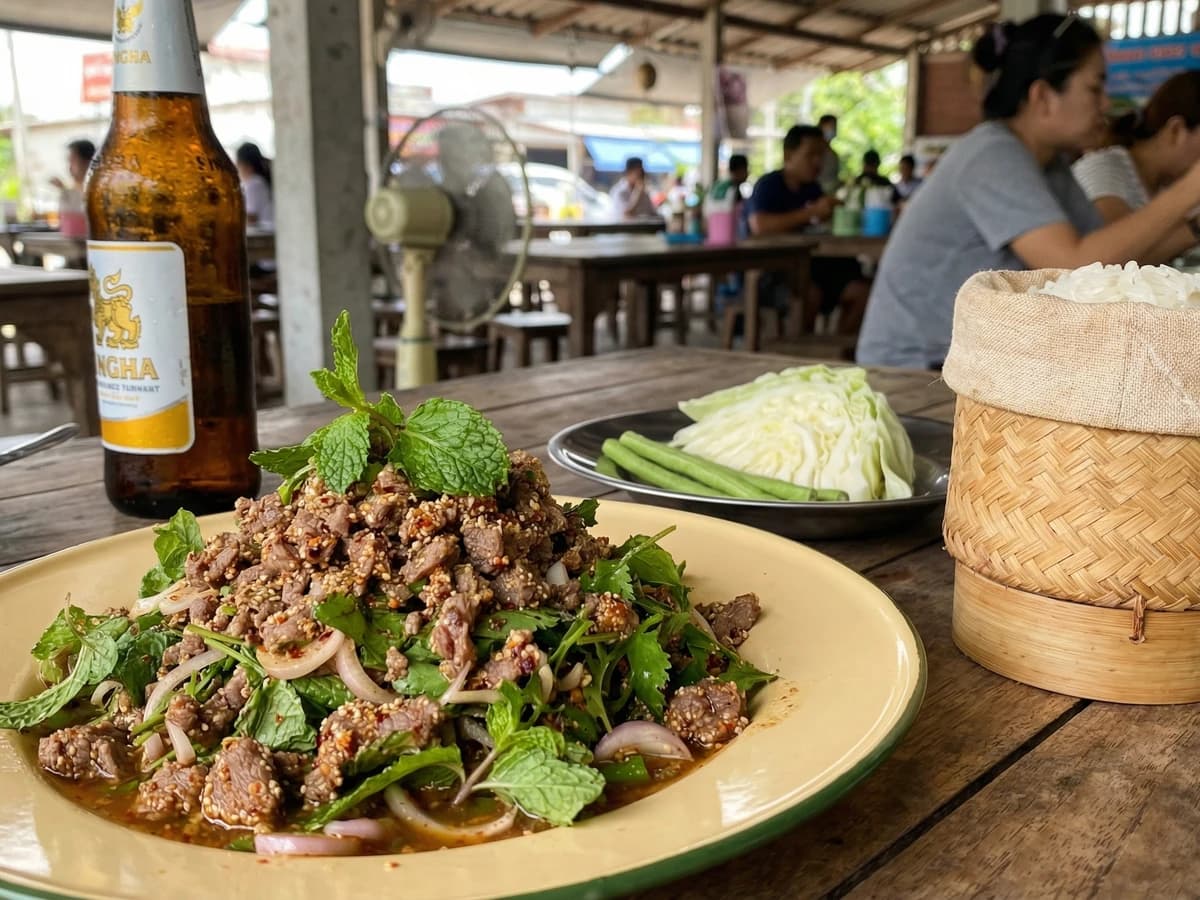
No sugar. That's the rule. Isan larb strips Thai cuisine down to three pillars: nam pla for salt, manao for sour, prik for heat, bound by the smoky crunch of freshly pounded khao khua. The absence defines the dish.
A cooking platform built around craft, culture, and the stories behind what we eat.

Created by
Two dishes on one plate: a golden mountain of shattered catfish and a sharp green mango yam dressed in the four pillars. The contrast is the point, and the yam dressing formula is the law.
This dish is a lesson in what Thai cooks understand better than anyone: texture is flavor. You take a catfish, cook it, shred it to threads, and fry those threads until they explode into a golden cloud that shatters between your teeth. Then you set it next to a green mango salad so sharp and wet it makes your mouth water. Crispy meets sour. Dry meets dressed. That tension on the plate is the whole design.
The yam dressing on the mango salad is the four pillars made portable. Fish sauce for salt. Palm sugar for sweet. Lime for sour. Chili for heat. That's the formula that governs every Central Thai yam, whether you're dressing squid, wing beans, or glass noodles. The protein changes. The vegetables change. The dressing stays. Ajarn always said: if you understand the yam dressing ratio, you can dress anything on a Thai table. This is what he meant.
The catfish technique is where most people fall apart. The flesh has to be shredded so fine it looks like cotton. If your strands are thick, they fry heavy and greasy. If they're fine and dry, they puff into something weightless, like the Thai version of cotton candy but savory and golden. The trick is patience: cook the fish first (grill or steam, I'll teach you both), scrape the flesh from the bones, then work it between your fingers until every strand separates. Spread it thin, let it dry slightly, and fry in hot oil. It takes sixty seconds. The transformation is violent and beautiful.
This is Central Thai street food at its sharpest. No kreung tam here. No paste. The principle is the yam dressing and the understanding that a Thai plate balances textures as deliberately as it balances flavors. Fai Thai, baby.
Yam pla duk foo is a Central Thai creation that rose to prominence in Bangkok's restaurant and drinking-food (กับแกล้ม) culture in the latter half of the 20th century. The technique of deep-frying shredded catfish into a fluffy mass likely originated with home cooks finding ways to use pla duk (walking catfish, Clarias batrachus), one of Thailand's most common freshwater fish, abundant in canals and rice paddies across the Central Plains. The pairing with yam mamuang (green mango salad) as a unified dish became a standard of Thai restaurants and street stalls, cementing it as one of the defining appetizers of Central Thai cuisine.
Quantity
400g total (2 fillets or 1 whole fish)
steamed or grilled, flesh shredded fine
Quantity
3 cups
for deep-frying
Quantity
1 large
peeled, shredded into matchsticks
Quantity
3 tablespoons
Quantity
2 tablespoons (about 2 limes)
Quantity
1 tablespoon
shaved or grated
Quantity
5
sliced thin
Quantity
3
sliced thin
Quantity
2 tablespoons
roughly crushed
Quantity
2 tablespoons
Quantity
a few sprigs
for serving
Quantity
1 stalk
sliced thin
| Ingredient | Quantity |
|---|---|
| catfish fillets (pla duk)steamed or grilled, flesh shredded fine | 400g total (2 fillets or 1 whole fish) |
| vegetable oilfor deep-frying | 3 cups |
| green mango (mamuang)peeled, shredded into matchsticks | 1 large |
| fish sauce (nam pla) | 3 tablespoons |
| lime juice (nam manao) | 2 tablespoons (about 2 limes) |
| palm sugar (nam tan pip)shaved or grated | 1 tablespoon |
| bird's eye chilies (prik khi nu)sliced thin | 5 |
| shallots (hom daeng)sliced thin | 3 |
| roasted peanutsroughly crushed | 2 tablespoons |
| dried shrimp (goong haeng) | 2 tablespoons |
| fresh cilantro (pak chi)for serving | a few sprigs |
| Chinese celery (kheun chai)sliced thin | 1 stalk |
If you have a grill or charcoal, grill the whole catfish or fillets over medium-high heat until cooked through, about 8 to 10 minutes, turning once. The skin will char. Good. That smoky flavor carries into the final dish. If no grill, steam the fillets over boiling water for 10 minutes until the flesh flakes easily. Either method works. Grilling gives you more flavor. Steaming is faster. Both get the job done.
Let the cooked catfish cool until you can handle it. Scrape all the flesh from the skin and bones using a fork or your fingers. Discard every bone. Now here's where it matters: work the flesh between your fingers, pulling it apart into the finest threads you can manage. It should look like pulled cotton, not chunks. Spread the shredded fish on a plate in a thin, even layer and let it air-dry for 10 to 15 minutes. The drier the fish, the crispier the result. If the fish is wet, it spatters in the oil and fries heavy.
Heat the oil in a wok or deep pan to 180°C (350°F). The oil should shimmer. Test with a single strand of fish: it should sizzle immediately and puff within seconds. Add the shredded catfish in one batch, spreading it gently with a slotted spoon. Don't pack it. The strands need room to separate and puff. Fry for 60 to 90 seconds. The fish will expand and turn golden. It happens fast. The moment it's uniformly golden, scoop it out with a spider strainer onto paper towels. It will crisp further as it drains. Don't touch it. Let it set.
In a small bowl, combine the fish sauce, lime juice, and palm sugar. Stir until the sugar dissolves completely. Taste it. Sour should lead. Salt should support. Sweet should whisper. Adjust until it hits. Add the sliced chilies to the dressing. This is the yam formula: the same ratio that governs every Central Thai salad. The dressing is the system. The ingredients you dress are the variable.
In a mixing bowl, combine the shredded green mango, sliced shallots, dried shrimp, crushed peanuts, and Chinese celery. Pour the yam dressing over and toss with your hands or tongs until every strand is coated and glistening. The mango should be sharp and sour on its own, and the dressing amplifies that. Taste a strand. If it makes your mouth pucker and then hits you with salt and a slow sweetness, you're there.
Mound the crispy catfish on one side of a serving plate. It should look like a golden hill, light and jagged. Pile the dressed green mango salad next to it, not on top. The two components stay separate on the plate. The diner takes a piece of crispy fish, tops it with a forkful of mango salad, and eats them together. Crispy, sour, salty, sweet, spicy in one bite. Scatter cilantro over the mango salad. Serve at room temperature. Immediately. The catfish starts losing its crunch within minutes. This dish does not wait.
1 serving (about 175g)
Culinary guides, cultural storytelling, and the editorial depth that makes cooking meaningful.
Discover Culinary ExplorerChef Fai
No sugar. That's the rule. Isan larb strips Thai cuisine down to three pillars: nam pla for salt, manao for sour, prik for heat, bound by the smoky crunch of freshly pounded khao khua. The absence defines the dish.
Chef Fai
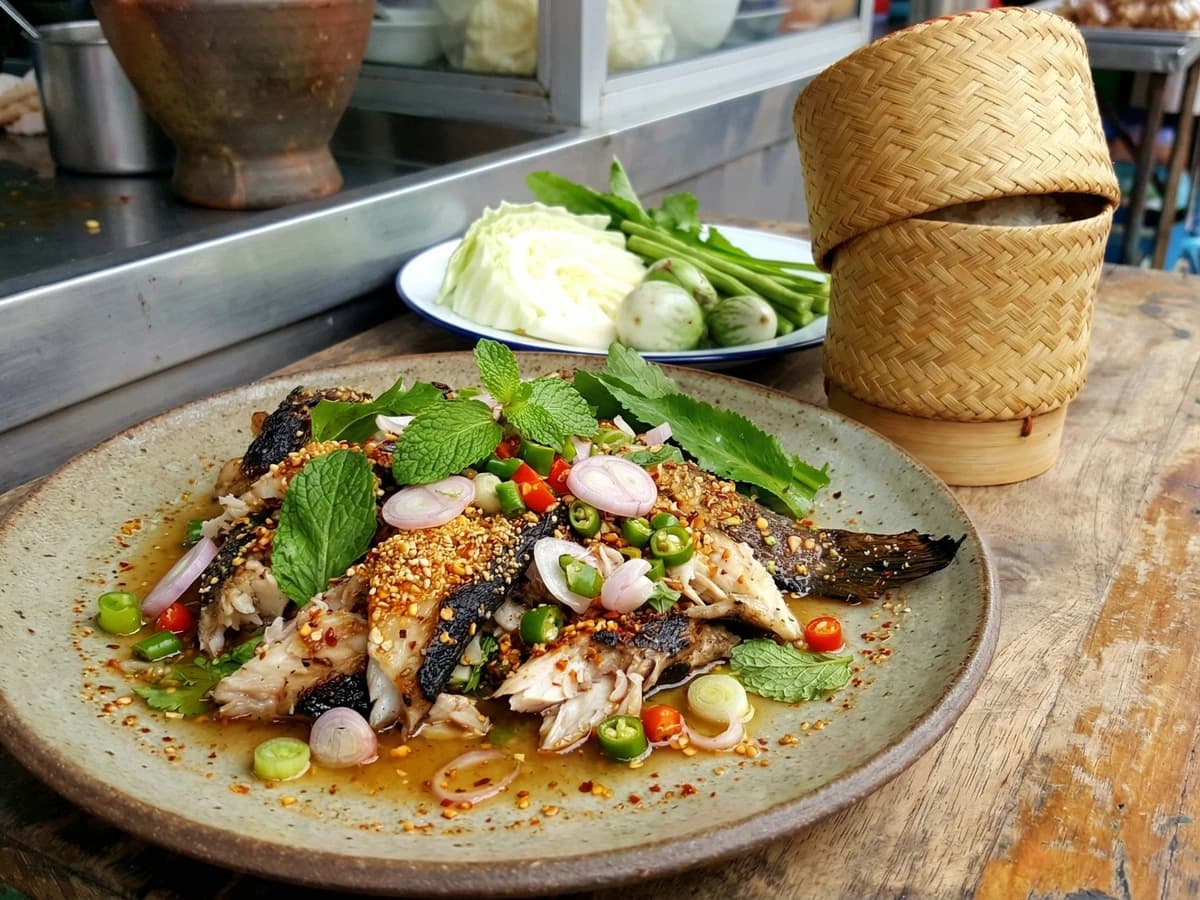
No sugar. That's the line between Isan and Central Thai larb. Grilled catfish flaked while warm, dressed with nam pla, manao, khao khua, prik pon, and a storm of fresh herbs. The plateau on a plate.
Chef Fai
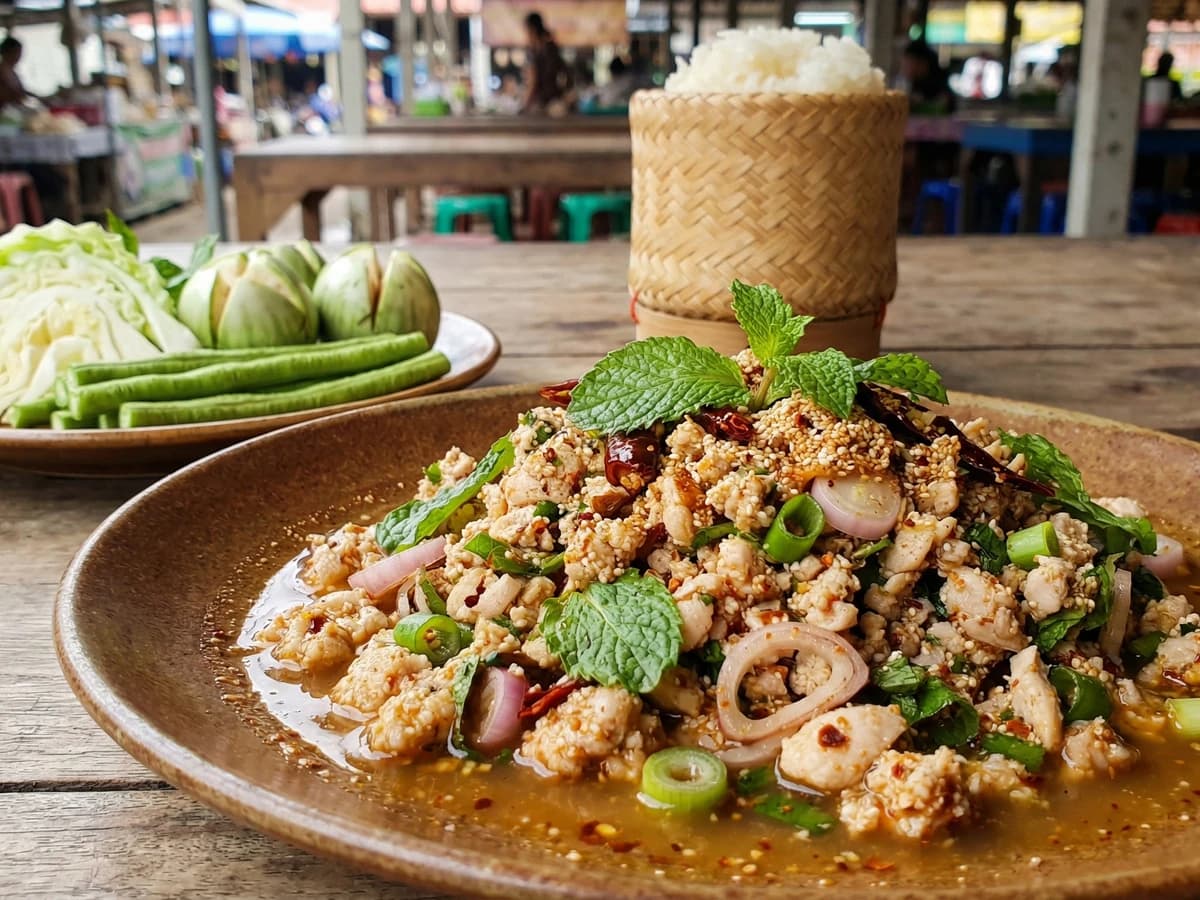
No sugar. That's the rule. Isan larb strips Thai cuisine down to three pillars: nam pla for salt, manao for sour, prik for heat, with khao khua tying it together in a way nothing else can.
Chef Fai
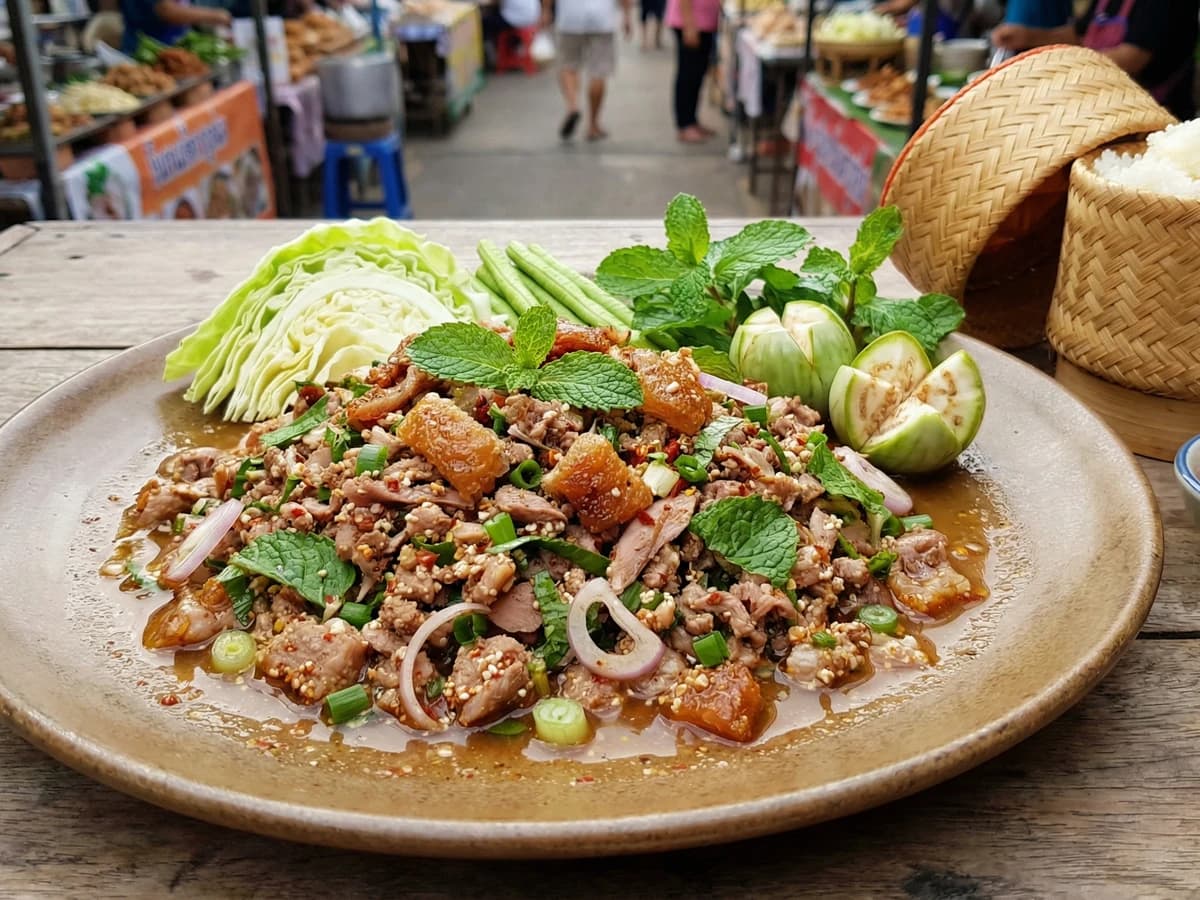
Duck brings gamey depth to the Isan larb formula. No sugar. Lime, fish sauce, khao khua, prik pon, and a wall of fresh herbs. This is the celebration table standard, and the governing rule is restraint.