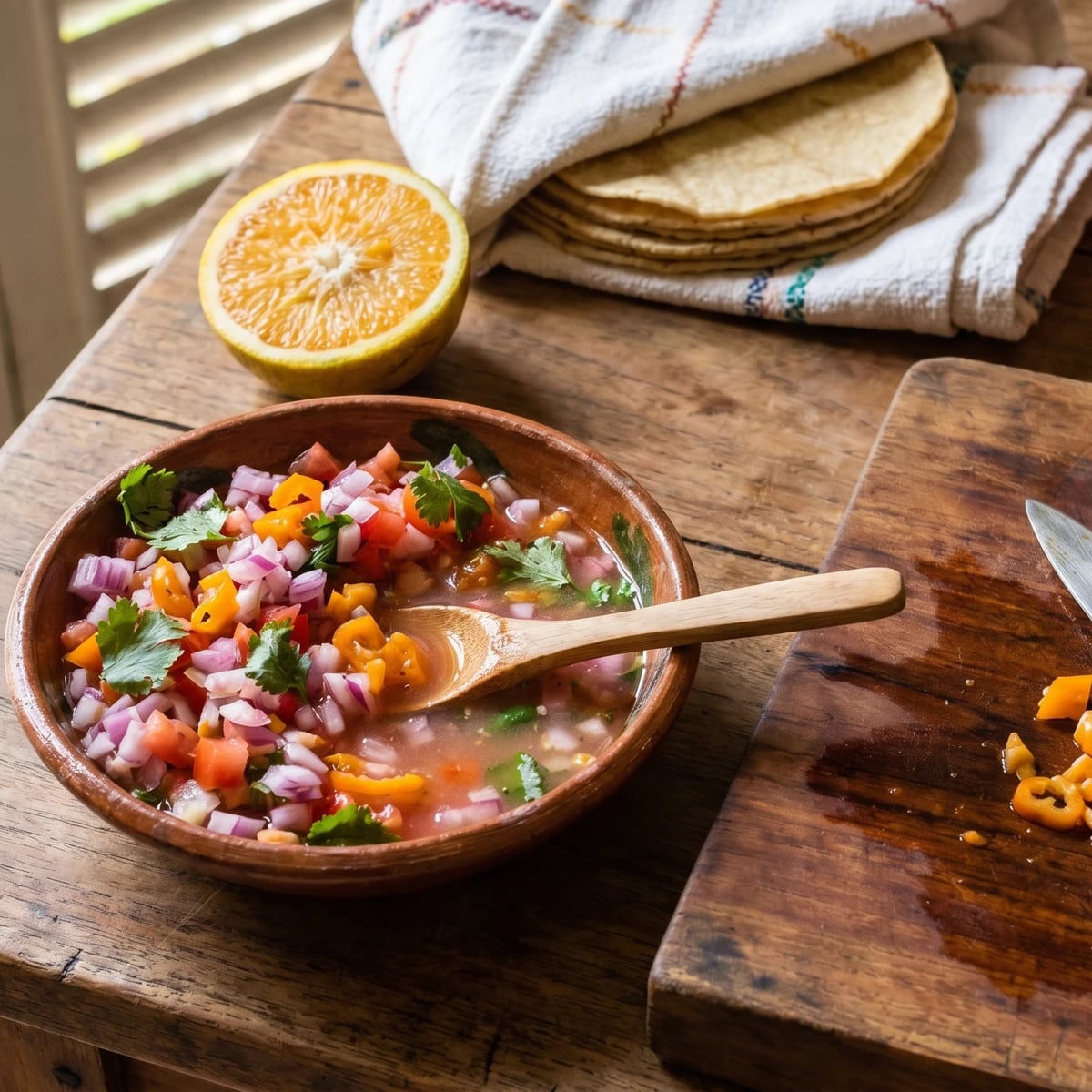
Yucatan's hand-chopped habanero salsa, sour orange and red onion and cilantro, named for the sweat it pulls from your nose. The condiment that lives on every Peninsula table, never blended, never optional.
Appetizers & Snacks
Mexican
Quick Meal
Dinner Party
BBQ
15 min
Active Time
0 min cook•15 min total
YieldAbout 1 1/2 cups (6 servings)
Xnipec belongs to the Peninsula. Yucatan, Campeche, Quintana Roo. The three states that share the chile habanero, the naranja agria, and the Mayan culinary inheritance that the rest of Mexico borrows from but does not own. The name is Mayan, x'nip ek, meaning nose of the dog, because a proper xnipec makes your nose run the way a dog's nose runs wet. The name tells you what the salsa is supposed to do. If you are not sweating, it is not xnipec.
Three ingredients define it: chile habanero, naranja agria, red onion. Without habanero, you have a different salsa from a different state. Without sour orange, you have a different cuisine entirely. The Peninsula does not use lime here. Sour orange is what cures the onion and brightens the chile, and the flavor is older, rounder, more bitter than lime. If your mercado does not carry naranja agria, mix orange juice with lime juice. It is a compromise, not an upgrade.
Never, ever, put this in a blender. Xnipec is a chopped salsa. Every spoonful should hold a piece of habanero, a piece of onion turning pink, a piece of cilantro. The texture is the recipe. I learned this in the kitchen of a senora in Valladolid who watched me reach for a blender once and put her hand on my wrist. She said, in Yucateco Spanish, that xnipec made in a blender is not xnipec, it is chile water. She was right. Cada estado, su propia cocina. Saber cocinar es saber vivir.
Xnipec's name comes from the Yucatec Maya x'nip ek, meaning nose of the dog, a reference to the way a habanero-laced salsa pulls a wet sheen onto the eater's nose. The chile habanero is the legally protected designation of origin product of the Yucatan Peninsula, recognized by Mexico's Instituto Mexicano de la Propiedad Industrial in 2010, though the chile itself originated in the Amazon basin and arrived in the Peninsula through Caribbean trade routes centuries before Spanish contact. Naranja agria, the bitter Seville orange that anchors Peninsula cooking, was introduced by the Spanish in the 16th century and was so thoroughly absorbed into Mayan cooking that it now functions as a native ingredient, taking the role that lime plays in the rest of Mexican cuisine.
The technique, the tradition, and the story behind every dish.
or 1/4 cup fresh orange juice mixed with 1/4 cup fresh lime juice
ripe tomato
Quantity
1 medium
seeded and finely diced
fresh cilantro leaves and tender stems
Quantity
1/3 cup
finely chopped
kosher salt
Quantity
1 teaspoon, plus more to taste
garlic clove (optional)
Quantity
1 small
minced
Ingredient
Quantity
fresh chile habanerostemmed
3 to 4
red onionfinely diced
1 medium
fresh sour orange juice (naranja agria)or 1/4 cup fresh orange juice mixed with 1/4 cup fresh lime juice
1/2 cup
ripe tomatoseeded and finely diced
1 medium
fresh cilantro leaves and tender stemsfinely chopped
1/3 cup
kosher salt
1 teaspoon, plus more to taste
garlic clove (optional)minced
1 small
Equipment Needed
•Sharp paring knife for chopping the habanero finely
•Wooden cutting board
•Disposable kitchen gloves
•Small glass or ceramic mixing bowl (never aluminum)
•Small clay cazuelita for serving
Instructions
1
Sweeten the onion
Place the finely diced red onion in a small glass or ceramic bowl. Pour the sour orange juice over it and add half a teaspoon of the salt. Stir and leave it alone for 10 minutes. The naranja agria pulls the bite out of the raw onion and softens the texture without cooking it. This is the Peninsula's trick. Skip it and the salsa tastes harsh.
Use a glass or ceramic bowl, never aluminum. The sour orange will react with the metal and turn the salsa metallic. Asi se hace y punto.
2
Hand-chop the habanero
Put on gloves. Habanero oil burns your skin and burns whatever you touch afterward, including your eyes for the rest of the day. Stem the chiles. Slice each one in half lengthwise. For a hotter salsa, leave the seeds and veins. For a softer one, scrape them out with the tip of a spoon. Chop the chile as finely as you can with a sharp knife. Do not use a blender. No me vengas con atajos. A blender purees the chile and turns xnipec into chile water. The whole point of this salsa is the texture, every spoonful should have a little piece of habanero waiting for you.
Three habaneros for a guest who knows the Peninsula. Four for one who grew up there. Two if your guest is from elsewhere and you are being kind.
3
Combine and rest
Add the chopped habanero, diced tomato, chopped cilantro, and the optional garlic to the bowl with the cured onion. Stir gently with a wooden spoon. Do not crush anything. The salsa should look like a bowl of distinct pieces of color, white onion turning pink in the sour orange, red tomato, orange-yellow chile, green cilantro. Let it sit at room temperature for at least 10 minutes before serving so the flavors find each other.
4
Taste and adjust
Taste a spoonful. It should be sour first, then hot, then aromatic from the cilantro and the bite of raw onion underneath. Adjust the salt. If it tastes flat, more salt. If it tastes shy, more chile, chopped fine and stirred in. The name comes from what it does to your face: xnipec is Mayan for nose of the dog, because a proper one makes your nose run the way a dog's nose runs wet. If your guests are not sweating, you have not made xnipec. You have made onion salad.
5
Set it on the table
Spoon the salsa into a small clay cazuelita or a glass bowl. Place it on the table next to the cochinita pibil, the panuchos, the salbutes, the poc chuc, whatever you are eating. Xnipec is not a dip. It is a condiment, a spoonful at a time, on top of the bite. The Peninsula does not eat it with chips. It eats it with the meal. Recetas probadas y garantizadas.
Chef Tips
•Sour orange is non-negotiable for the real flavor. If your mercado or Latin grocer does not carry naranja agria, mix equal parts fresh orange juice and fresh lime juice. It is a compromise, not an upgrade, and you should know what you are missing.
•Wear gloves when you chop the habanero. The capsaicin sticks to your fingers and the next time you touch your eye, your contact lens, or your face, you will remember. I am telling you because the senoras in Merida told me, and they were right.
•Xnipec is best eaten within an hour of making it. The cilantro fades, the onion gets soft, the chile bleeds out. This is not a salsa you make ahead. This is a salsa you make when the food is almost on the table.
•If your tomato is out of season and watery, leave it out entirely. A bad tomato will ruin the salsa. The classical Yucatecan version is often made without tomato anyway, just chile, onion, sour orange, cilantro, salt. Preguntale a las senoras del mercado.
Advance Preparation
•Xnipec does not keep. Make it within an hour of the meal. Past two hours the onion turns limp, the cilantro darkens, and the habanero loses its bright bite.
•You can dice the red onion and chop the cilantro up to two hours ahead and refrigerate them in separate covered bowls. Combine with the sour orange and chile only when you are ready to serve.
Frequently Asked Questions
Nutrition Information
1 serving (about 65g)
Calories
20 calories
Total Fat
0 g
Saturated Fat
0 g
Trans Fat
0 g
Unsaturated Fat
0 g
Cholesterol
0 mg
Sodium
335 mg
Total Carbohydrates
5 g
Dietary Fiber
1 g
Sugars
3 g
Protein
1 g
Where cooking meets culture.
Culinary guides, cultural storytelling, and the editorial depth that makes cooking meaningful.