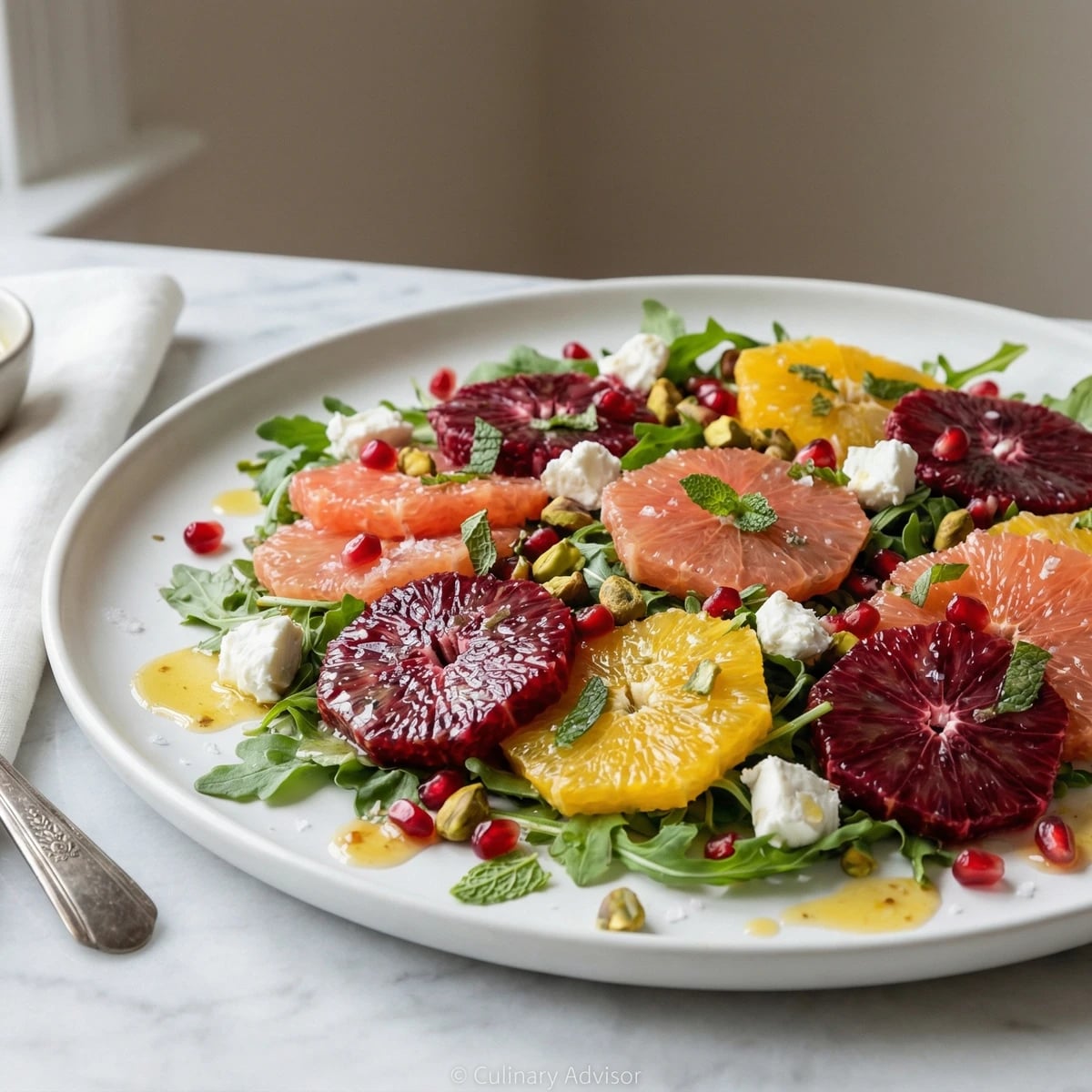
A composed winter salad of supremed blood oranges, ruby grapefruit, and navel segments scattered with pomegranate jewels, pistachios, and crumbled goat cheese over peppery arugula, dressed in a bright citrus vinaigrette.
Salads
Mediterranean
Holiday
35 min
Active Time
0 min cook•35 min total
Yield6 servings
When winter settles in and the produce aisles grow sparse, citrus arrives like a telegram from warmer climates. Blood oranges from Sicily, grapefruits from Texas, navels from California. This is the season's gift to those of us who cook with the calendar.
I first encountered this style of salad in a small restaurant outside Marseille, where the chef treated citrus with the reverence most reserve for truffles. She supremed each segment tableside, arranging them like stained glass on white plates. The lesson stayed with me: winter fruit deserves ceremony.
The technique here matters as much as the ingredients. Learn to supreme citrus properly and you'll wonder why you ever ate oranges any other way. Those membrane-free segments release their juice in your mouth rather than fighting against your teeth. Master the vinaigrette emulsion and you'll have a skill that transfers to a hundred other dressings.
This salad demands to be eaten immediately. The greens wilt, the citrus weeps, the magic fades. Make it for a holiday table, a dinner party, a Tuesday when you need beauty on your plate. Just don't make it ahead.
The technique, the tradition, and the story behind every dish.
Working over a bowl to catch juices, use a sharp knife to cut away the peel and white pith from each piece of citrus. Hold the fruit in your palm and slice along each membrane to release individual segments, letting them fall into the bowl. Squeeze the empty membranes over the bowl to extract every drop of juice. This technique, called supreming, gives you jewel-like segments without bitter pith. Reserve the juice separately for the dressing.
A flexible boning knife or sharp paring knife works best. The blade should glide along the membrane, not saw through it.
2
Extract pomegranate seeds
Score the pomegranate around its equator, cutting just through the skin without piercing the seeds. Hold each half over a bowl, cut side down, and strike the back firmly with a wooden spoon. The seeds will release in clusters. Pick out any clinging white membrane. You want about one cup of ruby seeds, each one a burst of tart sweetness waiting to happen.
Do this in the sink or over a large bowl. Pomegranate juice stains everything it touches, including your favorite shirt.
3
Build the vinaigrette base
In a small bowl, combine the minced shallot with champagne vinegar and let sit for ten minutes. This brief maceration softens the shallot's raw bite and begins the flavor exchange. Add one quarter cup of the reserved citrus juice, honey, Dijon mustard, fine salt, and several grinds of black pepper. Whisk until the honey dissolves completely.
The mustard is essential for emulsification. It contains compounds that help oil and acid form a stable bond rather than separating on contact.
4
Emulsify with oil
Set your bowl on a damp towel to hold it steady. Add the olive oil in a thin, steady stream while whisking constantly in a circular motion. Watch the transformation: the mixture will shift from thin and separated to thick and creamy, clinging to the whisk. This takes about ninety seconds of continuous whisking. The finished dressing should coat a spoon and hold together when you stop stirring.
If the dressing breaks and looks curdled, start fresh with a teaspoon of mustard in a clean bowl. Slowly whisk in the broken dressing as if it were oil.
5
Prepare the greens
Spread the arugula on a large platter or shallow serving bowl. Its peppery bite provides essential contrast to the sweet citrus. The greens should form a loose bed, not a compressed pile. Give them room to breathe.
Baby arugula offers the best balance of tenderness and pepper. Mature arugula can be too assertive. In a pinch, mix half arugula with half butter lettuce for a gentler base.
6
Arrange the citrus
Lift the citrus segments from their juice and arrange them over the greens in an artful scatter, mixing the blood oranges' deep crimson with the grapefruit's blush pink and the navel oranges' bright gold. Let some segments overlap, others stand alone. This is not a tossed salad. It is a composed plate where each element deserves to be seen.
7
Add texture and finish
Scatter the pomegranate seeds across the citrus, followed by the chopped pistachios and crumbled goat cheese. Tear the mint leaves and let them fall where they may. Drizzle two thirds of the vinaigrette over everything in long, sweeping motions. Finish with flaky salt. Serve the remaining dressing alongside for those who want more.
Dress the salad at the table, moments before serving. The acid in the vinaigrette will wilt the arugula within minutes. This salad does not wait.
Chef Tips
•Seek out blood oranges at their peak from December through March. The best ones come from California or imported from Sicily. Their crimson flesh ranges from streaked to solid burgundy depending on variety and cold exposure.
•Toast your pistachios in a dry skillet over medium heat for three minutes, shaking frequently, to amplify their flavor. Let them cool completely before adding to the salad or they'll wilt the greens.
•The vinaigrette ratio here is intentionally tart to stand up to the sweet fruit. Taste and adjust. Your citrus may be sweeter or more acidic than mine.
•For a more substantial meal, add shaved fennel or thinly sliced red onion soaked in ice water for ten minutes to remove its bite.
Advance Preparation
•Citrus can be supremed up to four hours ahead. Store segments in their juice, covered, in the refrigerator.
•Pomegranate seeds keep refrigerated in an airtight container for up to five days.
•The vinaigrette can be made up to three days ahead and refrigerated. Bring to room temperature and whisk vigorously before using, as it will separate.
•Do not assemble the salad until moments before serving. Once dressed, you have about five minutes before the arugula begins to wilt.
Frequently Asked Questions
Nutrition Information
1 serving (about 400g)
Calories
375 calories
Total Fat
23 g
Saturated Fat
2 g
Trans Fat
0 g
Unsaturated Fat
20 g
Cholesterol
22 mg
Sodium
127 mg
Total Carbohydrates
40 g
Dietary Fiber
6 g
Sugars
32 g
Protein
6 g
Where cooking meets culture.
Culinary guides, cultural storytelling, and the editorial depth that makes cooking meaningful.