
Chef Lupita
Almendrados Conventuales Poblanos
Puebla's convent almond cookies, made from blanched almonds, sugar syrup, egg yolks, canela, and patient hands, the kind of sweet that belongs beside coffee in talavera, not in a plastic bakery box.
A cooking platform built around craft, culture, and the stories behind what we eat.
Created by
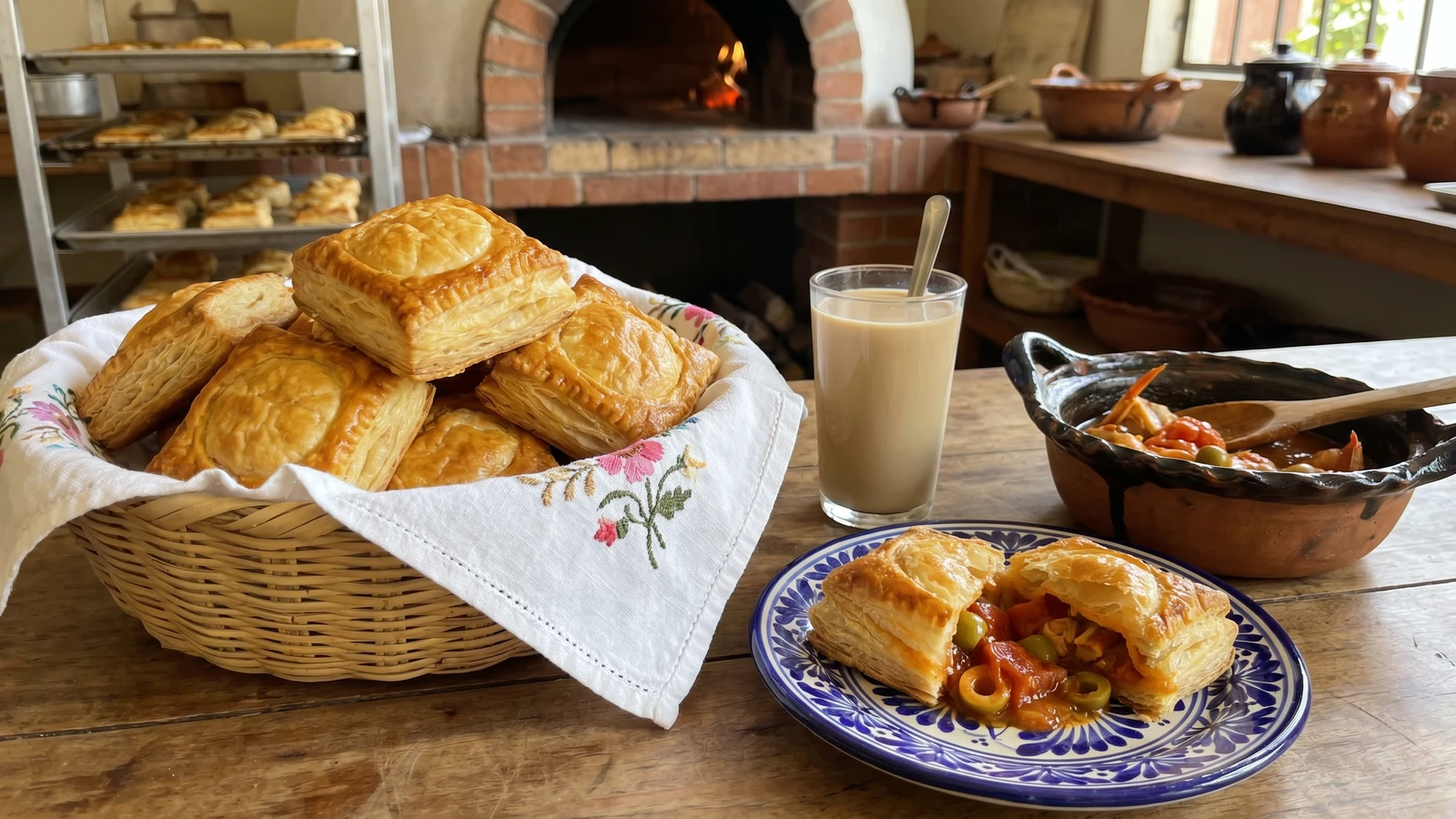
Veracruz port breakfast pastry, laminated hojaldre baked tall around jaiba guisada with tomato, chile jalapeño, olives, capers, and epazote, the kind sold from wicker baskets before the city is fully awake.
Veracruz, the port city on the Gulf in the Sotavento, is where these volovanes live. Not in a hotel buffet. Not under a white napkin. They come out at sunrise in wicker baskets, wrapped in cotton servilletas, carried through streets that still smell of salt, coffee, diesel, and panadería ovens.
The filling is jaiba guisada, crab cooked down with jitomate, white onion, garlic, chile jalapeño, olives, capers, Mexican oregano, and a little epazote. That combination tells you where you are. The jalapeño points inland toward Xalapa, the olives and capers remember the port, and the crab belongs to the Gulf. Cada estado, su propia cocina.
The pastry is French by ancestry and jarocho by adoption. Veracruz took the vol-au-vent and made it practical: a square of hojaldre, sealed around seafood, baked high, eaten from the hand with café lechero. The women who sell them know the rule better than any pastry chef: the filling must be cold and dry, the dough must stay cold, and the edges must not be crushed. Smash the layers and they will not rise. No me vengas con atajos.
My mother's notebook had no volován page. She was from Jalisco. I learned this one from a señora near the Mercado Hidalgo who corrected my first batch before I even put it in the oven. 'Más seco el guiso,' she said. Drier filling. She was right. Saber cocinar es saber vivir.
The French vol-au-vent entered Mexican baking through 19th-century French pastry practice, strengthened during the French Intervention of 1862 to 1867 and later through Porfirian panadería culture. Veracruz adapted the form to port ingredients, especially seafood fillings such as jaiba, atun, and minilla, turning a European pastry shell into a street breakfast sold from baskets. The chile jalapeño takes its name from Xalapa, Veracruz, and its use with tomato, olives, and capers places this filling firmly in the port's Spanish-Caribbean cooking tradition.
Quantity
3 1/2 cups, plus more for rolling
Quantity
1 1/2 teaspoons for dough, plus 1/2 teaspoon for filling and more to taste
Quantity
1 teaspoon
Quantity
1 pound
cut into 1/2-inch slabs
Quantity
1 cup
Quantity
1 teaspoon
Quantity
2 tablespoons
Quantity
1 small
finely chopped
Quantity
3
minced
Quantity
1
finely chopped
Quantity
1 pound
grated on the large holes of a box grater
Quantity
1
Quantity
1/2 teaspoon
Quantity
2 tablespoons
chopped
Quantity
1 tablespoon
rinsed and chopped
Quantity
1 pound
checked carefully for shell
Quantity
1 tablespoon
chopped
Quantity
1/4 teaspoon
Quantity
1 egg beaten with 1 tablespoon water and a pinch of salt
| Ingredient | Quantity |
|---|---|
| all-purpose flour | 3 1/2 cups, plus more for rolling |
| kosher salt | 1 1/2 teaspoons for dough, plus 1/2 teaspoon for filling and more to taste |
| granulated sugar | 1 teaspoon |
| cold unsalted buttercut into 1/2-inch slabs | 1 pound |
| ice water | 1 cup |
| fresh lime juice | 1 teaspoon |
| olive oil | 2 tablespoons |
| white onionfinely chopped | 1 small |
| garlic clovesminced | 3 |
| fresh chile jalapeñofinely chopped | 1 |
| jitomate guaje or Roma tomatoesgrated on the large holes of a box grater | 1 pound |
| bay leaf | 1 |
| dried Mexican oregano | 1/2 teaspoon |
| green oliveschopped | 2 tablespoons |
| capersrinsed and chopped | 1 tablespoon |
| picked cooked crab meat, preferably Gulf blue crabchecked carefully for shell | 1 pound |
| fresh epazotechopped | 1 tablespoon |
| freshly ground black pepper | 1/4 teaspoon |
| egg wash | 1 egg beaten with 1 tablespoon water and a pinch of salt |
Whisk the flour, salt, and sugar in a wide bowl. Add the cold butter slabs and toss until each piece is coated. Stir the lime juice into the ice water, then drizzle in just enough water to make a shaggy dough that holds when pressed. You should still see large pieces of butter. Do not knead it smooth. Smooth dough gives you bread, not hojaldre.
Pat the dough into a rectangle, wrap it, and chill 30 minutes. Roll it on a floured counter into a long rectangle about 10 by 20 inches. Fold it in thirds like a business letter, rotate it a quarter turn, and roll again. Give it two folds, then chill 45 minutes. Repeat until you have five folds total. The butter should stay firm and visible in thin sheets. If it smears, stop and chill the dough. Así se hace y punto.
Heat the olive oil in a wide cazuela or heavy skillet over medium heat. Add the onion and cook until translucent, about 5 minutes. Add the garlic and chile jalapeño and cook 1 minute more, just until the garlic smells sharp and sweet. Do not brown it. Burned garlic makes the whole filling taste tired.
Add the grated tomatoes, bay leaf, Mexican oregano, olives, capers, salt, and black pepper. Cook over medium heat, stirring often, until the tomato thickens and a spoon dragged through the pan leaves a clean path, 12 to 15 minutes. This is the step people rush. Then their volovanes leak. The guiso must be thick enough to sit on a spoon.
Fold in the crab meat and epazote. Cook 2 to 3 minutes, just long enough for the crab to take the tomato and chile flavor. Taste for salt. Remove the bay leaf. Spread the filling on a tray and refrigerate until completely cold, about 45 minutes. Warm filling melts the butter in the dough before the oven can do its work.
Line two baking sheets with parchment. Divide the chilled dough in half. Roll one half into a rectangle about 1/8 inch thick and cut twelve 4-inch squares. Repeat with the second half for twelve more squares. Keep the cut pastry cold while you work. Trim cleanly with a sharp knife, not a dull wheel that drags the layers shut.
Place twelve pastry squares on the baking sheets. Spoon about 2 tablespoons cold jaiba filling into the center of each. Brush the edges lightly with egg wash. Cover with the remaining squares and press the edges gently with your fingertips to seal. Do not crush them with a fork. Cut one small slit in the top of each volován so the filling can settle without bursting the pastry.
Refrigerate the assembled volovanes for 20 minutes while the oven heats to 425F. Brush the tops with egg wash, keeping it off the cut sides. Egg wash running down the sides glues the layers together. That is how you get flat pastry and disappointment.
Bake at 425F for 15 minutes, then reduce the oven to 375F and bake 12 to 15 minutes more, until the pastry is deeply golden, crisp at the corners, and dry on the bottom. Pale hojaldre is underbaked hojaldre. Let the volovanes rest 10 minutes before serving. The filling inside will be fierce.
Serve warm from a wicker basket lined with a clean cotton servilleta, or on blue-and-white talavera plates with café lechero. No cheddar, no sour cream, no lettuce. This is Veracruz, not a costume.
1 serving (about 135g)
Culinary guides, cultural storytelling, and the editorial depth that makes cooking meaningful.
Discover Culinary ExplorerChef Lupita
Puebla's convent almond cookies, made from blanched almonds, sugar syrup, egg yolks, canela, and patient hands, the kind of sweet that belongs beside coffee in talavera, not in a plastic bakery box.

Chef Lupita
Ciudad de Mexico's panaderia banderillas are long sticks of hojaldre pressed with sugar, baked until amber, and finished with a hard glaze for coffee at the kitchen table.

Chef Lupita
Mérida's pale egg-yolk-and-vanilla kisses, tiny cookies built on eight yolks and a perfume of orange blossom, sandwiched with guava paste and dusted heavy with powdered sugar.

Chef Lupita
Hidalgo's bisquet de nata carries Pachuca's mining history into the breakfast table: a Cornish-style bread softened by Mexican nata, split warm and eaten with café de olla.