
Chef Lupita
Acitrón de Cidra Conventual
Puebla's convent-style acitrón, made from cidra peel instead of endangered biznaga, built through repeated syrup soakings until the cubes turn firm, translucent, and ready for rosca or chiles en nogada.
A cooking platform built around craft, culture, and the stories behind what we eat.
Created by
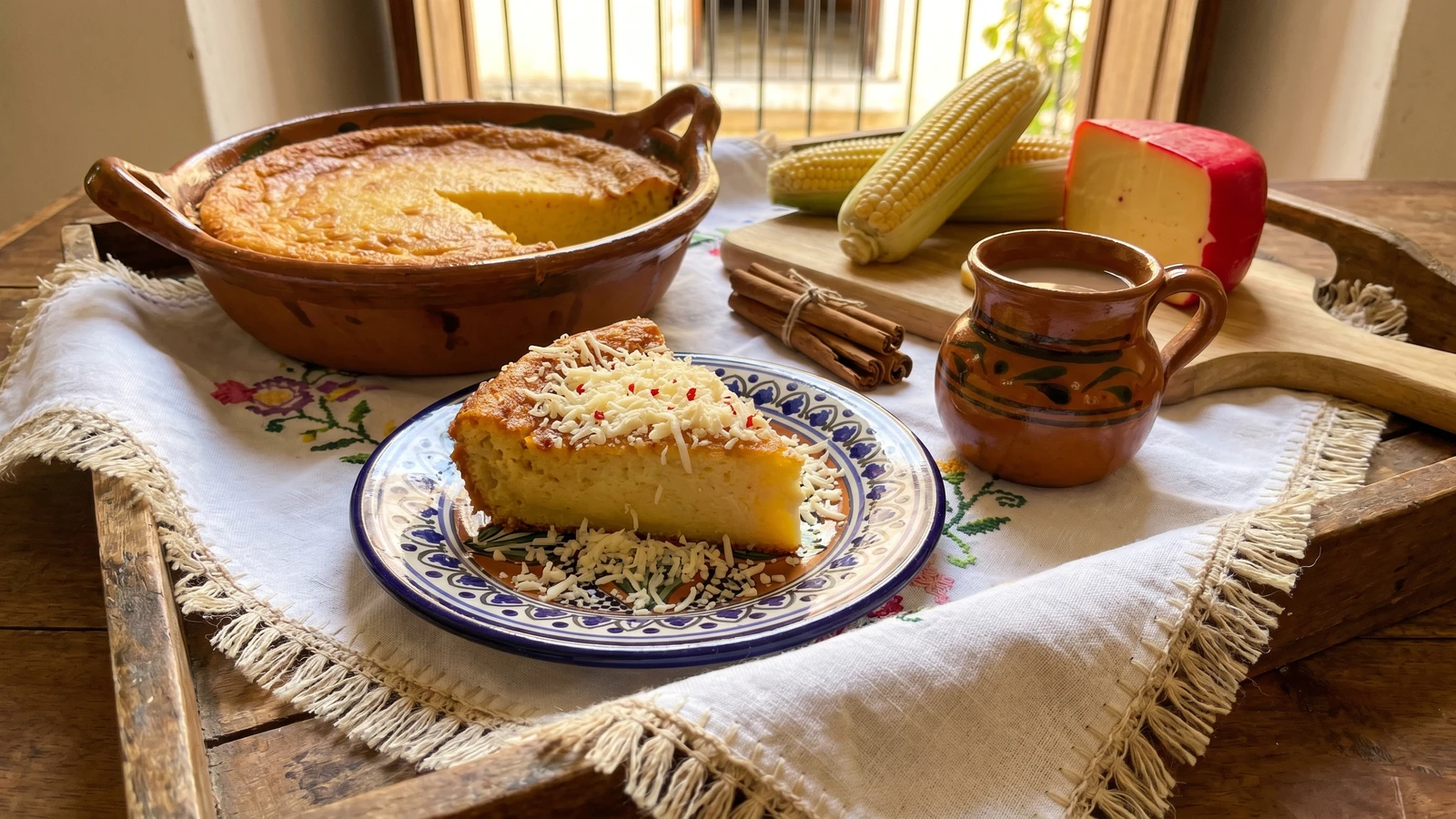
Yucatán's milk-corn custard cake, baked slow in a bain-marie until the center barely trembles, then crowned with grated queso de bola while still hot. The salty-sweet contrast Mérida's dulcerías built their name on.
This is from Yucatán. Not the Yucatán of tourist resorts and frozen margaritas. The Yucatán of Mérida's dulcerías, of the Lucas de Gálvez market, of the señoras who set out bandejas of dulces every afternoon and know exactly which one to recommend with which café. Torta de elote belongs to that world, and the queso de bola on top is not a garnish, it is the dish.
Queso de bola is Yucatecan Edam, the red wax-coated cheese that Dutch traders brought to the peninsula through the port of Sisal and that yucatecos absorbed into their cuisine so completely that nobody questions it anymore. You will see it grated over codzitos, melted inside queso relleno, and scattered hot across the top of this torta. The salt of the cheese cuts the sweetness of the milk corn. The richness of the cheese marries the custard underneath. Take the cheese away and the cake collapses into something ordinary. Cada estado, su propia cocina, and this state took a Dutch cheese and made it suyo.
The technique that matters here is the bain-marie. A torta de elote baked directly in a hot oven becomes corn bread, dense and dry at the edges. Baked slow in a water bath with a stick of canela perfuming the steam, it becomes a custard cake, the texture between flan and cake, set but still trembling when you pull it out. My mother did not make this dish. She was from Jalisco and her sweet tooth ran toward jericalla. But I learned this version from a señora named Doña Lupe Pacheco in a small dulcería off Calle 65 in Mérida, who watched me write down her recipe and told me, no me vengas con atajos, this cake takes the time it takes. She was right.
Use fresh elote when corn is in season. Out of season, find another dessert. A Mexican grandmother cooks with what the mercado is selling today, not with a freezer bag of yellow corn from last August. Saber cocinar es saber vivir.
Queso de bola arrived in Yucatán through 18th and 19th century maritime trade between the port of Sisal and Dutch merchant ships, part of the same Caribbean commerce that connected the peninsula more closely to Havana, New Orleans, and Rotterdam than to Mexico City. The peninsula's geographic isolation from central Mexico, separated by jungle and lacking rail connection until 1957, allowed Yucatecan cuisine to absorb Lebanese, Spanish, Maya, and Dutch influences into a regional kitchen that contemporary Mexican food historians like Diana Kennedy treated as essentially its own cuisine. Torta de elote with queso de bola sits squarely in this tradition: a pre-Columbian crop, elote tierno, bound into a Spanish-style custard cake and finished with a Dutch cheese the locals consider as Yucatecan as the limestone they build their houses from.
Quantity
6 cups
cut from about 8 ears of elote
Quantity
1 cup
Quantity
1 cup
Quantity
1/2 cup
Quantity
6
room temperature
Quantity
1 cup
melted and slightly cooled
Quantity
3/4 cup
Quantity
1/2 cup
Quantity
1/4 cup
Quantity
1 tablespoon
Quantity
1 teaspoon
Quantity
1 teaspoon
Quantity
1
for the bain-marie water
Quantity
1 cup
finely grated, plus more for serving
Quantity
as needed
| Ingredient | Quantity |
|---|---|
| fresh sweet corn kernelscut from about 8 ears of elote | 6 cups |
| whole milk | 1 cup |
| sweetened condensed milk | 1 cup |
| evaporated milk | 1/2 cup |
| large eggsroom temperature | 6 |
| unsalted buttermelted and slightly cooled | 1 cup |
| granulated sugar | 3/4 cup |
| fine corn masa harina | 1/2 cup |
| all-purpose flour | 1/4 cup |
| baking powder | 1 tablespoon |
| fine sea salt | 1 teaspoon |
| Mexican vanilla extract | 1 teaspoon |
| cinnamon stick (canela de Ceylan)for the bain-marie water | 1 |
| queso de bola (Edam)finely grated, plus more for serving | 1 cup |
| butter for greasing the pan | as needed |
Use fresh elote, not frozen and not canned. The corn does the work in this cake and a tired kernel gives you a tired torta. In Yucatán the cooks use elote tierno, young milk-stage corn that gives off a starchy white liquid when you press a kernel with your thumbnail. If you press a kernel and the juice runs clear like water, the corn is too mature. If it runs milky white, you have what you need. Si no conoces el mercado, no conoces la cocina.
Heat the oven to 325°F (165°C). Generously butter a 10-inch round or 9x13-inch ceramic baking dish, the deeper the better. Set a kettle of water to heat. Place the canela stick in a larger roasting pan that the baking dish will sit inside. The cinnamon in the water bath perfumes the cake from underneath as it bakes. This is a Mérida dulcería trick. Así se hace y punto.
Place the corn kernels, whole milk, condensed milk, and evaporated milk in a blender. Blend on high for about two minutes. You want a thick, pale yellow puree with visible flecks of corn skin. Do not strain it. Those flecks give the torta its texture and tell the eater this came from real elote, not a box.
In a large bowl, whisk the eggs with the sugar until pale and slightly thickened, about a minute. Pour in the melted butter in a steady stream while whisking. Add the vanilla. Pour in the corn puree from the blender and whisk to combine. In a separate bowl, sift together the masa harina, flour, baking powder, and salt. Add the dry mixture to the wet in three additions, whisking gently after each. The batter will be loose, almost like a thick crepe batter. That is correct. This is a custard cake, not a sponge.
Pour the batter into the buttered dish. Set the dish inside the roasting pan with the canela stick. Pull out the oven rack and place the roasting pan on it. Carefully pour the hot kettle water around the baking dish until it comes one inch up the sides. Slide the rack back in. Bake for 60 to 75 minutes. The torta is ready when the edges are deep golden, the center is set but still trembles when you nudge the pan, and a knife inserted two inches from the edge comes out clean. The very center should still be moist. It firms as it cools.
While the torta is still hot from the oven, scatter the grated queso de bola evenly across the top. The residual heat will soften the cheese into a salty, faintly tangy blanket that melts into the sweet custard underneath. This contrast is the entire point of the dish. Without the queso de bola you have a sweet corn cake. With it, you have a torta yucateca.
Let the torta cool in its dish for at least 30 minutes before cutting. Hot from the oven it will fall apart. Warm and rested, it holds a clean square. Serve at room temperature or barely warm, with more grated queso de bola passed at the table for those who want to add their own. A small cup of café de olla on the side is how a señora in Mérida would finish the meal. Recetas probadas y garantizadas.
1 serving (about 224g)
Culinary guides, cultural storytelling, and the editorial depth that makes cooking meaningful.
Discover Culinary ExplorerChef Lupita
Puebla's convent-style acitrón, made from cidra peel instead of endangered biznaga, built through repeated syrup soakings until the cubes turn firm, translucent, and ready for rosca or chiles en nogada.

Chef Lupita
Ciudad de México's Tulyehualco alegría is popped huautli folded into piloncillo honey, pressed with peanuts, pepitas, and raisins, then cut into the rectangular bars that built a pueblo's identity.

Chef Lupita
Oaxaca's pre-Columbian amaranth bar, popped on a hot comal and bound with piloncillo, honey, and the sacred Zapotec grain that the Spanish tried, and failed, to outlaw.

Chef Lupita
Querétaro's mercado candy of popped amaranto pressed with dark piloncillo syrup, pepitas, pecans, and cacahuate, a Bajío sweet that respects the seed before it decorates the table.