
Chef Lupita
Agua de Alfalfa
Ciudad de México's highland market agua fresca, fresh alfalfa blended with pineapple and lime until bright green, strained clean, and poured cold from the vitrolero.
A cooking platform built around craft, culture, and the stories behind what we eat.

Created by
Boca del Río's torito jarocho: tart yellow jobo from the Sotavento coast blended with raw cane spirit, condensed milk, and ice. The cane is the spine, the fruit is the brightness, and the kick earns the name little bull.
Atorito is from Boca del Río. That's the port town at the mouth of the Jamapa River, where the water meets the Gulf just below the city of Veracruz. Not a cocktail bar. A jarocho cantina with a marble counter, a slow ceiling fan, and a blender that has seen ten thousand batches.
People hear condensed milk and they decide this is a soft, sweet drink. They're wrong. The spine of a torito is aguardiente de caña, raw cane spirit, and it has a kick. That's why it's called a little bull. The milk and the fruit ride on top of the alcohol. They don't replace it. No me vengas con atajos, don't pour in half the aguardiente and call it a torito.
The jobo is what makes this one veracruzano to the bone. It's a small yellow fruit, Spondias mombin, that grows along the Sotavento coast and turns the color of ripe mango when it's ready. Tart, almost sour, with a big seed and barely any flesh, which is why you simmer the fruit and press the pulp through a sieve. That tartness is the whole point. It cuts the condensed milk so the drink stays bright instead of turning into dessert.
My mother was from Jalisco. She never made a torito in her life. I learned this one the only way you can, on a plastic stool in Boca del Río, watching a woman blend batch after batch while the regulars argued over whether jobo or guanábana makes the better one. I wrote her measurements on a napkin and I still have it. Cada estado, su propia cocina, and this cup belongs to Veracruz.
The torito was born in the cantinas of Boca del Río, Veracruz, in the mid-20th century, where the harsh local aguardiente de caña was softened with fruit pulp and condensed milk into a drink whose kick earned it the name 'little bull.' The jobo, Spondias mombin, is native to tropical Mesoamerica and was eaten across the Gulf coast for centuries before the Spanish arrived. The drink's cane-spirit base ties it to the sugar economy of central Veracruz and the Afro-Mexican communities of the Sotavento, whose presence was formally recognized in the Mexican Constitution in 2019 and recorded in the national census of 2020.
Quantity
2 pounds (about 2 cups pulp), or 2 cups frozen jobo pulp
Quantity
1 cup
for simmering the jobo
Quantity
1 cup
Quantity
1 can (14 ounces)
Quantity
1 cup
Quantity
4 cups
| Ingredient | Quantity |
|---|---|
| ripe jobo (yellow Spondias mombin) | 2 pounds (about 2 cups pulp), or 2 cups frozen jobo pulp |
| water (optional)for simmering the jobo | 1 cup |
| aguardiente de caña | 1 cup |
| sweetened condensed milk (leche condensada) | 1 can (14 ounces) |
| evaporated milk (leche evaporada) | 1 cup |
| ice | 4 cups |
Pick through the jobos and keep the ones that have gone fully yellow and give a little when you press them. Green ones are too tart and too firm to surrender their pulp. Rinse them under cold water. You need about two pounds to end up with two cups of pulp, because most of a jobo is seed.
Put the jobos in a saucepan with one cup of water. Bring to a gentle simmer over medium heat and cook for eight to ten minutes, until the skins split and the flesh goes soft. If your jobos are very ripe and already soft, skip this and mash them raw. Let them cool until you can handle them.
Work the softened jobos through a fine-mesh sieve set over a bowl, pressing with the back of a spoon. The pulp and juice go through. The big seeds and the skins stay behind. Scrape the underside of the sieve so you don't waste any. You should have about two cups. Chill it if you have the time.
Put your tallest glasses in the freezer. A torito belongs in a cold glass, frosted white, the way the cantinas pour it. A warm glass kills the froth and the drink goes flat in minutes.
Combine the chilled jobo pulp, the aguardiente de caña, the condensed milk, the evaporated milk, and the ice in the blender. Blend on high until thick, smooth, and frothy, about a minute. Taste it. It should hit you tart and creamy at the same time, with the cane spirit rising underneath. If your fruit was very sour, add a little more condensed milk. If it leans sweet, a splash more aguardiente.
Pour into the frosted glasses right away, foamy head and all. A torito waits for nobody. It separates as it sits, so serve it the moment it leaves the blender. Así se hace y punto.
1 serving (about 355g)
Culinary guides, cultural storytelling, and the editorial depth that makes cooking meaningful.
Discover Culinary ExplorerChef Lupita
Ciudad de México's highland market agua fresca, fresh alfalfa blended with pineapple and lime until bright green, strained clean, and poured cold from the vitrolero.
Chef Lupita
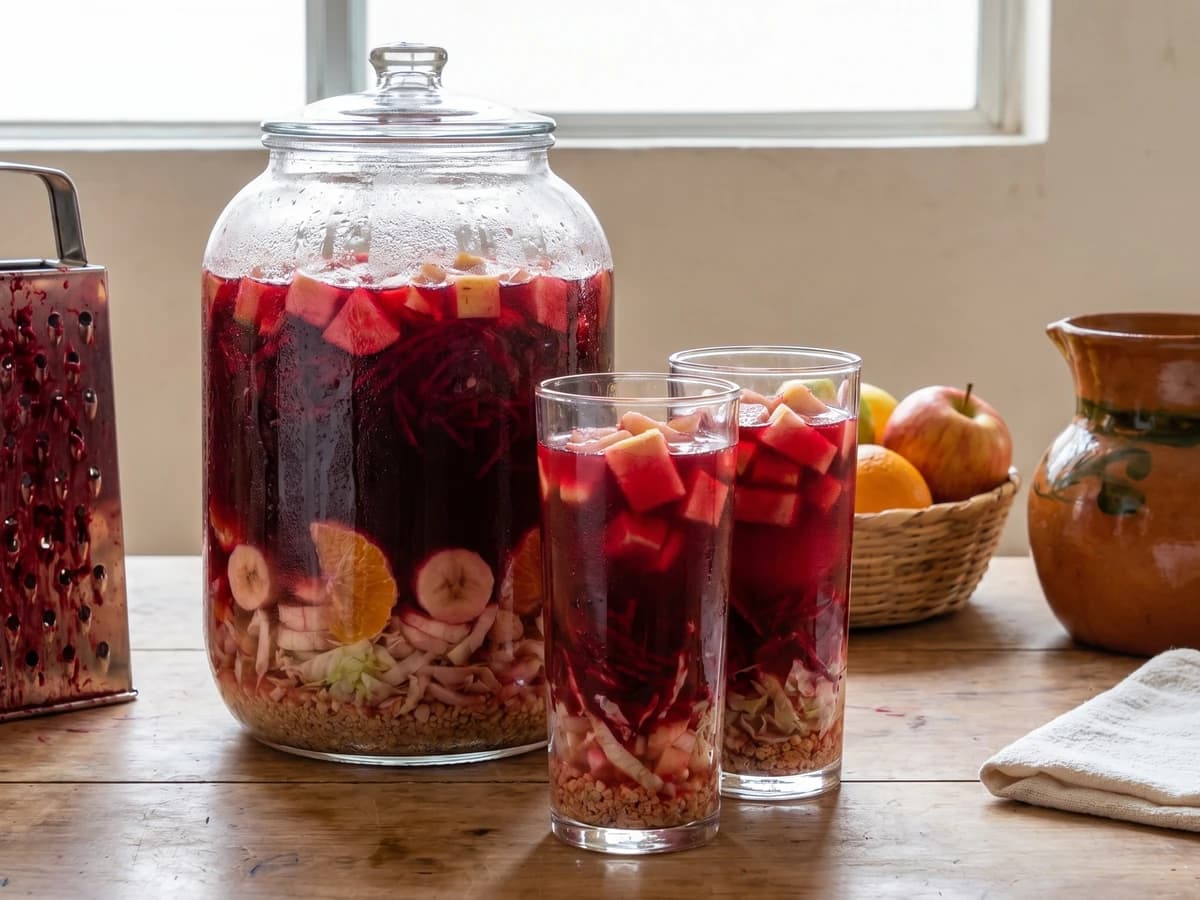
Aguascalientes' Lenten agua fresca, jewel-red from cooked beet and full of apple, banana, orange, lettuce, and ground peanuts, served cold when Holy Week meets the Feria de San Marcos.

Chef Lupita
Sonora and Sinaloa's creamy malted barley water, built on toasted cebada perla, Mexican canela, vanilla from Papantla, and evaporated milk. Pink-beige, rich, and served cold over heavy ice in a heavy glass tumbler. Liquid cookie comfort the northwest way.

Chef Lupita
Yucatán's everyday tonic of boiled chaya leaves blended with lima agria, sugar, and ice. The bright green jarra that sits on every Peninsula table from Mérida to Valladolid.