
Chef Jeong-sun
Agwi-jjim (Braised Monkfish with Bean Sprouts)
Firm monkfish buried under crisp soybean sprouts, minari, and a red gochugaru sauce thickened at the end; Masan's market dish asks for heat, timing, and a steady hand.
A cooking platform built around craft, culture, and the stories behind what we eat.
Created by
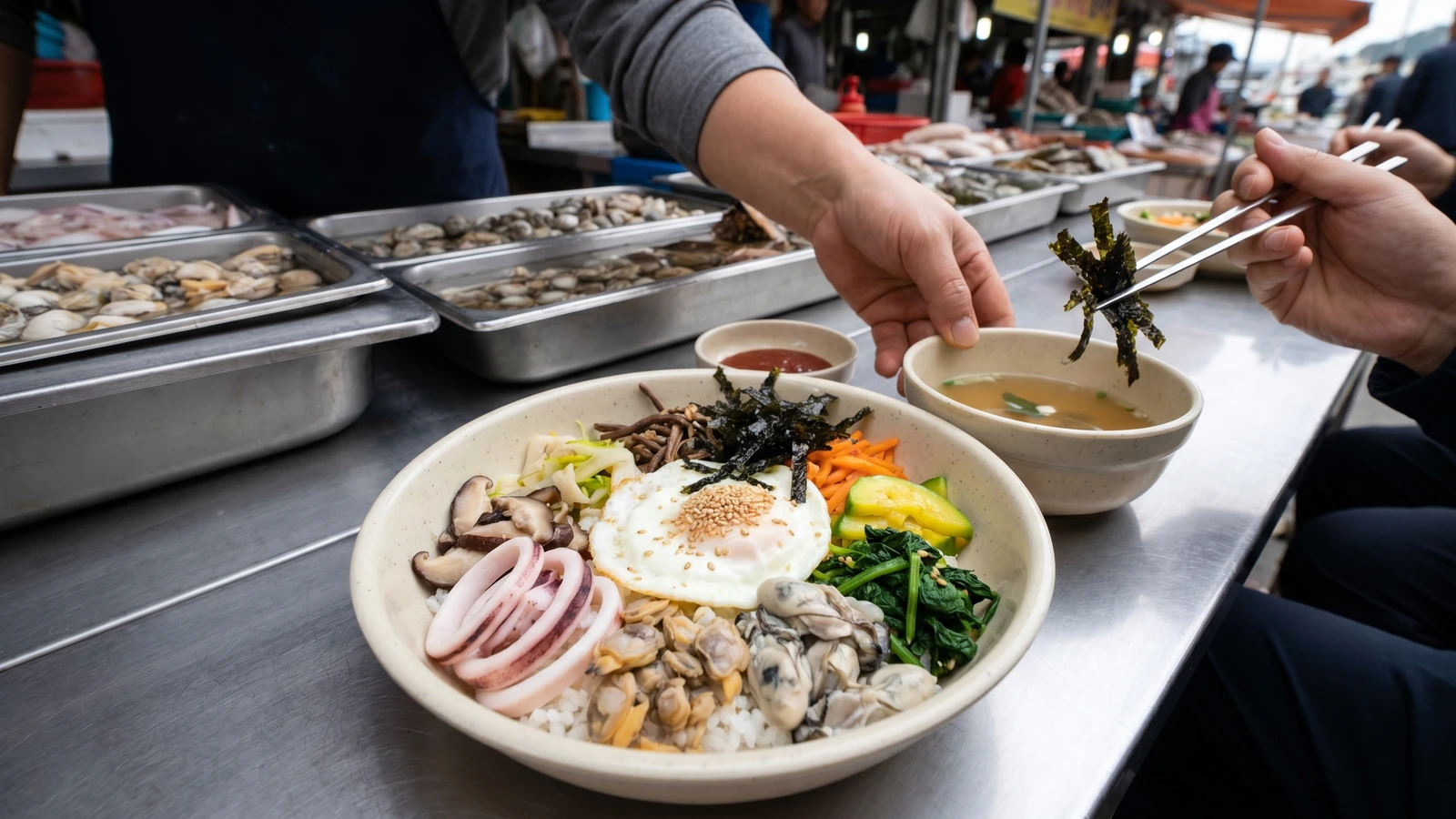
The southern port's bibimbap, built from boats and market baskets: warm rice, blanched shellfish, seasoned namul, and a clear broth served beside the bowl.
Tongyeong eats from the sea first. In that port market, the bowls of clams, squid, oysters in winter, and sea squirt in spring tell you what the rice should carry before any recipe does. Cook the month you're standing in. A bibimbap from Tongyeong should taste like a coastal table, not like gochujang hiding everything under one red blanket.
This dish lives or dies by restraint. Blanch the seafood only until it tightens, then cool it. Season each namul (seasoned vegetable) alone in its own bowl, because spinach wants sesame and almost no soy, bean sprouts want salt and time, and zucchini wants a quick pan and a light hand. If you season them as one crowd, the bowl becomes muddy. Season them separately, and the rice carries clear voices.
Notebook 43 says the mistake is sauce before tasting. Put the cho-gochujang (vinegared chili paste) on the side and add it by the half-spoon, because Tongyeong's seafood is the point. Tonight this asks for a little organization: broth first, rice cooking, vegetables in order, seafood last. It is not hard, but it is exact. Write it down. Memory is a borrowed bowl.
Tongyeong, on the southern coast of Gyeongsangnam-do, grew around fishing, shipyards, and port markets, and its local bibimbap reflects that harbor life more than the beef and brass-bowl style associated with Jeonju. The city's mixed rice often includes seasonal seafood such as oysters, clams, squid, or sea squirt, with namul and a clear guk served alongside, so the bowl changes with the catch. It belongs to the same regional family as other southern coastal rice dishes where the sea, not meat, supplies the center.
Quantity
2 cups
rinsed until the water runs nearly clear
Quantity
2 1/4 cups
Quantity
4 cups
Quantity
1 piece, about 4 inches square
Quantity
10
heads and guts removed
Quantity
1/2 teaspoon, plus more as needed
Quantity
200g
scrubbed and soaked in salted water
Quantity
200g
cleaned and cut into thin strips
Quantity
150g
gently rinsed and drained
Quantity
1 tablespoon
Quantity
200g
Quantity
150g
trimmed
Quantity
1 small
cut into thin matchsticks
Quantity
1 small
cut into thin matchsticks
Quantity
6
thinly sliced
Quantity
1 cup
soaked and cooked, cut into 2-inch lengths
Quantity
3 tablespoons, divided
Quantity
3 cloves
minced, divided
Quantity
3 tablespoons, divided
Quantity
2 1/2 tablespoons, divided
Quantity
2 tablespoons, divided
Quantity
1/2 teaspoon, divided
Quantity
4
Quantity
2 sheets
cut into thin strips
Quantity
2
thinly sliced
Quantity
3 tablespoons
Quantity
1 1/2 tablespoons
Quantity
1 tablespoon maesil-cheong or 2 teaspoons sugar
Quantity
1 tablespoon
Quantity
1 teaspoon
| Ingredient | Quantity |
|---|---|
| short-grain white ricerinsed until the water runs nearly clear | 2 cups |
| water for cooking rice | 2 1/4 cups |
| water for broth | 4 cups |
| dried kelp (dasima) | 1 piece, about 4 inches square |
| large dried anchovies (myeolchi)heads and guts removed | 10 |
| salt for broth | 1/2 teaspoon, plus more as needed |
| small clams or cocklesscrubbed and soaked in salted water | 200g |
| squidcleaned and cut into thin strips | 200g |
| oysters (optional)gently rinsed and drained | 150g |
| rice wine | 1 tablespoon |
| soybean sprouts (kongnamul) | 200g |
| spinachtrimmed | 150g |
| zucchini (aehobak)cut into thin matchsticks | 1 small |
| carrotcut into thin matchsticks | 1 small |
| fresh shiitake mushroomsthinly sliced | 6 |
| fernbrake (gosari)soaked and cooked, cut into 2-inch lengths | 1 cup |
| neutral oil | 3 tablespoons, divided |
| garlicminced, divided | 3 cloves |
| soup soy sauce (guk-ganjang) | 3 tablespoons, divided |
| toasted sesame oil | 2 1/2 tablespoons, divided |
| toasted sesame seeds | 2 tablespoons, divided |
| fine sea salt | 1/2 teaspoon, divided |
| eggs | 4 |
| roasted gim (seaweed)cut into thin strips | 2 sheets |
| scallionsthinly sliced | 2 |
| gochujang (Korean chili paste) | 3 tablespoons |
| rice vinegar | 1 1/2 tablespoons |
| maesil-cheong (green plum syrup) or sugar | 1 tablespoon maesil-cheong or 2 teaspoons sugar |
| reserved anchovy-kelp broth | 1 tablespoon |
| toasted sesame oil for sauce | 1 teaspoon |
Cook the rinsed rice with 2 1/4 cups water in a rice cooker or heavy pot. When it is done, let it rest 10 minutes before opening, then fluff it gently. Bibimbap needs warm rice with separate grains, not wet rice, because the namul and seafood will bring their own moisture.
Put 4 cups water, the kelp, and the cleaned anchovies in a pot over medium heat. Pull the kelp out as soon as the water reaches a simmer, because kelp left too long turns the broth slick and bitter. Simmer the anchovies 10 minutes more, strain, and season with 1/2 teaspoon salt. Keep 1 tablespoon for the sauce and serve the rest warm on the side.
Bring 3 cups water and 1 tablespoon rice wine to a gentle boil. Blanch the clams or cockles until they open, 2 to 4 minutes, then lift them out and remove the meat. Blanch the squid 45 to 60 seconds, only until it turns opaque and curls. If using oysters, lower the heat and poach them 30 to 45 seconds, just until the edges firm. Cool the seafood on a plate and discard any clams that do not open.
Put the soybean sprouts in a pot with 1/2 cup water. Cover, bring to a boil, and cook 6 minutes without lifting the lid. Drain, then season in its own bowl with 1/2 teaspoon minced garlic, 1 teaspoon soup soy sauce, 1 teaspoon sesame oil, 1 teaspoon sesame seeds, and a small pinch of salt. Taste one sprout. It should be nutty and clean, with the crunch still there.
Blanch the spinach in boiling water for 20 to 30 seconds, then rinse cold and squeeze firmly. Cut into short lengths. Season in its own bowl with 1/2 teaspoon minced garlic, 1 teaspoon soup soy sauce, 1 teaspoon sesame oil, and 1 teaspoon sesame seeds. Spinach collapses quickly, so squeeze it well or it will water down the rice.
Heat 1 tablespoon oil in a skillet. Cook the zucchini with a pinch of salt for 1 to 2 minutes, just until flexible, then move it to its own bowl and season with 1/2 teaspoon sesame oil. Add 1/2 tablespoon oil and cook the carrot 2 minutes with a pinch of salt, keeping it bright and slightly firm. These two are not side dishes by themselves here; they are color, sweetness, and texture for the mixed bowl.
Add 1/2 tablespoon oil to the skillet and cook the shiitake with 1 teaspoon soup soy sauce until glossy and tender, about 3 minutes. Move them aside. Add the last 1 tablespoon oil, the gosari, 1 teaspoon minced garlic, and 1 tablespoon soup soy sauce, and cook 4 to 5 minutes until the fernbrake tastes seasoned through. Gosari needs more soy than the tender greens, which is why it gets its own pan time.
Stir together the gochujang, rice vinegar, maesil-cheong or sugar, 1 tablespoon reserved broth, and 1 teaspoon sesame oil. This is cho-gochujang, a bright vinegared chili paste. Serve it on the side. Start each bowl with 1 tablespoon, then add more only after tasting, because the seafood should still read as itself.
Fry the eggs sunny-side up or over easy. Keep the yolks soft if your table likes them that way, because the yolk rounds the sauce and helps the rice mix. For a firmer weeknight bowl, cook them through; the dish will still stand.
Divide the warm rice among 4 wide bowls. Arrange the soybean sprouts, spinach, zucchini, carrot, shiitake, gosari, and seafood in separate small piles over the rice. Set an egg in the center, scatter gim and scallion over the top, and serve the cho-gochujang and warm clear broth beside each bowl. Mix at the table, gently at first, so the seafood does not break.
1 serving (about 590g)
Culinary guides, cultural storytelling, and the editorial depth that makes cooking meaningful.
Discover Culinary ExplorerChef Jeong-sun
Firm monkfish buried under crisp soybean sprouts, minari, and a red gochugaru sauce thickened at the end; Masan's market dish asks for heat, timing, and a steady hand.

Chef Jeong-sun
A quick Korean rice bowl built on contrast: warm rice, cold popping flying-fish roe, chopped vegetables, gim, sesame oil, and the crisp rice bottom a hot stone bowl gives you.

Chef Jeong-sun
Andong's guest noodles, wheat and roasted soybean flour rolled thin, boiled and rinsed cold, then set in a clear chilled anchovy broth with careful strips of beef, egg, and cucumber.

Chef Jeong-sun
Andong's ritual-table rice served on an ordinary day: separate soy-sesame namul, warm rice, and clear radish soup, mixed without gochujang so every vegetable keeps its own voice.