
Chef Dimitra
Agrafa Batzina (Μπατζίνα), Courgette and Feta Pie
Agrafa's batzina is the no-phyllo pie of Karditsa: grated courgette, feta, eggs, milk, and flour poured thin into a hot oiled tapsi.
A cooking platform built around craft, culture, and the stories behind what we eat.
Created by
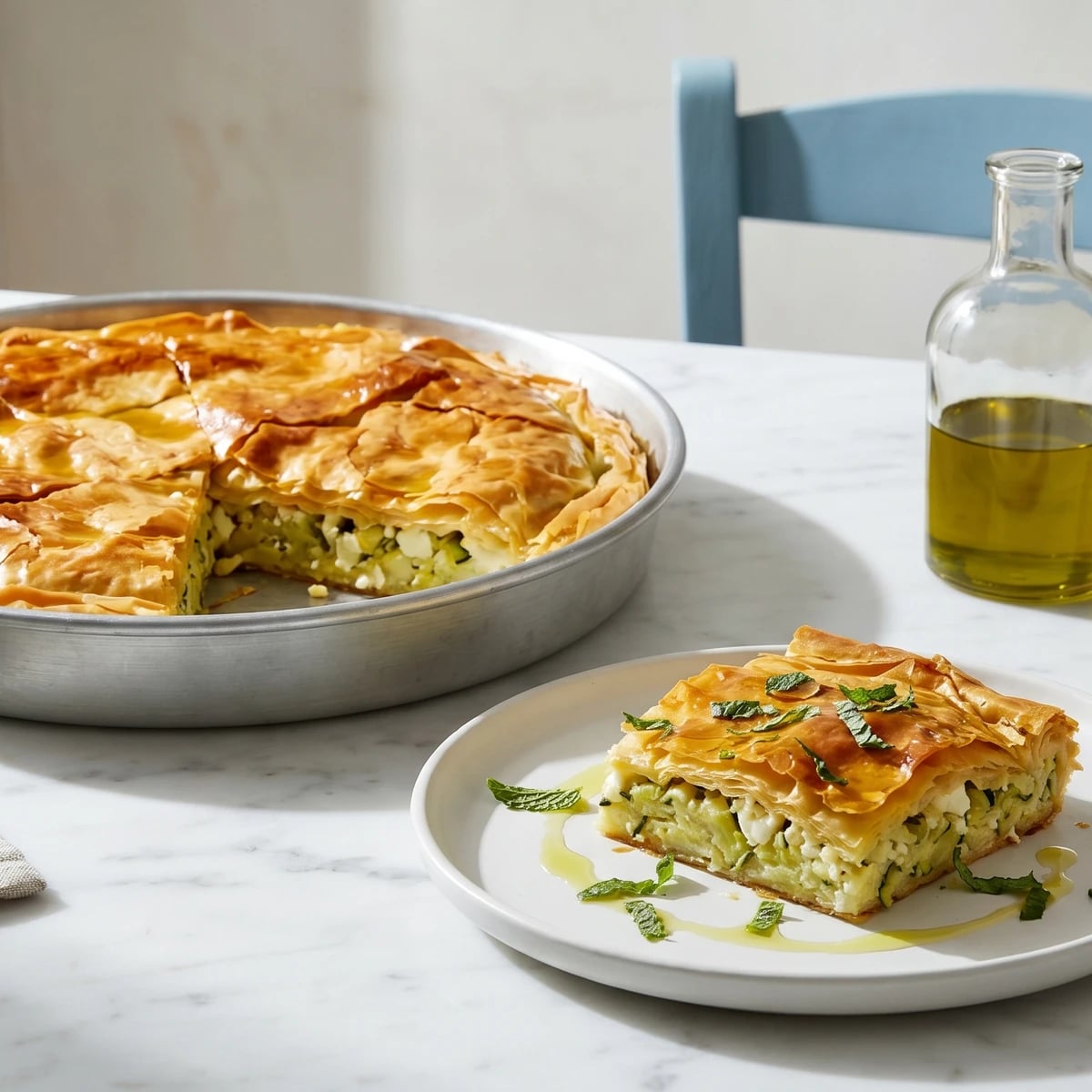
Thessalian kolokithopita is summer courgette pie with feta, mint, and crisp phyllo. Drain the squash hard, and the whole pan behaves.
Thessalian kolokithopita is the summer courgette pie of the mainland table: grated squash, feta, mint, dill, and phyllo baked in a tapsi until the top is crisp and the filling is soft but not wet. The region is the dish's surname. In Thessaly, pies are not decoration for a feast. They are supper, lunch, breakfast the next day, and something to send with a child wrapped in paper.
The one rule is not romantic. Salt the grated courgette and wring it dry. Courgettes carry a great deal of water, and if you leave that water in the bowl, it has only one place to go: into the bottom sheets. Drain it hard, then the feta can stay creamy, the herbs stay bright, and the phyllo bakes instead of steaming itself soft.
Use good feta, not the rubbery white block that tastes only of salt, and use mint while it still smells alive. I keep the filling plain on purpose. I don't invent it. I find it, I test it, I write it down. A proper kolokithopita needs courgette, cheese, herbs, oil, and patience. Λίγα και καλά, a few things, and good ones.
Kolokithopita belongs to the mainland pita tradition of Thessaly and Epirus, where thin pastry turned seasonal vegetables, cheese, and a little grain into a full meal. Courgettes entered Greek kitchen gardens after New World squashes moved through early modern trade routes, but by the nineteenth century they were ordinary summer food. The small addition of semolina or rice in many household versions is not filler; it is the old cook's way of catching the last moisture from the squash.
Quantity
1.2kg
coarsely grated
Quantity
12g
for draining the courgettes
Quantity
450g
thawed
Quantity
350g
crumbled
Quantity
120g
Quantity
3
beaten
Quantity
80ml
plus more for the pan
Quantity
6
finely sliced
Quantity
20g
chopped
Quantity
15g
chopped
Quantity
40g
Quantity
1 teaspoon
| Ingredient | Quantity |
|---|---|
| courgettes (kolokithakia)coarsely grated | 1.2kg |
| fine sea saltfor draining the courgettes | 12g |
| phyllo pastrythawed | 450g |
| Greek fetacrumbled | 350g |
| Greek yogurt | 120g |
| large eggsbeaten | 3 |
| extra virgin olive oilplus more for the pan | 80ml |
| spring onionsfinely sliced | 6 |
| fresh mint leaveschopped | 20g |
| fresh dillchopped | 15g |
| fine semolina or short-grain rice | 40g |
| freshly ground black pepper | 1 teaspoon |
Put the grated courgettes in a colander, toss with the salt, and leave them for 30 minutes. Then gather them in a clean kitchen towel and twist hard over the sink until the water runs out, more than you think is polite. This is the step that decides the pie. Wet courgette turns the bottom phyllo soft and heavy, while drained courgette bakes sweet and clean.
Heat the oven to 180C. In a wide bowl, mix the drained courgette with feta, yogurt, eggs, spring onions, mint, dill, semolina or rice, black pepper, and 2 tablespoons of the olive oil. Taste carefully, because feta brings its own salt. The filling should smell green and sharp, with the mint coming forward.
Oil a 30cm round tapsi or a 23 by 33cm baking pan. Lay in half the phyllo sheets one at a time, brushing each sheet lightly with olive oil and letting the edges climb the sides of the pan. Keep the unused sheets covered with a barely damp towel so they stay supple.
Spread the courgette filling evenly over the phyllo base, right into the corners, without pressing it down into a paste. Fold any overhanging edges over the filling. Lay the remaining phyllo sheets on top, brushing each with oil, then tuck the edges down inside the pan.
Score the top into 8 generous pieces with a sharp knife, cutting through the top layers but not dragging through the filling. Brush with the last of the olive oil and sprinkle the surface with a few drops of water. Bake for 50 to 55 minutes, until the top is deep gold, the edges pull slightly from the pan, and the phyllo crackles when tapped.
Let the kolokithopita rest at least 20 minutes before cutting. Hot from the oven, the filling is still loose. Warm or room temperature, it settles into clean squares and the feta, mint, and courgette taste like themselves.
1 serving (about 225g)
Culinary guides, cultural storytelling, and the editorial depth that makes cooking meaningful.
Discover Culinary Explorer
Chef Dimitra
Agrafa's batzina is the no-phyllo pie of Karditsa: grated courgette, feta, eggs, milk, and flour poured thin into a hot oiled tapsi.

Chef Dimitra
Zagori's flour pie skips phyllo completely: a loose egg-and-flour batter, crumbled feta, and a hot buttered tapsi that makes the edges crisp.

Chef Dimitra
Hydra and Andros give amygdalota their island surname: ground almond, sugar, egg white, and rosewater, baked pale so the center stays soft as marzipan.

Chef Dimitra
Asia Minor ekmek kataifi is built in three clear layers: crisp syruped kataifi, thick semolina custard, and cold kaimaki cream under pistachios.