Culinary Explorer

A cooking platform built around craft, culture, and the stories behind what we eat.
Discover Culinary Explorer
Telera Poblana

Telera Poblana

Created by

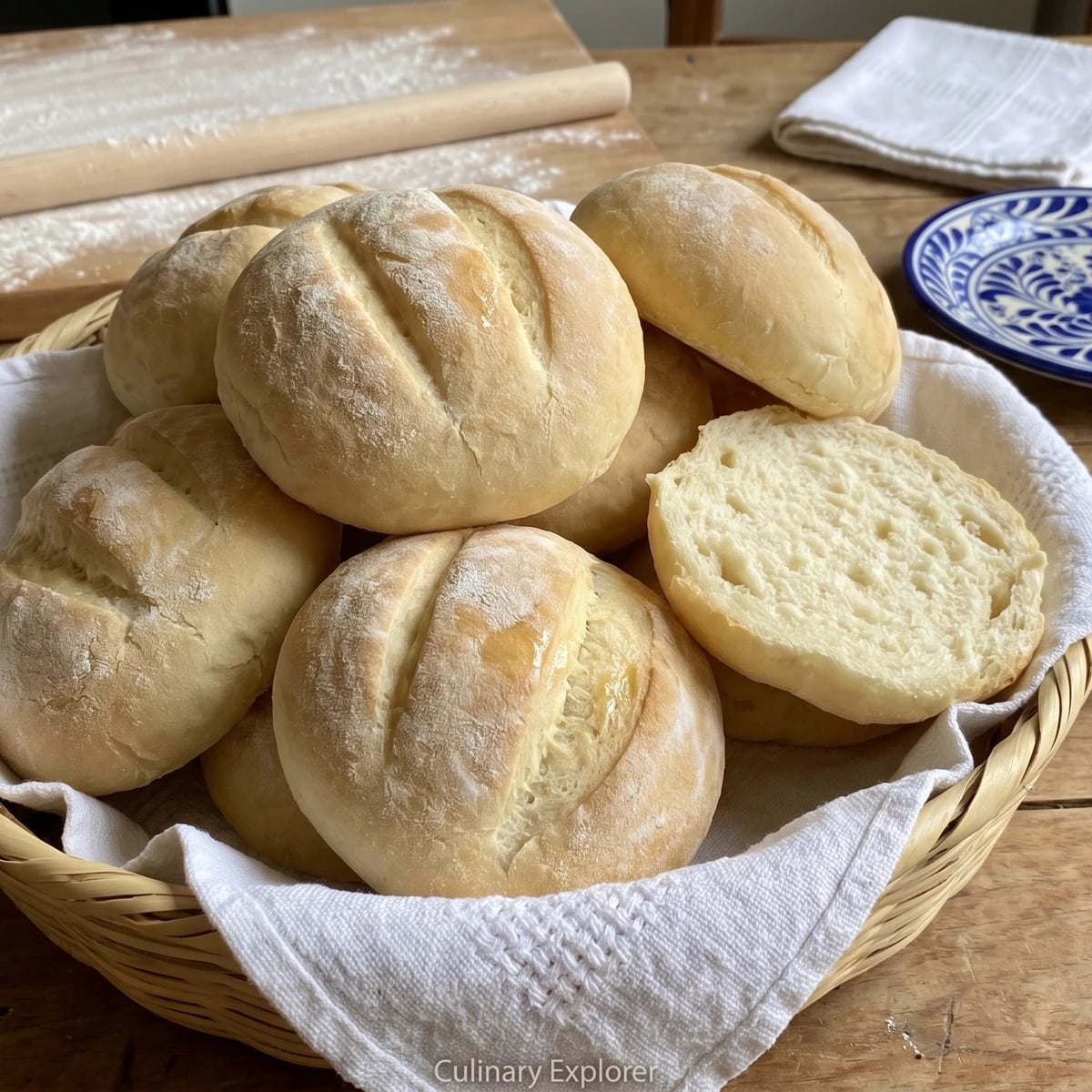
Puebla's central-highland telera is a soft, flat wheat roll marked into three sections, built to hold a real torta without tearing, collapsing, or pretending to be a bolillo.

Breads
Mexican
Budget Friendly
Batch Cooking
Make Ahead
35 min
Active Time
18 min cook3 hr 20 min total
Yield10 teleras

Puebla, in the central highlands, is where this telera makes sense: wheat country, bakery discipline, and tortas that need a roll flatter and softer than a bolillo. This is pan de sal for working kitchens, for school lunches, for market counters where the filling is heavy and the bread has to do its job without drama.

The ingredient that defines telera is not chile. It is wheat flour handled with patience, enough water for a tender crumb, and manteca de cerdo for softness. Don't confuse this with cemita poblana, the sesame-topped roll with its own pride and its own rules. Telera has three sections pressed into the dough, a matte crust, and a crumb that can take beans, avocado, milanesa, salsa roja, and still close around the filling.

I learned the shaping from a panadera near Mercado La Acocota who pressed the grooves with the handle of a wooden spoon and told me, without looking up, that shallow lines are for people who don't understand bread. She was right. The oven erases timid work. Press deep, proof correctly, bake pale. No me vengas con atajos.

Set these in a palm basket lined with a cotton servilleta, with Talavera plates on the table if you want Puebla in the room. This is a 32-state cuisine, and even the everyday bread has geography. Cada estado, su propia cocina.

Wheat arrived in central Mexico after the Spanish conquest, and Puebla, founded in 1531 on the road between Veracruz and Mexico City, became an important milling and baking center because grain, commerce, convent kitchens, and European baking techniques met there. In the 19th century, French-trained and French-influenced bakers helped refine Mexico's pan blanco tradition, including the bolillo and the flatter telera used for tortas. The telera's two pressed channels distinguish it from both the crustier bolillo and Puebla's sesame-topped cemita, a reminder that central Mexican breads are related, but not interchangeable.

The technique, the tradition, and the story behind every dish.

Discover Culinary Explorer

Ingredients

bread flour or Mexican harina panadera

Quantity

500 grams (about 4 cups plus 2 tablespoons)

plus more for dusting

warm water

Quantity

315 grams (1 1/3 cups)

95F to 100F

instant yeast

Quantity

2 1/4 teaspoons

granulated sugar

Quantity

1 tablespoon

fine sea salt

Quantity

2 teaspoons

manteca de cerdo

Quantity

2 tablespoons

softened, plus more for greasing the bowl

Equipment Needed

  • Kitchen scale for dividing even rolls
  • Large mixing bowl or stand mixer with dough hook
  • Wooden spoon handle or clean 1/2-inch dowel for pressing the grooves
  • Heavy baking sheet or panaderia-style charola
  • Woven cotton servilleta for holding the baked rolls

Instructions

  1. 1

    Start the sponge

    In a large bowl, mix 1 cup of the flour with the yeast, sugar, and 3/4 cup of the warm water. Stir until you have a loose paste. Cover and let it stand for 20 to 25 minutes, until the surface looks bubbly and smells faintly sweet. This short esponja gives the bread better flavor than dumping everything together like you are mixing cement.

  2. 2

    Mix the dough

    Add the remaining flour, remaining warm water, softened manteca de cerdo, and salt. Mix until the dough comes together in a rough mass. The lard is not decoration. It softens the crumb and gives the telera the tenderness a torta roll needs. Many modern panaderias use vegetable shortening because it is cheap. At home, use good manteca. La manteca es el sabor.

  3. 3

    Knead until smooth

    Knead by hand for 10 to 12 minutes, or in a stand mixer with the dough hook for 6 to 7 minutes on medium-low. The dough should become smooth, elastic, and just a little tacky. If it sticks heavily to your hands, dust in flour one tablespoon at a time. Do not make it stiff. A dry telera splits badly and eats like yesterday's bread.

  4. 4

    Let it rise

    Grease a clean bowl lightly with manteca. Set the dough inside, turn it once, cover, and let it rise in a warm place for 60 to 75 minutes, until doubled. Press it gently with one finger. If the mark fills back slowly, the dough is ready. If it springs back hard, give it more time. Bread follows the room, not your impatience.

  5. 5

    Divide and rest

    Turn the dough onto a lightly floured board. Divide it into 10 equal pieces, about 85 grams each. Shape each piece into a tight ball by tucking the edges underneath. Cover with a cloth and rest for 10 minutes. This relaxes the gluten so you can form the oval without fighting the dough.

  6. 6

    Shape the teleras

    Flatten each ball into a squat oval about 5 inches long and 3 inches wide. Dust the handle of a wooden spoon or a clean dowel with flour. Press two deep lengthwise lines into each oval, dividing it into three raised sections. Press almost to the board without cutting through. Shallow marks disappear in the oven. Deep marks give you a telera. Así se hace y punto.

    The three-section shape is not decoration. It helps the bread open cleanly for tortas and keeps the crumb from bulging too high like a bolillo.
  7. 7

    Proof the rolls

    Set the shaped teleras on a floured baking sheet, leaving space between them. Cover with a clean cloth and proof for 35 to 45 minutes, until puffy but still holding their grooves. Heat the oven to 425F while they proof. If your kitchen is cold, give them more time. If your kitchen is hot, watch them closely. Overproofed telera collapses when you touch it.

  8. 8

    Bake pale gold

    Brush the rolls lightly with water. Bake for 15 to 18 minutes, rotating the pan once, until the crust is pale golden and the bottoms sound hollow when tapped. Do not chase a dark crust. Telera is softer than bolillo and flatter by design. If you bake it until it crackles, you missed the point.

  9. 9

    Cool and fill

    Move the teleras to a rack and cool at least 20 minutes before slicing. Split horizontally with a serrated knife, leaving one edge attached if you want the torta to hold together. Fill with refried beans, milanesa, pierna adobada, avocado, queso fresco, pickled jalapenos, or whatever the torteria in your neighborhood would recognize. Recetas probadas y garantizadas.

Chef Tips

  • Use bread flour if you are outside Mexico. Mexican harina panadera has enough strength to hold the shape. Weak all-purpose flour works in a hurry, but the crumb tears more easily under a heavy torta filling. That is a compromise, not an upgrade.
  • The manteca de cerdo matters. It keeps the bread tender and gives the crumb a quiet richness. If you use vegetable shortening, the bread will still rise, but it will taste flatter. Now you know why the old panaderias smelled better.
  • Press the grooves deeper than feels polite. The dough will rise and soften the marks. If you only scratch the surface, you will pull smooth oval rolls from the oven and call them telera by wishful thinking.
  • Do not sprinkle sesame seeds on telera. That belongs to cemita poblana. Puebla knows the difference, and so should you.
  • Teleras are best the day they are baked. For tortas ahogadas or very wet fillings, toast the cut sides on a comal so the crumb can stand up to the sauce.

Advance Preparation

  • For overnight dough, reduce the yeast to 1 teaspoon. Mix and knead the dough, then refrigerate it covered for 8 to 12 hours after the first 30 minutes of room-temperature rest. Shape and proof the next day.
  • Baked teleras keep wrapped in a clean cloth for 1 day at room temperature. For longer storage, freeze them once cooled, then reheat in a 325F oven until the crust softens and the crumb comes back to life.
  • If making tortas for a crowd, bake the teleras in the morning and slice them only when you are ready to fill. Pre-sliced bread dries faster. La cocina no es decoración, es trabajo.

Frequently Asked Questions

Nutrition Information

1 serving (about 80g)

Calories
210 calories
Total Fat
3 g
Saturated Fat
1 g
Trans Fat
0 g
Unsaturated Fat
2 g
Cholesterol
2 mg
Sodium
460 mg
Total Carbohydrates
38 g
Dietary Fiber
1 g
Sugars
1 g
Protein
6 g

Note: Chef personas and recipes are created with AI assistance. Cook with care: follow safe food-handling practices, check doneness with a thermometer when needed, and adapt for allergies and your kitchen.

Where cooking meets culture.

Culinary guides, cultural storytelling, and the editorial depth that makes cooking meaningful.

Discover Culinary Explorer

More from Central Mexican Breads

Browse the full collection