
Chef Lupita
Agua de Alfalfa
Ciudad de México's highland market agua fresca, fresh alfalfa blended with pineapple and lime until bright green, strained clean, and poured cold from the vitrolero.
A cooking platform built around craft, culture, and the stories behind what we eat.
Created by
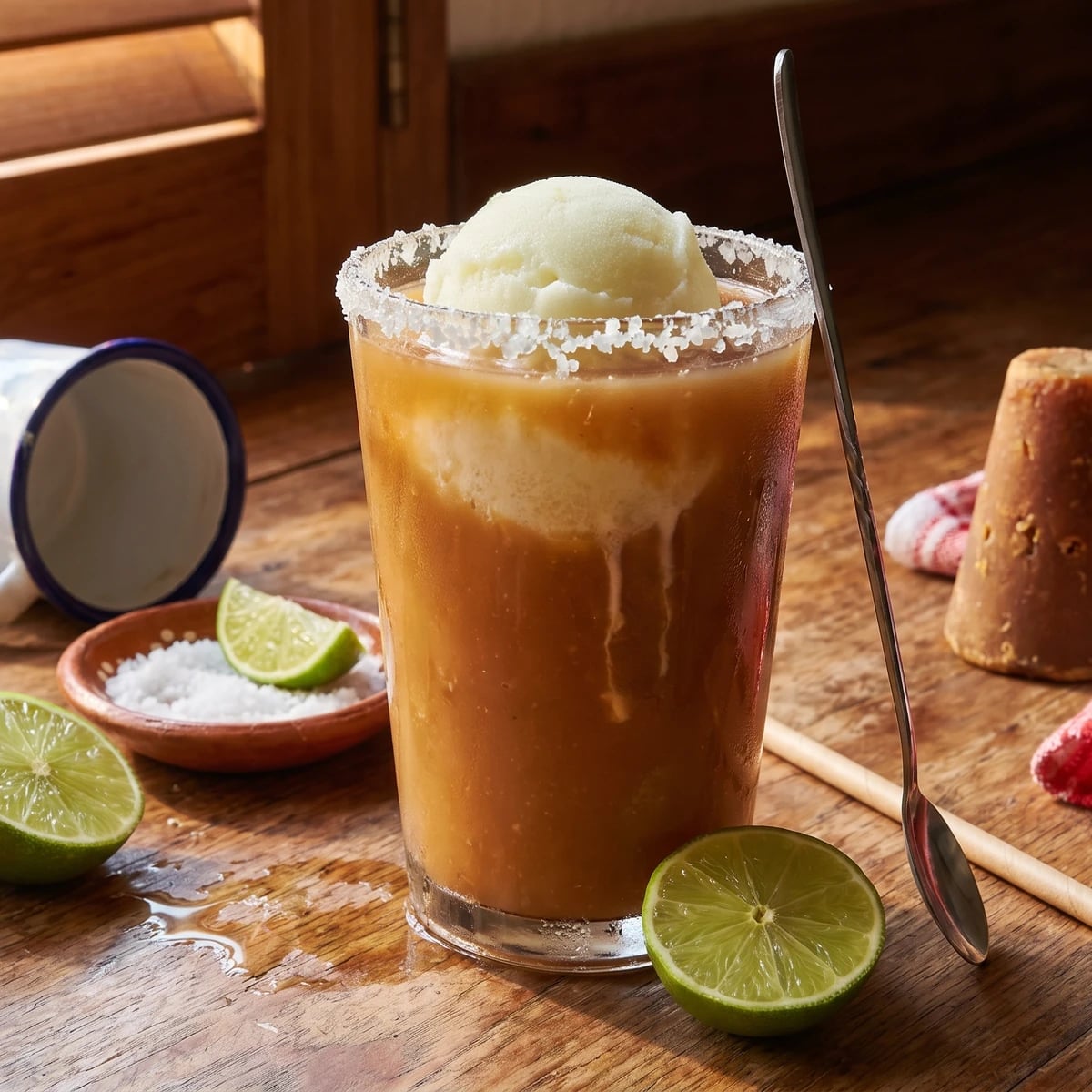
Sinaloa's cold fermented corn-masa drink, sweetened with piloncillo, sharpened with lime and sea salt, and crowned with a scoop of lime nieve that melts down into the glass as you drink it.
Tejuino is from northwest Mexico, and the version with nieve de limón on top belongs to Sinaloa. You find it on street corners in Culiacán, Mazatlán, Los Mochis, served from carts and from coolers parked under umbrellas, poured into a heavy glass with a salt rim and a scoop of lime sorbet floating on the surface. The vendor squeezes a fresh limón mexicano over the top, throws in a pinch of sea salt, and hands it to you with a long spoon. You eat the nieve and drink the tejuino and the two meet in the middle of the glass.
This is fermented corn. Masa, piloncillo, water, canela, cooked into a thick base and then left on the counter for a day or two until the wild yeasts in the masa wake up and turn it gently sour. It is not alcoholic in any serious way, the ferment is short and shallow, but it has the soft fizz and the deep tang that no fresh atole can match. The salt at the rim, the sharpness of the limón mexicano, and the cold sweetness of the nieve are not decoration. They are the dish. Remove any one of them and you have made something less.
A word about the names. The Yaqui and Tarahumara peoples of the northwest make tesgüino, a sacred fermented corn drink that belongs to ceremony, and it is not the same beverage as the street tejuino sold in glass cups in Sinaloa. The everyday tejuino in this recipe is the home-cook and street-vendor version, descended from but distinct from the indigenous original. Respect the difference. Esto no es comida de un solo Mexico.
My notebook from the 2014 trip through Sinaloa has a page from a vendor named Doña Rosario who worked a corner across from the Mercado Pino Suárez in Mazatlán for forty years. She told me three things. The masa has to be fresh. The salt has to be coarse on the rim and fine in the glass. And the nieve has to be made with limón mexicano, never Persian lime, because the small green-yellow lime is what makes it taste like Sinaloa. Recetas probadas y garantizadas.
Tejuino's name and method descend from tesgüino, the sacred fermented maize drink of the Rarámuri (Tarahumara) and Yaqui peoples of the Sierra Madre Occidental, which has been prepared for centuries in ceremonial contexts using sprouted or nixtamalized corn fermented over days. The Spanish encountered tesgüino throughout the northwest in the 16th and 17th centuries and noted its central role in indigenous communal labor and religious life. The secular street version known as tejuino, served cold with lime, salt, and eventually nieve de limón, evolved in Jalisco, Colima, and Sinaloa during the 19th and 20th centuries as urban vendors adapted the indigenous ferment into a brief, low-alcohol refreshment sold by the glass. Sinaloa's specific innovation of crowning the drink with a scoop of lime sorbet became codified at coastal mercados in Mazatlán and Culiacán by mid-century, where the heat of the Pacific lowlands made the cold-on-cold pairing logical and the proximity to the citrus groves of the coastal valleys made limón mexicano cheap and abundant.
Quantity
1 cup
or 1 cup masa harina mixed with 3/4 cup warm water
Quantity
8 ounces (about 1 large cone)
chopped
Quantity
6 cups, divided
Quantity
1 stick (about 3 inches)
Quantity
1/2 teaspoon, plus more for serving
Quantity
4 to 6
juiced, plus more to taste
Quantity
for serving
Quantity
6 to 8 generous scoops
recipe below
Quantity
2 cups
Quantity
1 cup
Quantity
1 cup (from about 12 to 15 limones mexicanos)
Quantity
from 2 limes
Quantity
pinch
| Ingredient | Quantity |
|---|---|
| fresh masa for tortillas (masa de nixtamal)or 1 cup masa harina mixed with 3/4 cup warm water | 1 cup |
| piloncillochopped | 8 ounces (about 1 large cone) |
| water | 6 cups, divided |
| Mexican canela | 1 stick (about 3 inches) |
| fine sea salt | 1/2 teaspoon, plus more for serving |
| limones mexicanosjuiced, plus more to taste | 4 to 6 |
| coarse sea salt for rimming | for serving |
| nieve de limónrecipe below | 6 to 8 generous scoops |
| water (for nieve) | 2 cups |
| granulated sugar (for nieve) | 1 cup |
| fresh lime juice (for nieve) | 1 cup (from about 12 to 15 limones mexicanos) |
| zest of limones mexicanos (for nieve) | from 2 limes |
| fine sea salt (for nieve) | pinch |
Two days before you plan to serve, start with the nieve de limón. In a small saucepan, combine 2 cups water with the sugar and bring to a gentle simmer. Stir until the sugar dissolves completely, about three minutes. Pull off the heat and let it cool to room temperature. The base needs to be cold before the lime goes in, or the acid will turn cloudy and dull.
Stir the lime juice, lime zest, and pinch of salt into the cold syrup. Taste it. It should be bracingly sour with a clean sweet edge underneath. If it tastes shy, add another tablespoon of juice. Pour into an ice cream maker and churn according to your machine. If you do not have one, pour into a shallow metal pan, freeze for one hour, then rake with a fork every 30 minutes for the next three hours. You want a coarse, granita-style nieve, not a creamy sorbet. The street vendors in Mazatlán scoop it from a wooden tub with a flat paddle, and the texture is closer to shaved ice than to gelato.
The day before you serve, start the tejuino. In a heavy pot, whisk the masa with 1 cup of cold water until completely smooth. No lumps. Lumps in the base mean a gritty tejuino, and a gritty tejuino tells the drinker the cook did not pay attention. Add the remaining 5 cups water, the chopped piloncillo, and the stick of canela. Place over medium heat and bring to a simmer, whisking often.
Reduce the heat to medium-low and cook for 30 to 40 minutes, whisking every few minutes so the masa does not stick to the bottom. The mixture will thicken into something between an atole and a thin porridge, and the color will deepen from pale beige to a rich caramel from the piloncillo. Taste it. It should be sweet, faintly smoky from the unrefined sugar, with the soft corn flavor underneath. Stir in the 1/2 teaspoon salt off the heat.
Pour the cooked base into a clean glass or food-grade plastic container. Cover loosely with a clean cloth or a lid set ajar, never sealed. Air has to move. Let it sit at room temperature on a kitchen counter for 24 to 48 hours. The wild yeasts in the masa will do the work. You are not making alcohol here, you are making the gentle, slightly sour, very faintly fizzy ferment that gives tejuino its character. The cooler the room, the longer it takes. In Culiacán in summer it is ready in a day. In a cold kitchen, give it two.
Once the ferment tastes right, give it a stir, transfer to the refrigerator, and chill for at least four hours. The cold sharpens the flavor and tightens the body. Tejuino is a cold drink. Warm tejuino is atole, and that is a different beverage from a different state.
Run a lime wedge around the rim of a tall heavy glass and dip the rim in coarse sea salt. Pour the cold tejuino in until the glass is two-thirds full. Squeeze in the juice of half a limón mexicano per serving, sprinkle a pinch of fine salt directly into the drink, and stir once. Now the crown: lay a generous scoop of nieve de limón on top so it sits half-submerged. The nieve melts slowly into the tejuino and the drink keeps shifting flavor as you work down the glass. Serve with a long spoon and a thick straw. You eat the top, you drink the bottom. Asi se hace y punto.
1 serving (about 415g)
Culinary guides, cultural storytelling, and the editorial depth that makes cooking meaningful.
Discover Culinary Explorer
Chef Lupita
Ciudad de México's highland market agua fresca, fresh alfalfa blended with pineapple and lime until bright green, strained clean, and poured cold from the vitrolero.

Chef Lupita
Aguascalientes' Lenten agua fresca, jewel-red from cooked beet and full of apple, banana, orange, lettuce, and ground peanuts, served cold when Holy Week meets the Feria de San Marcos.

Chef Lupita
Sonora and Sinaloa's creamy malted barley water, built on toasted cebada perla, Mexican canela, vanilla from Papantla, and evaporated milk. Pink-beige, rich, and served cold over heavy ice in a heavy glass tumbler. Liquid cookie comfort the northwest way.

Chef Lupita
Yucatán's everyday tonic of boiled chaya leaves blended with lima agria, sugar, and ice. The bright green jarra that sits on every Peninsula table from Mérida to Valladolid.