
Chef Lupita
Agua de Alfalfa
Ciudad de México's highland market agua fresca, fresh alfalfa blended with pineapple and lime until bright green, strained clean, and poured cold from the vitrolero.
A cooking platform built around craft, culture, and the stories behind what we eat.

Created by
Jalisco's street-corner tejuino, made from lightly fermented nixtamalized corn and piloncillo, served cold with lime, sea salt, and a scoop of nieve de limon.
Jalisco owns this glass in the public imagination, especially Guadalajara, where tejuino vendors stand in the heat with buckets of fermented corn, piloncillo, lime, salt, and nieve de limon. This is the drink of plazas, mercados, school exits, and afternoons when the pavement gives back the sun.
The ingredient that matters is nixtamalized corn masa. Not cornstarch. Not corn syrup. Masa. The same corn body that gives you tortillas gives tejuino its weight, its faint grit, its dignity. The piloncillo sweetens it with dark cane flavor, and the short fermentation gives it that sour edge that makes you keep drinking even when the glass is almost empty.
I learned to respect tejuino from women in Guadalajara who could judge a batch by smell before tasting it. Too young and it is just sweet atole. Too old and it turns sharp in the wrong direction. The good one sits in the middle: corn, cane, lime, salt, cold nieve melting on top. No me vengas con atajos. The fermentation is the point.
My mother was from Jalisco, and in her notebook she wrote only this for tejuino: 'masa buena, poco agrio, mucha lima.' Good masa, a little sour, plenty of lime. She was right. Saber cocinar es saber vivir.
Tejuino is part of western Mexico's older family of fermented corn drinks, with deep roots in Nahua and other Indigenous corn cultures where nixtamalized maize was eaten, drunk, and fermented according to need and occasion. The version served with nieve de limon became strongly associated with Guadalajara's street vendors in the 20th century, when ice, sorbet carts, and urban mercado culture turned a fermented corn drink into a cold public refreshment. Jalisco claims it loudly, but Nayarit, Colima, and parts of Michoacan also have tejuino traditions, proof again that this is a 32-state cuisine with regional borders that overlap at the market stall.
Quantity
1 pound
Quantity
10 cups
divided
Quantity
12 ounces
chopped
Quantity
1 small
Quantity
1/2 teaspoon, plus more for serving
Quantity
1/3 cup, plus lime wedges for serving
Quantity
4 cups
for serving
Quantity
for serving
Quantity
pinch for each glass
| Ingredient | Quantity |
|---|---|
| fresh nixtamalized corn masa for tortillas | 1 pound |
| waterdivided | 10 cups |
| piloncillochopped | 12 ounces |
| Mexican cinnamon stick | 1 small |
| kosher salt | 1/2 teaspoon, plus more for serving |
| fresh Mexican lime juice | 1/3 cup, plus lime wedges for serving |
| lime sorbet or nieve de limonfor serving | 4 cups |
| ice (optional) | for serving |
| flaky sea salt (optional) | pinch for each glass |
Combine 4 cups of the water, the chopped piloncillo, cinnamon stick, and 1/2 teaspoon kosher salt in a heavy pot. Bring to a simmer over medium heat, stirring until the piloncillo dissolves into a dark brown syrup. The smell should be caramel, cane, and warm corn market air. Remove the cinnamon stick.
In a large bowl, whisk the fresh masa with 4 cups of the remaining water until smooth. Use your hand if the whisk fights you. Masa has a body and it needs to be broken up properly. If you leave lumps now, they will stay lumps later.
Pour the loosened masa into the piloncillo syrup, whisking constantly. Cook over medium-low heat for 15 to 20 minutes, stirring with a wooden spoon, until the mixture thickens like a loose atole and the raw masa smell disappears. Scrape the bottom often. Corn catches when the cook gets lazy.
Take the pot off the heat and whisk in the final 2 cups water. Let the mixture cool to room temperature. Do not cover it tight while it is hot. You want it cooled before fermentation begins, not trapped under condensation like a forgotten pot.
Transfer the cooled mixture to a clean clay jar, glass jar, or food-safe plastic container. Cover with a clean cloth or loose lid and leave at room temperature for 18 to 24 hours, until it tastes lightly tangy and smells like sweet corn, piloncillo, and a little sourness. This is fermentation, not neglect. If your kitchen is very hot, start tasting at 12 hours.
Stir in the fresh lime juice. Taste. It should be sweet first, then corn, then sour at the edge. Add a small pinch more salt if the flavor feels flat. Salt is not decoration here. It makes the piloncillo and lime speak clearly.
Refrigerate the tejuino until cold, at least 2 hours. Before serving, whisk it well. If it has thickened too much, loosen it with cold water, 1/4 cup at a time, until it pours like a thick agua fresca. Guadalajara vendors stir it constantly for a reason. Corn settles. The spoon corrects it.
Fill tall glasses halfway with ice. Pour in the cold tejuino, leaving room at the top. Add one scoop of lime sorbet or nieve de limon to each glass, squeeze a little lime over it, and finish with a pinch of flaky sea salt. Stir once or twice so the nieve starts to melt into the tejuino and make that creamy froth. Serve immediately. Así se hace y punto.
1 serving (about 500g)
Culinary guides, cultural storytelling, and the editorial depth that makes cooking meaningful.
Discover Culinary ExplorerChef Lupita
Ciudad de México's highland market agua fresca, fresh alfalfa blended with pineapple and lime until bright green, strained clean, and poured cold from the vitrolero.
Chef Lupita
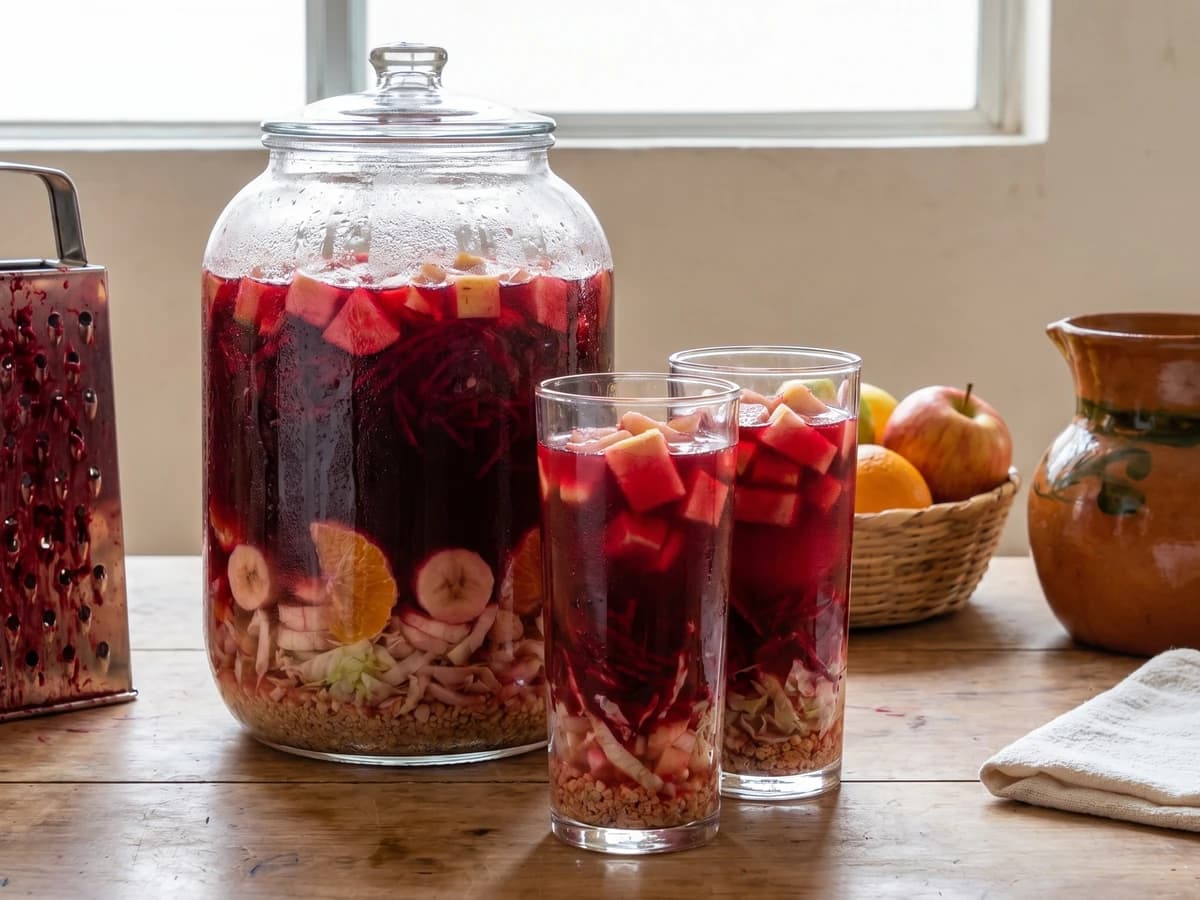
Aguascalientes' Lenten agua fresca, jewel-red from cooked beet and full of apple, banana, orange, lettuce, and ground peanuts, served cold when Holy Week meets the Feria de San Marcos.

Chef Lupita
Sonora and Sinaloa's creamy malted barley water, built on toasted cebada perla, Mexican canela, vanilla from Papantla, and evaporated milk. Pink-beige, rich, and served cold over heavy ice in a heavy glass tumbler. Liquid cookie comfort the northwest way.

Chef Lupita
Yucatán's everyday tonic of boiled chaya leaves blended with lima agria, sugar, and ice. The bright green jarra that sits on every Peninsula table from Mérida to Valladolid.