Culinary Explorer

A cooking platform built around craft, culture, and the stories behind what we eat.
Discover Culinary Explorer
Tatemado de Puerco Colimote

Tatemado de Puerco Colimote

Created by

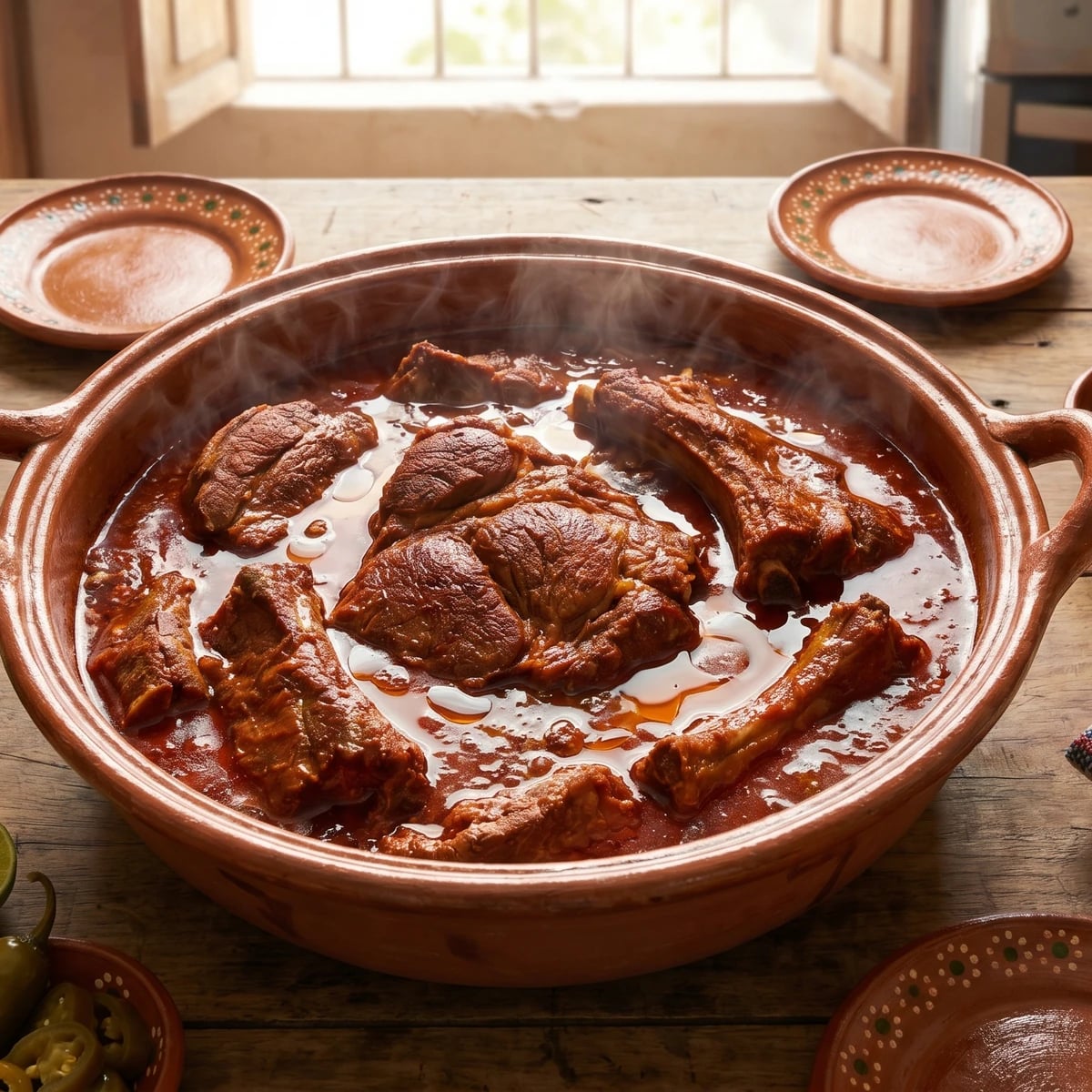
Colima's special-occasion pork stew, marinated overnight in chile guajillo, vinegar de tuba, laurel Colima, and oregano, then cooked in barro until the meat sinks into its own red broth.

Soups & Stews
Mexican
Special Occasion
Comfort Food
Make Ahead
45 min
Active Time
3 hr 15 min cook16 hr total
Yield8 servings

Colima, in Mexico's Occidente, sits between the Volcan de Fuego, the coconut groves, and the Pacific road to Manzanillo. Tatemado de puerco lives there, in the city of Colima, in Villa de Alvarez, in the market pots at Pancho Villa, and on family tables when there is a baptism, a birthday, or a wedding. This is a 32-state cuisine. Cada estado, su propia cocina.

The adobo is the map: chile guajillo for the red body, a little chile pico de pajaro for the bite, vinagre de tuba from coconut palm sap for the sour edge, laurel Colima if you can get it, oregano orejon, cumin, clove, ginger, and black pepper. This is sometimes called Colima's answer to mole poblano, not because it tastes like Puebla, but because it holds that same ceremonial weight. Mole is not chocolate sauce, and tatemado is not pulled pork in red salsa. Learn the difference before you touch the pot.

The women who perfected this dish understood patience better than any restaurant cook. Toast the chiles, soften them, blend the adobo smooth, strain it, and let the pork sleep in it overnight. No me vengas con atajos. The vinegar needs time to enter the shoulder and the chamorro, and the barro needs time to cook the meat until it loosens from the bone.

My mother did not cook Colima tatemado in our Roma kitchen. She was from Jalisco and she knew her borders. I learned this one by listening in Colima, from senoras who corrected the pot before they corrected the words. Enough sauce. Clay if you have it. Corn tortillas, never flour here. Frijoles refritos at the side. Saber cocinar es saber vivir.

Tatemado comes from the Nahuatl-rooted verb tatemar, to put on the fire, roast, or toast, and in Colima the name points to the treatment of chiles and spices before they become adobo. Older Colima versions were made with venison or iguana before pork became the usual meat, and by the 20th century tatemado de puerco had become the state's special-occasion stew for baptisms, birthdays, and weddings. The vinagre de tuba ties the dish to Colima's Pacific history: tuba, fermented coconut-palm sap, reached western New Spain through the Manila galleon trade that linked Manila and Acapulco from 1565 to 1815.

The technique, the tradition, and the story behind every dish.

Discover Culinary Explorer

Ingredients

bone-in pork shoulder or chamorro

Quantity

4 pounds

cut into 2 1/2-inch chunks

pork ribs or country-style pork ribs

Quantity

1 1/2 pounds

cut through the bone into 2-inch pieces

sal de Colima or kosher salt

Quantity

1 1/2 tablespoons

divided

dried chile guajillo

Quantity

10

wiped clean, stemmed and seeded; reserve 1 teaspoon seeds

dried chile ancho

Quantity

2

wiped clean, stemmed and seeded

dried chile pico de pajaro

Quantity

3

stemmed

reserved guajillo seeds

Quantity

1 teaspoon

coriander seeds

Quantity

1 teaspoon

cumin seeds

Quantity

1 teaspoon

black peppercorns

Quantity

8

whole cloves

Quantity

3

Mexican cinnamon

Quantity

1/2-inch piece

ripe jitomates

Quantity

3

quartered

tomates de cascara (tomatillos)

Quantity

2

husked, rinsed, and quartered

garlic cloves

Quantity

5

peeled

white onion

Quantity

1/2 medium

quartered

fresh ginger

Quantity

1-inch piece

peeled and sliced

hoja de laurel Colima

Quantity

1 large

or 2 small Mexican bay leaves if outside Colima

hoja de oregano orejon (optional)

Quantity

1

dried Mexican oregano

Quantity

2 teaspoons

vinagre de tuba (coconut-palm vinegar)

Quantity

1/2 cup

unsalted chicken broth or water

Quantity

2 to 3 cups

divided

manteca de cerdo

Quantity

2 tablespoons

red onion (optional)

Quantity

1 small

thinly sliced and desflemada with lime and salt

fresh cilantro leaves (optional)

Quantity

1/2 cup

chiles jalapenos en vinagre or fruit in vinegar (optional)

Quantity

for serving

limon de Colima or Mexican lime halves (optional)

Quantity

for serving

frijoles refritos (optional)

Quantity

for serving

hand-pressed corn tortillas (optional)

Quantity

for serving

warmed

Equipment Needed

  • 12-inch lead-free cazuela de barro or oven-safe olla de barro
  • Cast iron comal for toasting chiles and tatemando vegetables
  • Molcajete or spice grinder
  • High-powered blender
  • Fine-mesh strainer
  • Deep plates or shallow bowls for serving with sauce

Instructions

  1. 1

    Salt the pork

    Put the pork shoulder, chamorro, and ribs in a large nonreactive bowl. Sprinkle with 1 tablespoon of the sal de Colima and turn the pieces with your hands so the salt reaches the bone, the fat, and the lean meat. You want bone in this dish. Bone gives the broth body, and tatemado should be caldoso, spoonable, not dry.

  2. 2

    Toast the chiles

    Heat a dry comal over medium. Toast the chile guajillo one or two at a time, about 20 to 30 seconds per side, just until the skin darkens a shade and smells fruity. Toast the chile ancho the same way, then pass the chile pico de pajaro over the comal for only a few seconds. Do not blacken them. Burned chile makes bitter adobo, and no amount of pork fat will save it.

    Reserve only 1 teaspoon of guajillo seeds for the spice mix. More than that pushes the sauce toward harsh bitterness. The senoras who know this dish measure bitterness with restraint, not with bravado.
  3. 3

    Soften the chiles

    Place the toasted guajillo, ancho, and pico de pajaro in a bowl and cover with hot water. Hot, not boiling. Let them soften for 20 minutes, then drain. Boiling water toughens the chile skins and pulls out bitterness. Hot water gives you flesh that blends clean.

  4. 4

    Toast the spices

    On the same comal, toast the reserved guajillo seeds, coriander seeds, cumin seeds, peppercorns, cloves, and Mexican cinnamon for 60 to 90 seconds, moving them constantly. They should smell warm and sharp, never scorched. Grind them in a molcajete or spice grinder until fine. This is the backbone of the adobo.

  5. 5

    Tatemar the vegetables

    Set the jitomates, tomates de cascara, garlic cloves, and onion on the hot comal. Turn them until they have blackened spots and the tomatoes soften at the edges, 8 to 10 minutes. The verb tatemar is not decoration. It tells you what to do: put the ingredient to the fire until the raw edge leaves.

  6. 6

    Blend the adobo

    In a blender, combine the softened chiles, tatemados vegetables, ground spices, ginger, oregano orejon, dried Mexican oregano, vinagre de tuba, 1 cup of broth, and the remaining 1/2 tablespoon salt. If you have true laurel Colima, crumble it in and blend it; if you are using common bay leaves, keep them whole and add them to the pot later. Blend until very smooth, then strain through a fine-mesh sieve. Press hard on the solids. You want a red adobo that almost shines.

  7. 7

    Marinate overnight

    Pour the strained adobo over the salted pork and turn every piece until coated. The meat should be surrounded by sauce; add 1/2 cup broth if the adobo is too thick to move around the pork. Cover and refrigerate for 12 to 18 hours. This is where the vinegar enters the meat and the chile stops sitting on the surface. No me vengas con atajos.

  8. 8

    Load the cazuela

    Take the pork out of the refrigerator 30 minutes before cooking. Grease a lead-free, oven-safe cazuela de barro with the manteca de cerdo. Add the pork, all the adobo, any whole bay leaves, and enough broth to come about three-quarters up the meat. Do not drown it, and do not leave it dry. Cover the cazuela with its lid, or with parchment and foil if the lid does not sit tight.

    Do not put a cold clay pot straight into a hot oven. Barro cracks when you abuse it. Let the pot temper on the counter while the meat loses its refrigerator chill.
  9. 9

    Cook in barro

    Place the covered cazuela in a cold oven, then set the oven to 325F. Once the oven reaches temperature, cook for 2 1/2 hours. Check once halfway through and spoon sauce over the top pieces. The pork is ready for the next step when a rib bone wiggles easily and the shoulder begins to loosen when pressed with a spoon.

  10. 10

    Brown and loosen

    Uncover the cazuela and raise the oven to 375F. Cook 25 to 35 minutes more, basting twice, until the top pieces darken to brick red and the sauce thickens slightly around the edges. If the sauce reduces too much, add hot broth by the half cup. Chayito from the Pancho Villa market was right about this kind of tatemado: it should be consistent, but caldoso. You eat it with a spoon.

  11. 11

    Serve with sauce

    Rest the cazuela for 15 minutes. Spoon the pork into deep plates with plenty of red sauce. Serve with cebolla morada desflemada, cilantro leaves, chiles en vinagre or fruit in vinegar, limon de Colima, frijoles refritos, and warm corn tortillas. Flour tortillas belong where they belong, mostly the north. This table is Colima. Asi se hace y punto.

Chef Tips

  • Vinagre de tuba is the real souring agent. Ask at Mexican markets that carry Colima, Jalisco, Michoacan, or Guerrero products, and look for coconut-palm vinegar. Outside Mexico, Filipino sukang tuba is often closer than generic white vinegar because the history crossed the same Pacific. White cane vinegar works only as a compromise.
  • Laurel Colima is not the same as the small bay leaf in a supermarket jar. The Colima leaf is larger and more aromatic, almost like a mango leaf in size. If you cannot get it, use Mexican bay leaves, but know what you are missing.
  • Chile pico de pajaro gives a pointed heat without taking over the stew. If your chile vendor has none, use 1 or 2 chile de arbol. Do not turn this into a punishment. Tatemado is deep and sour and red before it is hot.
  • Use shoulder, chamorro, ribs, or a mix. Loin is wrong here. It dries before the adobo finishes cooking, then people blame the recipe instead of the cut.
  • The dish is not supposed to reduce into a dry shred. If the sauce drops below the halfway mark during cooking, add hot broth. A Colima tatemado plate should carry meat and enough adobo to stain the spoon.
  • Use only lead-free barro for acidic adobos. Vinegar and old glazed clay are not a game. If you do not own safe barro, use an enameled Dutch oven and admit the compromise.

Advance Preparation

  • The adobo can be made up to 2 days ahead and refrigerated. Stir it before using because the chile solids settle.
  • The pork must marinate at least 12 hours. Eighteen hours is better. Past 24 hours, the vinegar starts to push too hard on the texture.
  • Finished tatemado keeps refrigerated for 4 days and tastes better the next day. Reheat gently in a covered pot with a splash of broth so the sauce loosens back up.
  • Freeze the pork and sauce together for up to 2 months. Thaw overnight in the refrigerator and reheat slowly. Make the onion, cilantro, tortillas, and frijoles fresh.

Frequently Asked Questions

Nutrition Information

1 serving (about 500g)

Calories
895 calories
Total Fat
52 g
Saturated Fat
17 g
Trans Fat
0 g
Unsaturated Fat
33 g
Cholesterol
160 mg
Sodium
2200 mg
Total Carbohydrates
58 g
Dietary Fiber
14 g
Sugars
6 g
Protein
49 g

Note: Chef personas and recipes are created with AI assistance. Cook with care: follow safe food-handling practices, check doneness with a thermometer when needed, and adapt for allergies and your kitchen.

Where cooking meets culture.

Culinary guides, cultural storytelling, and the editorial depth that makes cooking meaningful.

Discover Culinary Explorer

More from Occidente Soups & Stews

Browse the full collection