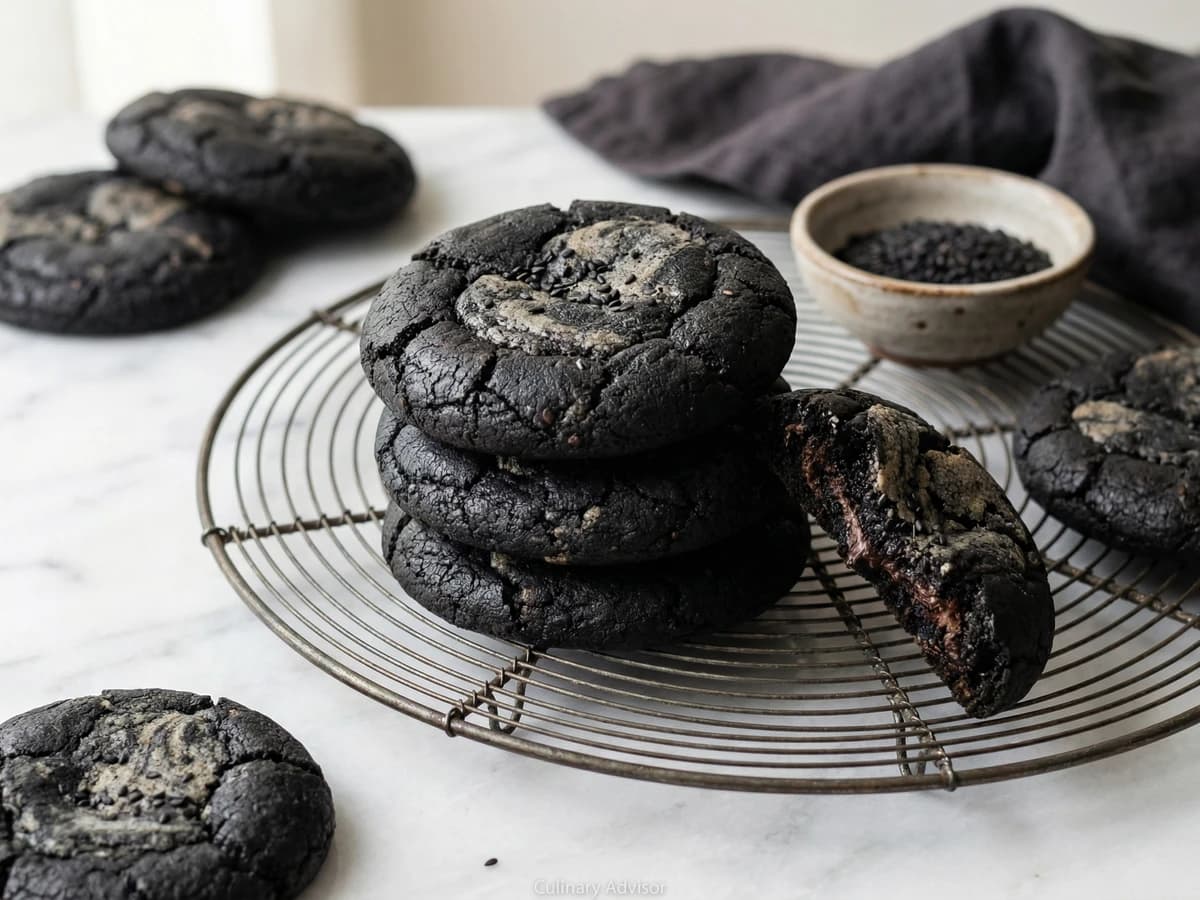
Impossibly chewy cookies studded with crumbled sesame halva and dark chocolate chunks, their nutty depth coming from tahini in the dough itself. A bridge between the bazaars of the Levant and the American cookie jar.
Pastries & Cookies
Fusion
Holiday
Make Ahead
25 min
Active Time
12 min cook•2 hr total
Yield24 cookies
The first time I encountered halva was in a tiny shop in Istanbul, where an old man carved slices from wheels the size of car tires. The confection shattered on my tongue, releasing that deep, almost smoky sesame flavor that haunts you for days. I knew immediately it belonged in an American cookie.
This recipe represents the best kind of culinary borrowing. We take the chewy, brown-butter soul of a great American cookie and marry it to tahini, that ancient paste of ground sesame seeds that has nourished people across the Middle East for millennia. The halva goes in as chunks that soften in the oven, creating pockets of crumbly sweetness throughout. Dark chocolate provides the bitter counterpoint that makes the whole thing sing.
These cookies arrived at my holiday table three years ago and haven't left since. They're unexpected on a cookie tray dominated by sugar cookies and gingerbread, which is exactly why people reach for them first. The sesame aroma rising from a fresh batch will have your guests asking questions before they've taken a bite.
For those unfamiliar with halva, you'll find it in Middle Eastern groceries, health food stores, and increasingly in regular supermarkets. Look for plain sesame halva without pistachios or chocolate. The vanilla-scented versions work beautifully here.
The technique, the tradition, and the story behind every dish.
Cut the butter into tablespoon-sized pieces and place in a light-colored saucepan over medium heat. The light color matters because you need to see the butter change. Swirl occasionally as it melts, foams, and then begins to smell like toasting nuts. Watch the milk solids at the bottom transform from white to golden to deep amber. This takes 5 to 7 minutes. The moment you see brown flecks and smell that nutty fragrance, pour immediately into a heatproof bowl. The residual heat of the pan will push it toward burnt if you wait.
Brown butter and tahini share the same nutty register, which is why they work so beautifully together. The browned milk solids amplify the sesame flavor throughout.
2
Mix dry ingredients
Whisk together the flour, baking soda, fine sea salt, and cinnamon in a medium bowl. Set this aside. The cinnamon is subtle here, just enough to add warmth without announcing itself. It bridges the Middle Eastern flavors with the American cookie tradition.
3
Combine wet ingredients
Add both sugars to the warm brown butter and whisk vigorously until combined. The mixture will look grainy and slightly separated. Whisk in the tahini until smooth. The dough will become glossy and cohesive. Add the eggs one at a time, whisking well after each, then the vanilla. The final mixture should be thick, shiny, and smell intensely of toasted sesame.
Tahini separates in the jar. Stir it thoroughly before measuring, scraping all the way to the bottom where the paste settles. Inconsistent tahini means inconsistent cookies.
4
Build the dough
Add the dry ingredients to the wet and fold with a rubber spatula until just combined. A few flour streaks remaining is fine. Add the crumbled halva and chocolate chunks, folding gently to distribute without pulverizing the halva. It should remain in distinct pieces that will create pockets of sweetness in the finished cookie.
5
Rest the dough
Cover the bowl tightly with plastic wrap and refrigerate for at least 1 hour, or up to 3 days. This rest is not optional. The flour hydrates, the flavors meld, and the dough firms enough to hold its shape in the oven. Warm dough spreads too thin and bakes up greasy. Cold dough bakes up thick and chewy.
The longer rest yields better cookies. If you can wait 24 to 48 hours, the sesame flavor deepens considerably. Plan ahead for the best results.
6
Portion and top
Line baking sheets with parchment paper. Scoop the dough into 2-tablespoon portions, rolling each into a rough ball. Space them 3 inches apart to allow for spreading. Press a few sesame seeds onto the top of each ball, then add 2 or 3 extra chunks of halva and chocolate to the surface where they'll be visible after baking. These are the beauty marks that make people reach for your cookies first.
7
Bake the cookies
Bake at 350°F (175°C) for 10 to 12 minutes, rotating the pan halfway through. The cookies are done when the edges turn golden brown but the centers still look slightly underdone and puffy. They'll appear almost raw in the middle. Trust this. They continue cooking on the hot pan after you remove them from the oven. Overbaking is the enemy of chewiness.
Every oven runs differently. Start checking at 9 minutes. The perfect cookie has a ring of golden brown around the edge and a pale, soft-looking center.
8
Finish and cool
Remove the pan from the oven and immediately sprinkle each cookie with a pinch of flaky sea salt. The salt crystals will stick to the warm surface and provide bursts of salinity that cut through the sweetness. Let the cookies rest on the pan for 5 minutes. They'll deflate slightly and firm up enough to transfer. Move them to a wire rack to cool completely, though I won't blame you for eating one warm.
Chef Tips
•Seek out halva from Middle Eastern or Israeli brands. Joyva is widely available in American supermarkets and works well. Avoid chocolate-covered or heavily flavored varieties for this recipe.
•Use dark chocolate in the 60 to 70 percent cacao range. The bitterness provides essential contrast to the sweet halva. Milk chocolate makes the cookies cloying.
•These cookies pair unexpectedly well with a glass of tawny port or a cup of strong Turkish coffee. The sesame notes harmonize with both.
•For uniform cookies, weigh your dough balls. Each should be about 50 grams. Consistent size means consistent baking.
•If your tahini is very thick and dry, it may be old. Fresh tahini should be pourable when stirred. Old tahini makes dense, dry cookies.
Advance Preparation
•Dough can be refrigerated for up to 3 days before baking. The flavor improves with time.
•Portioned dough balls freeze beautifully for up to 2 months. Freeze on a sheet pan until solid, then transfer to a freezer bag. Bake directly from frozen, adding 2 to 3 minutes to the baking time.
•Baked cookies keep in an airtight container at room temperature for up to 5 days. They soften slightly over time but remain delicious.
•For gifting, layer cooled cookies between sheets of parchment in a tin. They travel well and make memorable holiday presents.
Frequently Asked Questions
Nutrition Information
1 cookie (about 43g)
Calories
230 calories
Total Fat
15 g
Saturated Fat
5 g
Trans Fat
0 g
Unsaturated Fat
9 g
Cholesterol
32 mg
Sodium
48 mg
Total Carbohydrates
18 g
Dietary Fiber
1 g
Sugars
9 g
Protein
4 g
Where cooking meets culture.
Culinary guides, cultural storytelling, and the editorial depth that makes cooking meaningful.