
Chef Graziella
Arrosto di Maiale al Latte
Pork loin braised in milk until the liquid transforms into nutty, golden curds that cling to impossibly tender meat. The technique looks like failure and tastes like triumph.
A cooking platform built around craft, culture, and the stories behind what we eat.
Created by
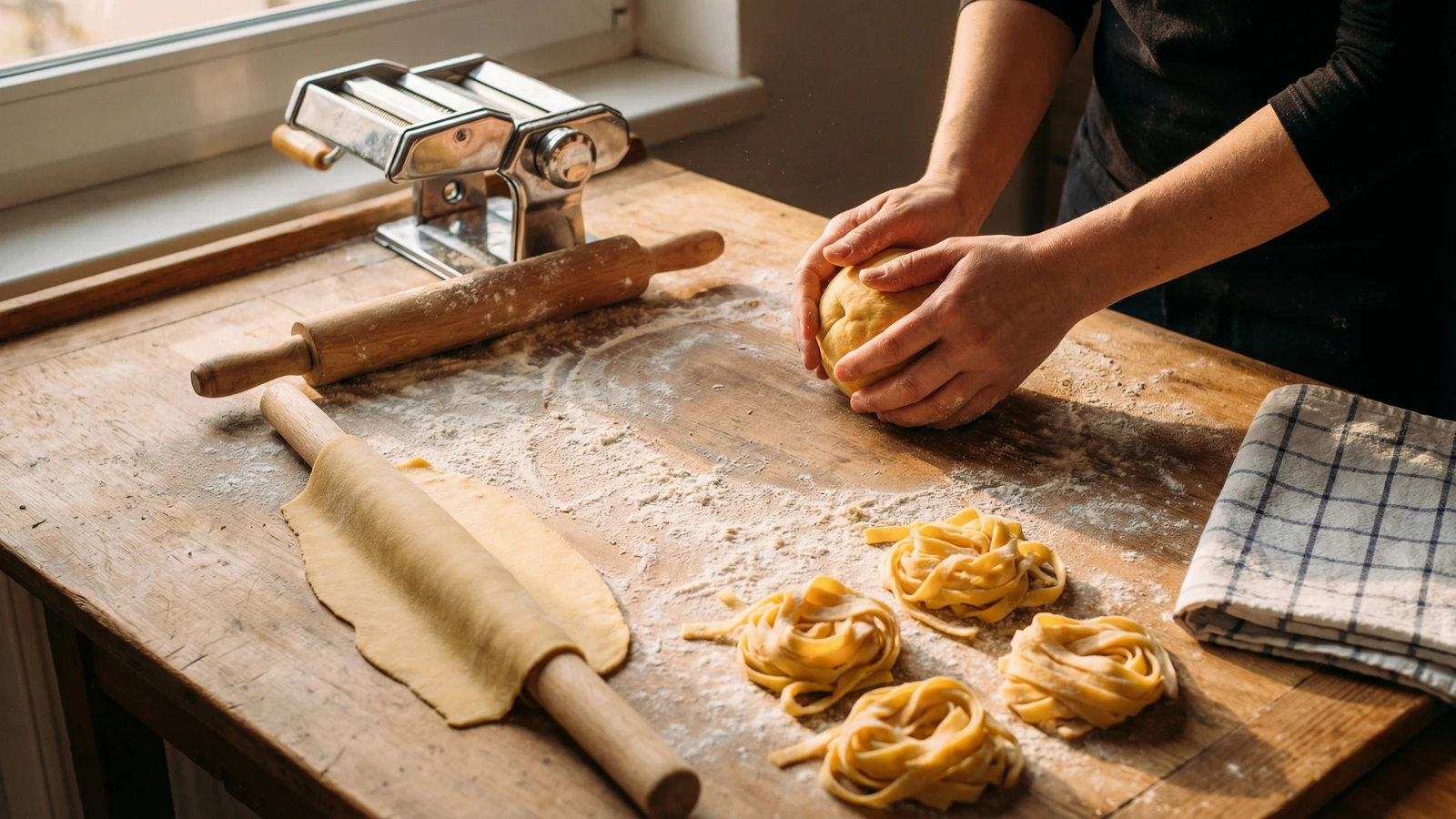
The golden ribbons of Bologna, cut from sheets of fresh egg pasta so thin you can read a love letter through them. The texture grips sauce. The flavor speaks of wheat and eggs and the work of your hands.
Tagliatelle is not difficult. It is demanding. There is a difference. Difficulty implies complexity, many steps, obscure techniques. Tagliatelle has two ingredients and a rolling pin. What it demands is attention, practice, and the willingness to fail several times before you succeed.
The sfogline of Bologna, the women who have rolled pasta for generations, can produce sheets nearly as big as a bedspread. Their arms are strong, their touch is light, and they learned at their grandmothers' sides. You did not. This is no reason to despair. A hand-crank pasta machine transforms this from an expert skill into a learnable one. The result will not be identical to hand-rolled sfoglia, but it will be excellent, and it will be yours.
The dough should feel like your earlobe when you press it. This is not poetry. It is instruction. Too wet and it sticks. Too dry and it cracks. The eggs provide moisture; the flour absorbs it. Every batch is slightly different because eggs vary and flour changes with humidity. You must learn to feel the dough, not follow numbers blindly.
What you keep out matters. No oil. No water. No salt in the dough. Eggs and flour. That is all.
The Accademia Italiana della Cucina and the Confraternita del Tortellino registered the official width of tagliatelle in 1972: exactly 8 millimeters when cooked, corresponding to 1/12,270th of the height of the Asinelli Tower in Bologna. The Chamber of Commerce keeps a golden tagliatella as the standard. This precision reflects Bologna's centuries-old pasta tradition, where sfogline passed their skills from mother to daughter.
Quantity
300 grams (about 2 1/3 cups)
plus more for dusting
Quantity
3 (about 180 grams total)
Quantity
for dusting cut pasta
| Ingredient | Quantity |
|---|---|
| tipo 00 flourplus more for dusting | 300 grams (about 2 1/3 cups) |
| large eggs | 3 (about 180 grams total) |
| semolina flour | for dusting cut pasta |
Pour the flour onto a large wooden board or clean work surface. Shape it into a mound, then make a deep well in the center with steep walls. The well must be wide enough to hold the eggs without breaching. If the walls collapse and the eggs run across your counter, you will understand why I am precise about this.
Crack the eggs directly into the well. Using a fork, beat the eggs gently, keeping the motion inside the well. Begin incorporating flour from the inner walls of the well, pulling it into the eggs gradually. Work from the inside out, maintaining the wall as long as possible.
When the mixture becomes too thick to stir with a fork, set the fork aside. Use your hands to bring the remaining flour into the dough, folding and pressing until you have a shaggy mass. Not all the flour may incorporate. This is correct. Scrape away any dry bits that refuse to join.
Knead the dough with the heel of your palm, pushing it away from you, folding it back, rotating it a quarter turn, and repeating. The dough will transform from rough and sticky to smooth and elastic. This takes 8 to 10 minutes of steady work. Your arms will tire. This is how you know you are working.
Wrap the dough tightly in plastic film and let it rest at room temperature for 30 minutes. The gluten must relax or the dough will spring back when you roll it. Do not skip this step. Do not shorten it. The dough knows how long it needs.
Cut the rested dough into four equal pieces. Work with one piece at a time, keeping the others wrapped. Flatten the piece into a rough rectangle with your palm. If using a pasta machine, set it to the widest setting. Pass the dough through, fold it in thirds like a letter, and pass it through again. Repeat this folding and rolling five or six times. This develops the gluten structure and creates smooth sheets.
Without folding now, pass the dough through progressively thinner settings. Support the sheet with your free hand as it emerges, letting it drape over your forearm. Move through each setting once until you reach the second-to-last setting on most machines. The sheet should be thin enough to see the shadow of your hand through it, but sturdy enough to hold together when cut.
Lay the finished sheets on a lightly floured surface or drape them over a clean wooden dowel. Let them dry for 5 to 10 minutes until the surface feels leathery but not brittle. The pasta should no longer stick to itself when touched. If too wet, the noodles clump. If too dry, they shatter when cut.
Dust each sheet lightly with flour. Roll it loosely from both ends toward the center, creating two rolls that meet in the middle. Using a sharp knife, cut straight down through both rolls at 6 to 8 millimeter intervals. Slip the knife blade under the center of the cut noodles and lift. They will unfurl into long ribbons. Toss immediately with semolina to prevent sticking.
Gather small portions of cut tagliatelle and twist them gently into loose nests. Lay them on a semolina-dusted tray. Fresh tagliatelle can be cooked immediately or dried for later. The nests hold their shape and cook evenly.
Bring abundant salted water to a vigorous boil. Four quarts for one pound of pasta. Add the tagliatelle and stir immediately to prevent clumping. Fresh pasta cooks in 2 to 3 minutes. It is done when tender but with pleasant resistance. There is no exact moment. You must taste. Drain, reserving pasta water, and sauce immediately. Fresh pasta waits for no one.
1 serving (about 115g)
Culinary guides, cultural storytelling, and the editorial depth that makes cooking meaningful.
Discover Culinary ExplorerChef Graziella
Pork loin braised in milk until the liquid transforms into nutty, golden curds that cling to impossibly tender meat. The technique looks like failure and tastes like triumph.

Chef Graziella
Thick pork chops rubbed with salamoia bolognese and grilled over live fire. This is how we eat in summer in Emilia-Romagna: simply, outdoors, with family.

Chef Graziella
Hand-rolled pasta sheets wrapped around a filling of ricotta and spinach, covered in besciamella and baked until golden. This is the Sunday cooking of Emilia-Romagna, made without shortcuts.

Chef Graziella
The pasta of the Este dukes, where sweet roasted pumpkin meets fresh egg pasta in shapes like little peasant hats. Dressed only with butter and sage, as Ferrara has done since the Renaissance.