
Chef Lupita
Acitrón de Cidra Conventual
Puebla's convent-style acitrón, made from cidra peel instead of endangered biznaga, built through repeated syrup soakings until the cubes turn firm, translucent, and ready for rosca or chiles en nogada.
A cooking platform built around craft, culture, and the stories behind what we eat.
Created by
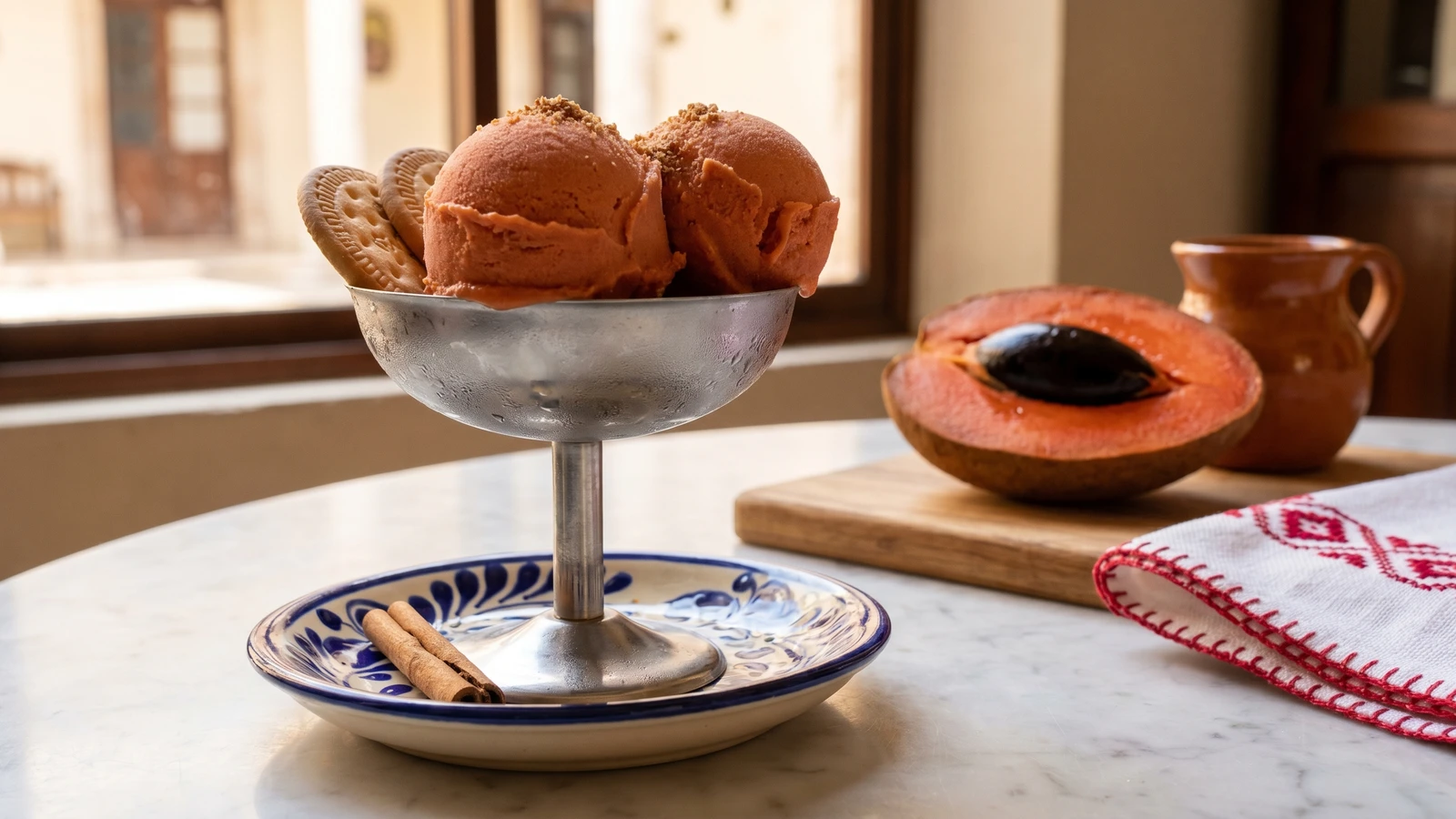
Mérida's most-ordered sorbete since Sorbetería Colón opened on the plaza grande in 1907. Pure mamey, sugar, water, lime. No cream, no eggs, no apologies. The dense orange flavor that defines Yucatán's frozen tradition.
This is from Yucatán. Specifically from Mérida, and even more specifically from a single counter on the corner of Calle 62 facing the plaza grande, where Sorbetería Colón has been spooning sorbete de mamey into metal coupes since 1907. Yucatecos do not call it ice cream and they do not want it to be. There is no cream, no milk, no egg yolk. The point is the fruit, undiluted.
Mamey sapote is a Mesoamerican fruit, native to the lowlands of southern Mexico and Central America, and Yucatán's heat is exactly the climate that ripens it properly. The flesh is dense, the color of a tile roof at sunset, sweet in a way that suggests sweet potato, pumpkin, and apricot all at once. A good mamey is everything. A bad mamey cannot be rescued by sugar or technique. Pregúntale a las señoras del mercado. At Lucas de Gálvez in Mérida the fruit vendors will press their thumb into the stem end before they sell you one, and if it does not give, they will tell you to come back in three days. Listen to them.
The technique is almost embarrassingly simple. Ripe pulp, a cool simple syrup with a whisper of canela, a squeeze of lime to lift the sweetness, a pinch of salt to focus the fruit. Blend, chill, churn, cure. The discipline is in the patience, not in the steps. A warm base or an unripe fruit will ruin you. Cada estado, su propia cocina, and Yucatán's frozen tradition is built on this kind of restraint: trust the ingredient, get out of its way.
My mother kept a page in her notebook with the words 'sorbete Colón' written across the top and a list of three ingredients underneath. She had eaten it once on a trip to Mérida in 1979 and she never forgot it. She never made it. I made it the first time the year after she died, with mamey I carried home from the Central de Abastos. It tasted like a city I had only read about in her handwriting. Saber cocinar es saber vivir.
Sorbetería Colón opened on Mérida's plaza grande in 1907, during Yucatán's henequen-fueled belle époque, when the peninsula's sisal exports made it one of the wealthiest regions in Mexico and Mérida's elite imported European refinements including the European sorbet tradition itself. The shop adapted the technique to native fruits, with mamey sapote (Pouteria sapota), a cultivated Mesoamerican species domesticated by the Maya long before contact, becoming its signature flavor alongside guanábana, coco, and tamarindo. The black almond-shaped pit of the mamey, called pixton or sicil in Maya communities, was traditionally ground and used as a chocolate-like flavoring and as the base for the regional drink tan chukwá; its toasted kernel remains an authentic, if uncommon, garnish for the sorbete.
Quantity
2 large (about 3 pounds whole, to yield 3 cups pulp)
Quantity
1 1/2 cups
Quantity
1 1/4 cups
Quantity
2 tablespoons
from Mexican limes if you can find them
Quantity
1 pinch
Quantity
1 small piece, about 2 inches
Quantity
for serving
Quantity
for garnish
finely grated
| Ingredient | Quantity |
|---|---|
| ripe mamey sapote | 2 large (about 3 pounds whole, to yield 3 cups pulp) |
| granulated cane sugar | 1 1/2 cups |
| water | 1 1/4 cups |
| fresh lime juicefrom Mexican limes if you can find them | 2 tablespoons |
| fine sea salt | 1 pinch |
| canela (Mexican cinnamon stick) (optional) | 1 small piece, about 2 inches |
| Galletas Marías (optional) | for serving |
| toasted mamey pit kernel (optional)finely grated | for garnish |
The mamey has to be ripe. Press your thumb gently into the brown sandpapery skin near the stem. It should give like a ripe avocado. If it feels rock-hard, leave it on the counter for three to five days. An underripe mamey is starchy and flavorless. There is no rushing this. The fruit dictates the calendar, not the cook.
Combine the sugar, water, and the small piece of canela in a small saucepan. Bring to a gentle simmer over medium heat, stirring until every grain of sugar dissolves. Once it is clear, pull the pan off the heat. Let it cool completely. Discard the canela. The syrup must be at room temperature or colder before it touches the mamey, otherwise the heat dulls the fruit.
Slice the mamey lengthwise around the long shiny black pit. Twist the two halves apart and pry out the pit with a spoon. The flesh inside should be a deep brick-orange, the color of a sunset over the Yucatán coast. If it is pale or has white starchy streaks near the skin, that part is underripe. Scoop only the deep orange flesh into a bowl with a spoon. Leave the lighter flesh behind.
Place 3 cups of the deep orange mamey pulp in a blender. Add the cooled simple syrup, the lime juice, and the pinch of salt. Blend on high for a full minute until completely smooth, with no lumps and no streaks. Mamey pulp is dense, almost like sweet potato, so the blender will work. Stop and scrape down the sides once if you need to. The mixture should be the color of saffron.
Pour the blended base into a bowl, cover, and refrigerate for at least four hours, or overnight. A cold base churns into a finer, smoother sorbete. A warm base churns into ice crystals. There is no shortcut here. No me vengas con atajos.
Pour the chilled base into an ice cream maker and churn according to your machine's instructions, usually 20 to 30 minutes. The sorbete is ready when it has the texture of soft-serve and holds a soft ribbon off the paddle. The color will lighten slightly as air gets folded in, but it should still be a vivid orange-coral. If you do not have a machine, see the chef tips for the still-freeze method.
Transfer the churned sorbete to a chilled metal loaf pan or freezer-safe container. Press a piece of parchment directly onto the surface to keep ice crystals off the top. Cover and freeze for at least four hours, until firm enough to scoop into clean rounds. Twenty-four hours is better. The flavor settles and the texture tightens. Sorbetería Colón has been doing exactly this since 1907 and there is no improving on it.
Scoop into chilled metal coupes or small glass cups. At Colón in the plaza grande they serve it with one or two Galletas Marías on the saucer, nothing else. The sorbete should not be served frozen solid. Let it sit out two or three minutes after scooping so the flavor opens. Cold mutes flavor. Slightly softened mamey is the version you remember. Así se hace y punto.
1 serving (about 192g)
Culinary guides, cultural storytelling, and the editorial depth that makes cooking meaningful.
Discover Culinary ExplorerChef Lupita
Puebla's convent-style acitrón, made from cidra peel instead of endangered biznaga, built through repeated syrup soakings until the cubes turn firm, translucent, and ready for rosca or chiles en nogada.

Chef Lupita
Ciudad de México's Tulyehualco alegría is popped huautli folded into piloncillo honey, pressed with peanuts, pepitas, and raisins, then cut into the rectangular bars that built a pueblo's identity.

Chef Lupita
Oaxaca's pre-Columbian amaranth bar, popped on a hot comal and bound with piloncillo, honey, and the sacred Zapotec grain that the Spanish tried, and failed, to outlaw.

Chef Lupita
Querétaro's mercado candy of popped amaranto pressed with dark piloncillo syrup, pepitas, pecans, and cacahuate, a Bajío sweet that respects the seed before it decorates the table.