Culinary Explorer
A cooking platform built around craft, culture, and the stories behind what we eat.
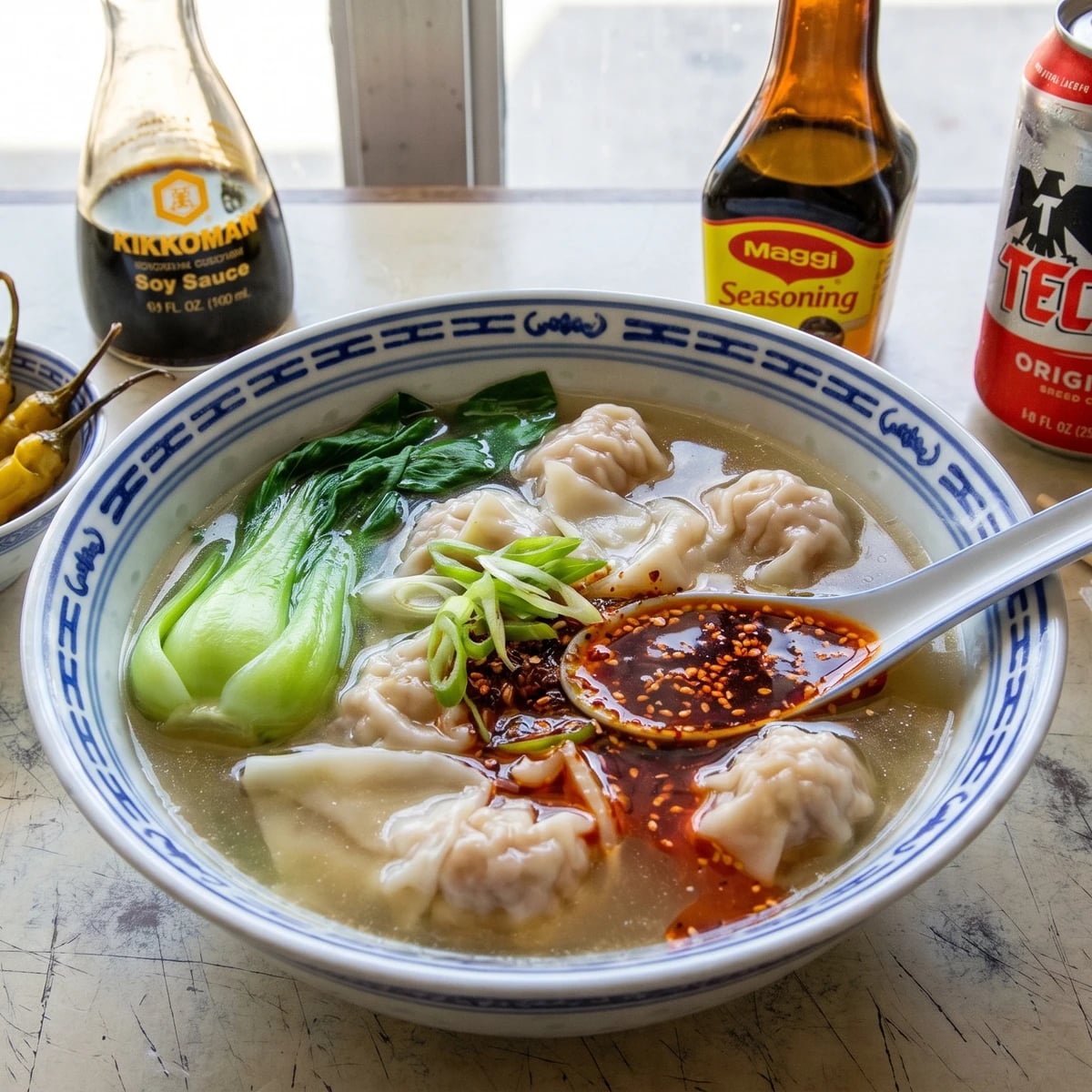
Sopa Wonton Mexicalense
Created by Chef Lupita
Mexicali's cocina chicalense wonton soup, pork-filled wontons in a clear chicken broth with bok choy and green onion, finished at the table with chile oil de arbol and a hard squeeze of lime.
This is a Mexicali dish. Baja California, the border with Calexico, the Valle de Mexicali where the desert heat sits at 115 degrees in August and the cooks still ladle hot broth at lunchtime because that is how the Chinese-Mexican kitchens of La Chinesca have done it for over a hundred years.
Do not call this fusion. Cocina chicalense is its own tradition. Cantonese laborers came to Mexicali at the turn of the twentieth century to dig the irrigation canals of the Colorado River delta, and they stayed. They opened restaurants. They raised families. They cooked Cantonese food with what the Valle gave them and they put lime on the table because lime is what Mexicans put on the table. By the 1920s, La Chinesca, the underground neighborhood beneath downtown Mexicali, was the largest Chinatown in Mexico. The wonton soup at Cafe Nueva Asia and at La Misión and at the dozens of cafes chinos along Avenida Reforma is not a Cantonese soup that arrived in Mexico. It is a Mexicali soup that happens to be Cantonese in its bones.
The broth is the discipline. Clear, slow-simmered, skimmed, ginger-forward, never boiled hard. The wontons are pork shoulder, ground with the fat in, seasoned with green onion, ginger, garlic, soy, Maggi, and a hint of sesame oil. The Maggi is not a substitute for anything. Maggi is a Mexicali ingredient by now. Every cafe chino in the city has a bottle on the table next to the soy sauce and the chile oil.
The finish is what makes it Mexicalense: chile oil built from chile de arbol and chile japones toasted on a comal, sesame seeds, sometimes a pinch of chiltepin from Sonora across the gulf, and lime wedges so each diner can dress the bowl. My notebook from Mexicali is full of margin notes from the cooks at three different cafes chinos who all told me the same thing: the broth is Cantonese, the wonton is Cantonese, but the lime and the chile oil are ours. Cada estado, su propia cocina. Saber cocinar es saber vivir.
Ingredients
whole chicken
Quantity
1 (about 4 pounds)
cut into pieces, or 3 pounds chicken backs and wings
white onion
Quantity
1 medium
halved
head of garlic
Quantity
1
halved crosswise
| Ingredient | Quantity |
|---|---|
| whole chickencut into pieces, or 3 pounds chicken backs and wings | 1 (about 4 pounds) |
| white onionhalved | 1 medium |
| head of garlichalved crosswise | 1 |
Where cooking meets culture.
Culinary guides, cultural storytelling, and the editorial depth that makes cooking meaningful.
Discover Culinary Explorer