
Chef Lupita
Aguascalientes Beef Tongue Pozole (Pozole de Lengua)
Aguascalientes' Bajio pozole de lengua, built with cacahuazintle hominy, tender beef tongue, chile ancho and guajillo, with xoconostle brightness and table garnishes.
A cooking platform built around craft, culture, and the stories behind what we eat.
Created by
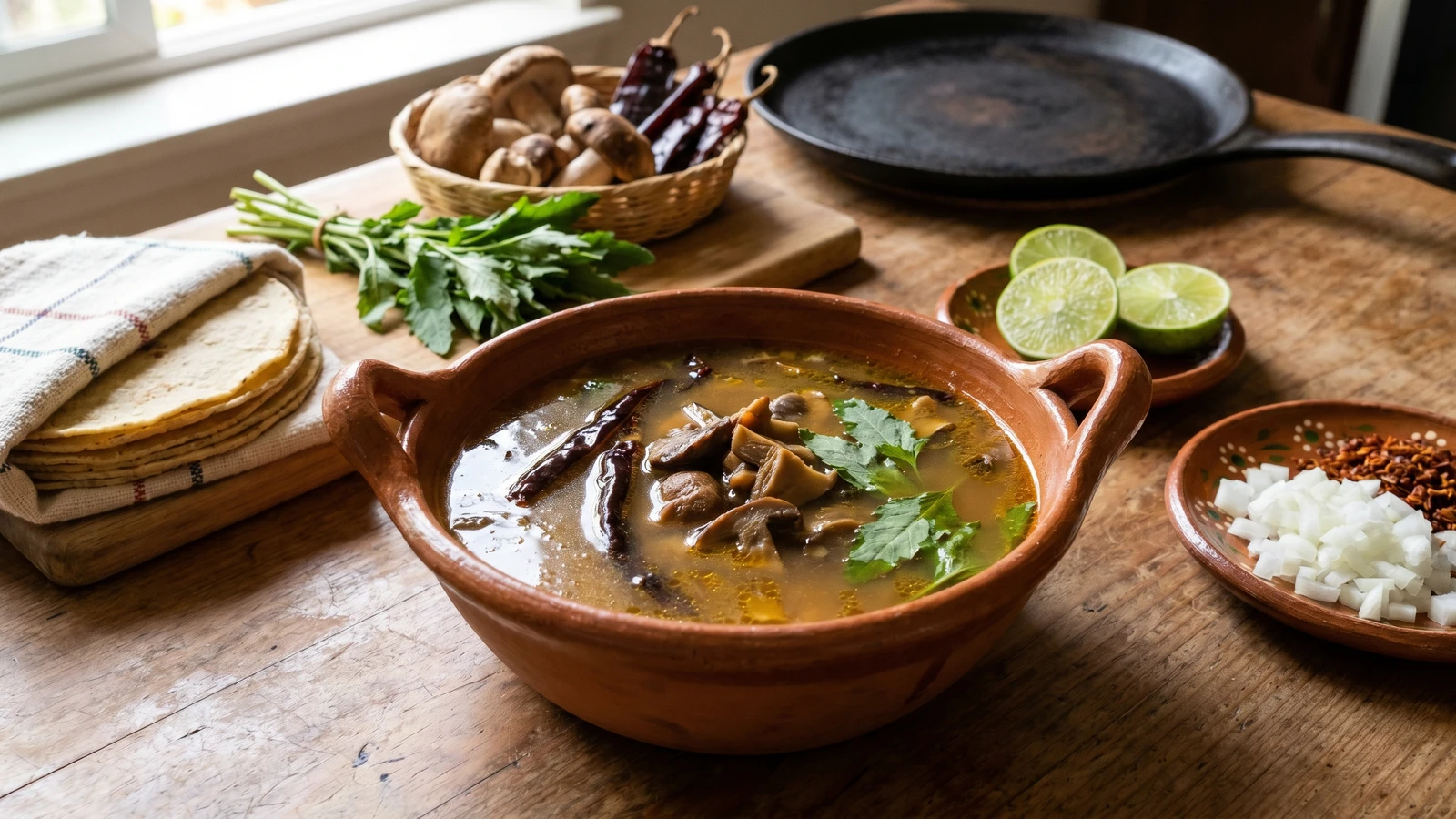
Tlaxcala and Morelos foragers pull wild hongos from the pine forests when the rains come. Seared in lard with guajillo strips and finished with epazote, loosened with a real chicken caldo.
This soup belongs to the central highlands, to Tlaxcala and the high pine country around the slopes of La Malinche, and to the mushroom foragers of Morelos and the Estado de Mexico who walk the wet forest floor every morning of the rainy season. From late June through October, when the rains break the dry season, the mercados of Tlaxcala fill with baskets of hongos de pino, clavitos, pancitas, and a dozen other wild varieties that have no English names and need none.
The dish is plain on paper. Sear the mushrooms in lard with onion and garlic. Add a few strips of toasted guajillo. Loosen with chicken caldo. Finish with epazote. That is the whole recipe. But every step has to be done right because there is nowhere to hide. If your mushrooms are wet, your soup is wet. If your caldo is weak, your soup is weak. If your epazote is dried, throw it away and start over.
Epazote is the ingredient that locates this soup on the map. The mineral, slightly bitter, almost gasoline-green note of fresh epazote is the central Mexican kitchen. You cannot substitute it. Not with cilantro, not with parsley, not with anything. Pregúntale a las señoras del mercado in Tlaxcala. They will tell you the same. Without epazote, you have a mushroom soup. With epazote, you have a sopa de hongos.
My mother kept a pot of epazote on the patio in Colonia Roma year-round. She wrote in the margin of her notebook, next to a sopa de hongos recipe she copied from a woman she met at the Mercado de Jamaica: 'no escatimes el epazote.' Do not skimp on the epazote. She was right. Saber cocinar es saber vivir.
Wild mushroom foraging in central Mexico is a pre-Columbian practice continuously maintained for over two thousand years, and the Nahua, Otomi, and Matlatzinca peoples of the central highlands cultivated detailed knowledge of dozens of edible species, much of which survives today in the rainy-season harvest of Tlaxcala, Puebla, Morelos, and the Estado de Mexico. Epazote (Dysphania ambrosioides), whose name comes from the Nahuatl 'epazotl' meaning skunk-sweat for its pungent aroma, was domesticated in Mesoamerica long before the conquest and was used both as a culinary herb and a vermifuge medicine, which is why it still appears in bean and mushroom dishes where its antiflatulent properties were valued. The combination of foraged hongos, chile, and epazote in a brothy soup is documented in 17th-century criollo cookbooks and remains one of the most direct culinary survivals of pre-Columbian central Mexican cuisine.
Quantity
1 pound
cleaned with a damp cloth and torn into bite-sized pieces
Quantity
6 cups
well-seasoned
Quantity
3
stemmed, seeded, and sliced into thin strips
Quantity
2 tablespoons
Quantity
1 medium
finely diced
Quantity
3
finely chopped
Quantity
2 medium
finely chopped
Quantity
2 large sprigs
leaves stripped from the stem
Quantity
1 teaspoon, plus more to taste
Quantity
to taste
Quantity
for serving
Quantity
for serving
warmed
Quantity
for serving
Quantity
for serving
toasted on the comal and crumbled
| Ingredient | Quantity |
|---|---|
| mixed wild mushrooms (hongos de pino, clavitos, pancitas)cleaned with a damp cloth and torn into bite-sized pieces | 1 pound |
| homemade chicken caldowell-seasoned | 6 cups |
| dried chile guajillostemmed, seeded, and sliced into thin strips | 3 |
| manteca de cerdo (pork lard) | 2 tablespoons |
| white onionfinely diced | 1 medium |
| garlic clovesfinely chopped | 3 |
| roma tomatoesfinely chopped | 2 medium |
| fresh epazoteleaves stripped from the stem | 2 large sprigs |
| kosher salt | 1 teaspoon, plus more to taste |
| freshly ground black pepper | to taste |
| lime wedges (optional) | for serving |
| hand-pressed corn tortillas (optional)warmed | for serving |
| diced white onion (optional) | for serving |
| chile de arbol (optional)toasted on the comal and crumbled | for serving |
Wipe each mushroom with a barely damp cloth. Do not rinse them under the tap. Wild hongos are sponges and water washes the flavor straight down the drain. Tear the larger pieces by hand into bite-sized chunks. The torn edges hold the caldo better than knife-cut surfaces. This is how the women at the Tlaxcala mercados clean their morning harvest.
Heat a dry comal over medium. Open the guajillos flat and press them against the hot surface for about 10 seconds per side, until they puff slightly and release their oils. Do not let them blacken. Burned guajillo turns bitter and there is no recovering from it. Once cool enough to handle, slice them into thin ribbons with kitchen scissors. The strips will soften in the broth without losing their bite.
In a heavy clay cazuela or a 4-quart pot, melt the lard over medium heat. La manteca es el sabor. Add the diced onion and cook for three to four minutes, until translucent and softened at the edges. Stir in the garlic and the guajillo strips and cook for another minute, just until the kitchen fills with that warm chile-and-allium smell that tells you the base is ready.
Raise the heat to medium-high. Add the torn mushrooms in one layer if the pan allows. Do not stir for the first two minutes. Let them release their water and start to brown against the hot lard. Then stir and cook for five to seven more minutes, until the mushrooms have shrunk down, deepened in color, and pulled in the flavor of the sofrito. This searing step is what separates a serious mushroom soup from a boiled one.
Stir in the chopped tomato and cook for three to four minutes, until it breaks down and the liquid it releases has mostly cooked off. The mixture should look glossy and concentrated. This is your soup's foundation. Skip this step and you will taste raw tomato in the broth, which is not what you want.
Add the chicken caldo and bring to a gentle simmer. Season with the salt and a few grinds of black pepper. Simmer uncovered for 15 minutes. The broth should taste of mushroom and chile, with the chicken supporting both. Taste now. If the caldo was thin, the soup will be thin. A good caldo is the difference between a sopa de hongos and a bowl of warm water with mushrooms in it.
Strip the epazote leaves from the stems and add them whole to the pot. Simmer for two more minutes, no longer. Epazote is not a garnish. It is structural. Its mineral, almost medicinal note is what makes this a central-highlands soup and not just any mushroom soup. Add too early and it turns muddy. Add too late and it sits raw on top. Two minutes is the window.
Ladle into clay cazuelas or hand-thrown bowls. Set the lime, diced onion, toasted chile de arbol, and warm tortillas on the table in small platitos. Each person seasons their own bowl. Tear a tortilla, scoop a mushroom, sip the broth. Así se hace y punto.
1 serving (about 450g)
Culinary guides, cultural storytelling, and the editorial depth that makes cooking meaningful.
Discover Culinary ExplorerChef Lupita
Aguascalientes' Bajio pozole de lengua, built with cacahuazintle hominy, tender beef tongue, chile ancho and guajillo, with xoconostle brightness and table garnishes.

Chef Lupita
Veracruz's Gulf coast rice from Alvarado, built with seafood stock, tomato, chile chipotle, epazote, shrimp, fish, jaiba, and pulpo, served loose and brothy in a clay cazuela.

Chef Lupita
Costa Chica's wet salt-beef stew, built from chile costeño, guajillo, tomato, manteca, yuca, plantain, and masa dumplings, the ranching pot of Cuajinicuilapa and Pinotepa.

Chef Lupita
Michoacán's P'urhépecha atápakua is a masa-thickened sauce and stew at once, built with pork, chile guajillo, and hierbabuena added only at the end.