Culinary Explorer

A cooking platform built around craft, culture, and the stories behind what we eat.
Discover Culinary Explorer
Sopa de Chaya Yucateca

Sopa de Chaya Yucateca

Created by

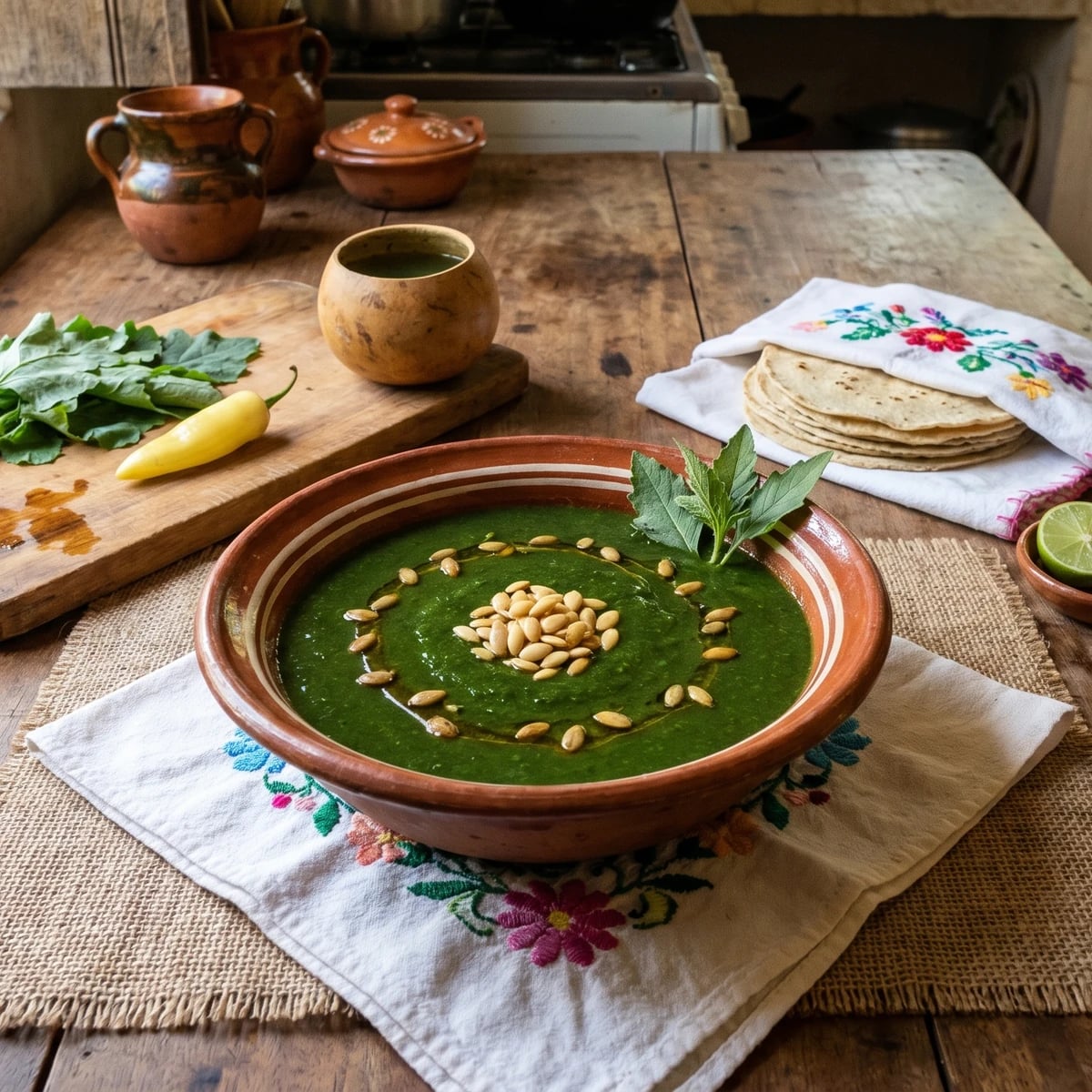
Yucatan's everyday green soup, built on chaya leaves boiled clean of their bite, then blended into a chicken broth thickened with toasted pepita and finished with manteca, lima agria, and habanero at the table.

Soups & Stews
Mexican
Weeknight
Quick Meal
Budget Friendly
15 min
Active Time
35 min cook50 min total
Yield4 to 6 servings

This soup belongs to the Yucatan Peninsula. To Merida, to Valladolid, to the small Maya towns in the interior where chaya grows in the courtyard of almost every house. It is not Mexican food in the generic sense. It is Maya food, a survival from a kitchen tradition that predates the Spanish by a thousand years.

Chaya is the heart of this dish and it has to be respected. The leaves are bigger and tougher than spinach, with a deeper green and a faintly mineral flavor. They also contain hydrocyanic compounds that have to be cooked out. You boil chaya. Always. You do not blend it raw, you do not eat it in a salad, you do not cook it in an aluminum pot. The senoras in the Lucas de Galvez market in Merida will tell you the same thing if you ask. Pregúntale a las señoras del mercado.

The rest of the soup is a Yucatecan base of chicken broth, white onion, garlic, manteca de cerdo, and a sprig of epazote. The pepita is what turns it from a broth into a soup. Toasted on a comal until it puffs, then blended into the chaya, the pepita gives the soup body and a quiet nutty depth that holds the green together. At the table, lima agria, the small, fragrant Yucatecan lime that is nothing like a Persian lime, and finely chopped chile habanero. Each diner finishes their own bowl. That ritual is part of how the Peninsula eats.

This is a weeknight soup in Yucatan. It costs almost nothing if you grow chaya in the yard, which most families do, and it feeds a household well. Saber cocinar es saber vivir, and the Maya cooks who hand this recipe down know exactly what that means.

Chaya (Cnidoscolus aconitifolius), known in Maya as 'chay' or 'chaay,' has been cultivated by the Maya of the Yucatan Peninsula for at least two thousand years and was an everyday green in pre-Columbian Maya kitchens long before spinach reached the Americas. Ethnobotanical surveys document chaya in nearly every traditional Yucatecan dooryard garden, where it serves as a perennial vegetable, a medicinal plant used for diabetes and circulatory complaints, and a living fence; the leaves' hydrocyanic glycosides are neutralized by boiling, a culinary safety practice passed down across generations. Sopa de chaya, sometimes called 'crema de chaya' in Merida home kitchens, is the soup form of a broader Peninsular cooking tradition that also produces brazo de reina (a chaya-and-pepita tamal) and chayuk (a Maya chaya beverage), all of which use the same logic of pairing the green with ground pepita to bind and enrich.

The technique, the tradition, and the story behind every dish.

Discover Culinary Explorer

Ingredients

fresh chaya leaves

Quantity

2 packed cups (about 30 leaves)

stems removed

homemade chicken broth

Quantity

6 cups

white onion

Quantity

1 small

finely chopped

garlic cloves

Quantity

4

finely chopped

manteca de cerdo

Quantity

2 tablespoons

raw hulled pepitas

Quantity

1/3 cup, plus 2 tablespoons for garnish

fresh epazote

Quantity

1 sprig

kosher salt

Quantity

1 1/2 teaspoons, plus more to taste

lima agria (optional)

Quantity

1, halved (or 1/2 naranja agria)

fresh chile habanero (optional)

Quantity

1

finely chopped

hand-pressed corn tortillas (optional)

Quantity

for serving

warmed

Equipment Needed

  • Heavy 4-quart stainless steel or enameled pot
  • Cast iron comal or heavy skillet for toasting pepitas
  • High-powered blender
  • Clay cazuela for serving

Instructions

  1. 1

    Handle the chaya correctly

    Chaya is not spinach. The raw leaves contain hydrocyanic glycosides and must be boiled before eating. This is not optional and it is not folklore. Strip the leaves from the woody stems while wearing gloves if your skin is sensitive to the sap. Rinse them in cold water and set aside. Never blend chaya raw. Never use an aluminum pot for cooking it, the leaves react with aluminum and turn the broth bitter.

    If you cannot find chaya, do not pretend spinach is the same thing. Spinach is a substitution and a compromise. Chaya has a deeper, slightly mineral, almost grassy flavor and a sturdier texture. If you must substitute, use a mix of spinach and a few leaves of Swiss chard, and know you are making something close, not the same dish.
  2. 2

    Boil the chaya

    Bring 4 cups of water to a boil in a stainless steel or enameled pot. Add the chaya leaves and a pinch of salt. Boil for 15 to 20 minutes. The leaves should turn dark, deep green and lose their raw edge. The water will turn a clean herbal green. Drain the leaves and rinse under cold water to stop the cooking. Squeeze them gently to remove excess water. Discard the boiling water. Así se hace y punto.

  3. 3

    Toast the pepitas

    Heat a dry comal over medium. Add the 1/3 cup of pepitas and toast them, shaking the pan constantly. They will pop and puff in about three minutes and turn pale gold. The kitchen will smell nutty and toasted. Pull them off the heat the moment they brown. Burned pepitas turn the soup bitter. Reserve the 2 extra tablespoons unroasted for garnish, or toast them lightly and keep separate.

  4. 4

    Build the base

    In a heavy 4-quart pot, melt the manteca de cerdo over medium heat. Add the chopped onion and cook for four minutes until translucent. Add the garlic and cook one more minute, until you can smell it. La manteca es el sabor. Do not substitute olive oil here. The pork fat carries the flavor of the Peninsula and rounds the green of the chaya.

  5. 5

    Simmer with broth and epazote

    Pour the chicken broth into the pot. Add the boiled chaya, the sprig of epazote, and the salt. Bring to a gentle simmer and cook uncovered for 10 minutes. The chaya will soften further and release its flavor into the broth. Pull out the epazote sprig before blending or it will overpower the soup.

  6. 6

    Blend with the pepitas

    Transfer the soup in batches to a blender. Add the toasted pepitas to the first batch. Blend on high until completely smooth and a deep, even green. Hold a folded towel over the lid when blending hot liquid. Return the puree to the pot and warm it through over low heat. Taste for salt. The pepitas will have thickened the soup slightly and given it a rounded, nutty body that distinguishes a real sopa de chaya from a thin spinach broth.

    Do not boil the soup after blending. A hard boil breaks the emulsion of the pepitas and the surface turns grainy. Keep it at a low whisper of heat from this point on.
  7. 7

    Serve the Yucatecan way

    Ladle the soup into deep bowls. Scatter the reserved pepitas across the surface. Set the halved lima agria and the finely chopped habanero in small dishes at the table. Each diner squeezes the lima agria into their own bowl and adds habanero to their tolerance. Warm corn tortillas alongside, never flour, never on the Peninsula. Recetas probadas y garantizadas.

Chef Tips

  • Chaya can be found in Mexican markets in the Yucatan and increasingly in Latin grocers in cities with Peninsular communities. If you cannot find fresh chaya, frozen chaya from a Yucatecan brand is a real option and not a compromise of flavor, only of texture. Avoid dried chaya, which loses too much of what makes the leaf interesting.
  • Use lima agria if you can find it. It is a distinct fruit, not a substitute for regular lime. It has a perfumed, almost floral bitterness that you cannot get from a Persian lime or a key lime. If you genuinely cannot find lima agria, use a small amount of naranja agria, or in the worst case, a 50/50 mix of regular lime and a few drops of grapefruit juice. Tell yourself the truth: you are making a compromise.
  • The habanero is non-negotiable as the table chile. Jalapeno and serrano are not Peninsular chiles. If habanero is too hot for your guests, chop it very finely and let them add a single grain at a time. The chile xkatik, the pale yellow Yucatecan chile, also works charred and chopped if you can find it.
  • Never cook chaya in aluminum. The leaves react with the metal, the broth turns dingy, and the soup picks up a bitter, metallic finish. Stainless steel, enameled cast iron, or clay only.

Advance Preparation

  • The chaya can be boiled and squeezed up to two days ahead and refrigerated in a covered container. This makes the soup a true weeknight dish.
  • The whole soup keeps in the refrigerator for three days. Reheat gently over low heat, never to a hard boil, or the pepita emulsion will break.
  • The toasted pepitas can be made up to one week ahead and stored in a sealed jar at room temperature.

Frequently Asked Questions

Nutrition Information

1 serving (about 340g)

Calories
145 calories
Total Fat
11 g
Saturated Fat
3 g
Trans Fat
0 g
Unsaturated Fat
7 g
Cholesterol
11 mg
Sodium
640 mg
Total Carbohydrates
6 g
Dietary Fiber
2 g
Sugars
2 g
Protein
7 g

Note: Chef personas and recipes are created with AI assistance. Cook with care: follow safe food-handling practices, check doneness with a thermometer when needed, and adapt for allergies and your kitchen.

Where cooking meets culture.

Culinary guides, cultural storytelling, and the editorial depth that makes cooking meaningful.

Discover Culinary Explorer

More from Yucatecan Soups & Stews

Browse the full collection