
Chef Graziella
Arrosto di Maiale al Latte
Pork loin braised in milk until the liquid transforms into nutty, golden curds that cling to impossibly tender meat. The technique looks like failure and tastes like triumph.
A cooking platform built around craft, culture, and the stories behind what we eat.
Created by
The foundation of Emilian cooking, a dough of eggs and flour that becomes everything: tagliatelle, lasagna verde, tortellini, cappelletti. Before you can make pasta, you must make sfoglia.
My grandmother stood on a crate because she was tiny, and she rolled pasta into sheets nearly as big as a bedspread. The farm girls who came to clean our house could make this dough before they could read. In Emilia-Romagna, this is not a special skill. It is what everyone knows.
Sfoglia is the simplest dough imaginable: flour and eggs. Nothing else. No water, no oil, no salt. The eggs provide moisture, fat, and structure. The flour provides body. Your hands provide everything else. This is where Italian cooking begins, with ingredients so elemental that technique becomes everything.
I did not cook before I married at thirty. When I finally stood at a counter with flour and eggs, the knowledge came as though it had been there all along, waiting to be expressed. The sfogline of Bologna, the women who roll pasta professionally, spend years perfecting their craft. You will not achieve their results on your first attempt. But you can achieve excellent results, results that will make you proud, if you pay attention and practice.
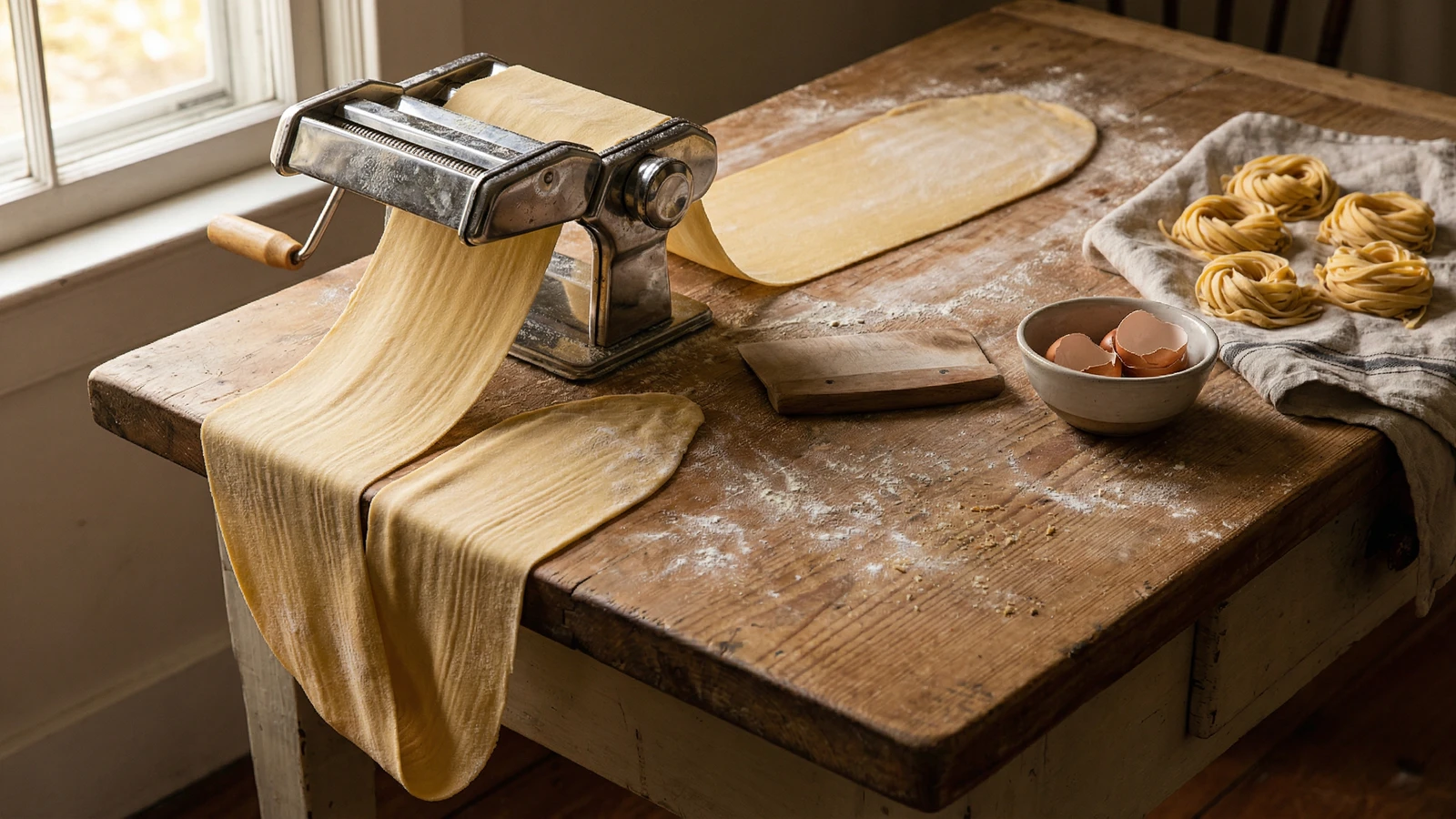
A hand-crank pasta machine transforms this from an expert skill into a learnable one. I recommend it without apology. The goal is you making pasta in your kitchen, not preserving difficulty for its own sake.
Fresh egg pasta has defined Emilian cooking since at least the Renaissance, when the wealthy courts of Bologna, Ferrara, and Modena demanded increasingly refined preparations. The sfogline, professional pasta makers who rolled sheets by hand for noble households, became a recognized trade. Their mattarello, the long rolling pin still used today, could stretch dough thin enough to read a newspaper through.
Quantity
300g (2 1/3 cups)
plus more for dusting
Quantity
3 (about 180g total)
Quantity
1-2 teaspoons
only if needed
| Ingredient | Quantity |
|---|---|
| tipo 00 flourplus more for dusting | 300g (2 1/3 cups) |
| large eggs | 3 (about 180g total) |
| water (optional)only if needed | 1-2 teaspoons |
Mound the flour on a large wooden board or clean countertop. Make a wide well in the center, pushing flour up the sides to create walls about three inches high. The well must be wide enough to contain the eggs. If it is too narrow, the eggs will breach the walls and run across your counter. This is not a disaster, but it is inconvenient.
Crack the eggs directly into the well. Use a fork to beat them lightly, keeping the fork within the well. You are breaking the yolks and mixing them with the whites, nothing more. Do not incorporate flour yet.
With the fork, begin drawing flour from the inner walls of the well into the eggs. Work in small amounts, stirring constantly. The mixture will become a thick paste, then a shaggy mass. When the fork becomes useless, set it aside and begin using your hands. Draw in the remaining flour gradually, pressing and folding the dough together.
Once the dough comes together into a rough mass, begin kneading. Push the heel of your hand into the dough, fold it over, rotate a quarter turn, and repeat. The motion should be rhythmic and firm. Knead for 8 to 10 minutes. The dough will transform from rough and sticky to smooth and elastic. When properly kneaded, it should feel like your earlobe when pressed: soft, pliable, with gentle resistance.
Perform the windowpane test. Pinch off a small piece of dough and stretch it gently between your fingers. Properly developed dough will stretch thin enough to see light through without tearing. If it tears immediately, knead for another two minutes and test again. This test tells you the gluten has developed sufficiently to roll thin without breaking.
Wrap the dough tightly in plastic wrap. Let it rest at room temperature for 30 minutes. This rest is not optional. It relaxes the gluten, making the dough easier to roll. Skip it and the dough will fight you, springing back each time you try to stretch it.
Unwrap the rested dough and cut it into four equal pieces. Work with one piece at a time, keeping the others wrapped to prevent drying. Flatten the piece you are working with into a rough rectangle using your palm.
Set your pasta machine to its widest setting. Pass the flattened dough through once. Fold the resulting strip into thirds, like a letter. Pass it through again on the same setting, feeding the open end first. Repeat this folding and rolling three or four times. This lamination strengthens the dough and creates an even texture.
Now begin reducing the thickness. Pass the dough through each successively narrower setting, one pass per setting, without folding. Support the sheet with your free hand as it emerges. For tagliatelle and pappardelle, stop at the second-to-last setting. For filled pastas like tortellini and ravioli, use the thinnest or second-thinnest setting. The sheet should be thin enough to see the shadow of your hand through it.
For filled pastas, use the sheets immediately while still pliable. For cut pastas like tagliatelle, let the sheets dry on a clean kitchen towel for 10 to 15 minutes until slightly leathery but still flexible, then cut. Pasta that is too wet will stick together when cut. Pasta that is too dry will shatter.
1 serving (about 95g)
Culinary guides, cultural storytelling, and the editorial depth that makes cooking meaningful.
Discover Culinary ExplorerChef Graziella
Pork loin braised in milk until the liquid transforms into nutty, golden curds that cling to impossibly tender meat. The technique looks like failure and tastes like triumph.

Chef Graziella
Thick pork chops rubbed with salamoia bolognese and grilled over live fire. This is how we eat in summer in Emilia-Romagna: simply, outdoors, with family.

Chef Graziella
Hand-rolled pasta sheets wrapped around a filling of ricotta and spinach, covered in besciamella and baked until golden. This is the Sunday cooking of Emilia-Romagna, made without shortcuts.

Chef Graziella
The pasta of the Este dukes, where sweet roasted pumpkin meets fresh egg pasta in shapes like little peasant hats. Dressed only with butter and sage, as Ferrara has done since the Renaissance.