
Chef Joost
Amsterdamse Ossenworst
The name means ox sausage, but the real story is Amsterdam itself: cattle trade, Jewish butchers, VOC spices, and raw beef sliced thin with onion.
A cooking platform built around craft, culture, and the stories behind what we eat.
Created by
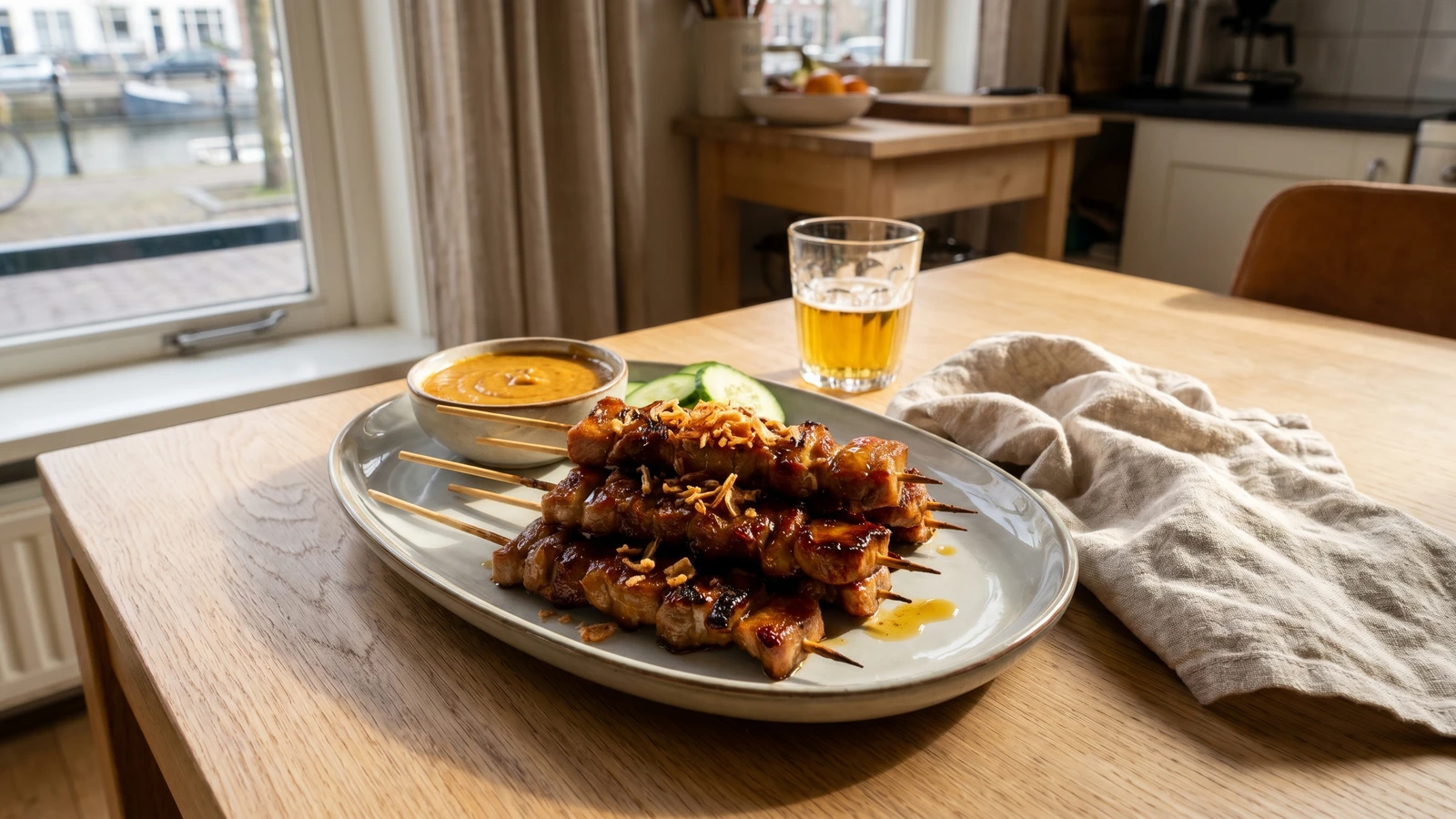
Pork on a bamboo skewer, ketjap lacquered at the edges, peanut sauce waiting beside it: saté babi is the Indo-Dutch table speaking plainly and very well.
The first time I understood the Indo-Dutch table, it wasn't in a book. It was at a family table where the rice was passed with military seriousness, the sambal was treated with proper caution, and the saté disappeared before any polite person could pretend not to count the skewers. History and cookery, they cannot be separated, especially when history comes glossed with ketjap manis, sweet soy sauce, and a little char from the grill.
The name already tells you where the dish has travelled, but it tells it quietly. Saté entered Dutch through Indonesian and Malay sate, and babi means pork. That last word matters. This is not the Muslim street-food satay of Java, where goat or chicken would be the safer guest. Saté babi belongs to other tables too: Chinese-Indonesian, Balinese, Christian Indonesian, and the Indo kitchens that came to the Netherlands after empire ended and memory had to be cooked again in smaller rooms.
But let me tell you a secret: the Dutch did not adopt saté as an exotic ornament. They made it weekday food, party food, barbecue food, borrelhapje, the little bite served with drinks. The method is simple because it should be. Cut pork with enough fat to forgive the fire, marinate it until the ketjap stains it dark, grill it fast, and keep the peanut sauce warm and loose. Hou het altijd simpel, always keep it simple. A skewer should taste of smoke, salt, sweetness, garlic, and the long road home.
Saté entered Dutch food culture through the former Dutch East Indies, where sate was already a broad family of skewered meats served with regional sauces; the Dutch spelling saté preserves that colonial-era borrowing. Rijsttafel, the many-dish rice table developed in the nineteenth-century colonial Indies and later carried to the Netherlands by Indo-European repatriates after 1945 and 1949, made saté one of its most recognizable dishes. Saté babi, specifically pork satay, marks the non-halal branches of the Indo-Dutch table, especially Chinese-Indonesian, Balinese, and Indo home cooking.
Quantity
700g
cut into 2.5cm cubes
Quantity
4 tablespoons
Quantity
2 tablespoons
Quantity
2 tablespoons
Quantity
3
finely grated
Quantity
2
finely grated
Quantity
2 teaspoons
Quantity
1 teaspoon
Quantity
1 teaspoon
or more to taste
Quantity
1/2 teaspoon
Quantity
16
soaked in water for 30 minutes
Quantity
200g
Quantity
250ml
Quantity
2 tablespoons
Quantity
1 tablespoon
Quantity
1
finely grated
Quantity
1 teaspoon
Quantity
1 teaspoon
Quantity
as needed
to loosen the sauce
Quantity
to serve
Quantity
to serve
| Ingredient | Quantity |
|---|---|
| pork shoulder or pork neckcut into 2.5cm cubes | 700g |
| ketjap manis | 4 tablespoons |
| neutral oil | 2 tablespoons |
| lime juice or lemon juice | 2 tablespoons |
| garlic clovesfinely grated | 3 |
| shallotsfinely grated | 2 |
| ground coriander | 2 teaspoons |
| ground cumin | 1 teaspoon |
| sambal oelekor more to taste | 1 teaspoon |
| salt | 1/2 teaspoon |
| bamboo skewerssoaked in water for 30 minutes | 16 |
| smooth peanut butter | 200g |
| coconut milk | 250ml |
| ketjap manis | 2 tablespoons |
| lime juice or lemon juice | 1 tablespoon |
| garlic clovefinely grated | 1 |
| sambal oelek | 1 teaspoon |
| brown sugar (optional) | 1 teaspoon |
| warm waterto loosen the sauce | as needed |
| fried shallots (optional) | to serve |
| cucumber slices (optional) | to serve |
Put the pork in a bowl with the ketjap manis, oil, lime juice, garlic, shallots, coriander, cumin, sambal, and salt. Turn everything through with your hands until the meat is dark and glossy. Cover and refrigerate for at least 2 hours, or overnight if the table can wait.
Soak the bamboo skewers in water for 30 minutes. Bamboo is a useful servant but a poor martyr; soaked skewers char at the tips instead of burning through before the pork is cooked.
Thread 4 or 5 pieces of pork onto each skewer, leaving a little space between pieces so the heat can reach the edges. Do not pack them like luggage. Saté wants browned corners, and browned corners need air.
Warm the peanut butter, coconut milk, ketjap manis, lime juice, garlic, sambal, and brown sugar in a small saucepan over low heat, stirring until smooth. Add warm water a spoonful at a time until it pours thickly from the spoon. Keep it warm, not boiling; peanut sauce turns sulky and grainy when bullied.
Heat a barbecue, grill pan, or heavy skillet until properly hot. Grill the skewers for 8 to 10 minutes, turning often, until the pork is cooked through and the ketjap has lacquered the edges dark brown. A little char is welcome. Black sugar is bitterness, so move any skewer that is catching too fast.
Lay the skewers on a platter and spoon a little peanut sauce over them, with the rest in a bowl for dipping. Scatter with fried shallots and serve cucumber slices alongside for cool crunch. This is borrel food, rijsttafel food, barbecue food: it belongs wherever people reach across the table.
1 serving (about 295g)
Culinary guides, cultural storytelling, and the editorial depth that makes cooking meaningful.
Discover Culinary ExplorerChef Joost
The name means ox sausage, but the real story is Amsterdam itself: cattle trade, Jewish butchers, VOC spices, and raw beef sliced thin with onion.

Chef Joost
The little yellow onion on the Amsterdam borrel board looks modest, until vinegar, turmeric, and patience turn it into the sharp bite that wakes cheese, herring, and sausage.

Chef Joost
The bear's claw of the northern snackbar: a seasoned gehaktbal, Dutch meatball, cut into thick discs, skewered with onion, fried until the edges catch, then dragged through peanut sauce.

Chef Joost
The name points to the drink, not the mood: bitterballen are crisp little balls of beef ragout made for the borrel table, mustard beside them, fingers slightly burned by impatience.