
Chef Lupita
Agua de Alfalfa
Ciudad de México's highland market agua fresca, fresh alfalfa blended with pineapple and lime until bright green, strained clean, and poured cold from the vitrolero.
A cooking platform built around craft, culture, and the stories behind what we eat.

Created by
Baja California's sangria, built on a Valle de Guadalupe Cabernet with its Pacific-fog salinity, fresh orange and lime, piloncillo, Mexican brandy, and a pinch of Guerrero Negro sea salt. The whole coast in a pitcher.
This sangria belongs to Baja California. Specifically to the Valle de Guadalupe, the narrow corridor of vineyards an hour east of Ensenada where the Pacific fog rolls in every morning, condenses over the vines, and gives the Cabernet and Tempranillo grown there a faint salinity you will not find in any other Mexican wine. Esto no es comida de un solo Mexico. Baja drinks differently than Oaxaca, than Yucatan, than the central valleys. This is the northwest, where the desert pours into the glass.
The wine is the recipe. Monte Xanic, L.A. Cetto, Adobe Guadalupe, any serious Valle red will do. Do not use a Spanish Rioja or a cheap supermarket Cabernet from somewhere else. You are not making Spanish sangria. You are making bajacaliforniana sangria, which means the wine has to come from those vineyards on the Pacific side of the Sierra de Juarez. The salinity is the entire point. Take it out and you have lost the dish.
The rest is restraint. Mexican brandy, not Spanish. Fresh orange and lime, not bottled juice. Piloncillo, not white sugar. Mexican limes, the small ones with thin yellow-green skin, not Persian limes from the supermarket. A pinch of sea salt from the Guerrero Negro salt flats further south on the peninsula, because Baja Sur and Baja Norte share a coastline and the salt belongs in the glass. Topo Chico at the end to lift the whole thing. No sugar bomb, no orange soda, no triple sec. Cada estado, su propia cocina, y su propia bebida.
I learned this version from a sommelier in Ensenada who poured it for me at three in the afternoon during the harvest in 2019. She said the sangria she grew up with in Spain was sweet and heavy. The one she made in Baja was dry and salty. The land told her what to do.
Wine has been made in Baja California since the late 18th century, when the Dominican mission of Santo Tomas planted vines in the valley south of Ensenada in 1791, making the region home to the oldest continuously producing wine industry in the Americas. The Valle de Guadalupe itself was settled by Russian Molokan immigrants in 1905 who brought viticultural knowledge and established vineyards that still produce today; the modern Baja wine boom dates to the 1980s with the founding of Monte Xanic and the rise of small-production wineries influenced by California's neighboring Napa tradition. The coastal Mediterranean microclimate, with its morning fog and afternoon sun, gives Valle wines a distinctive mineral salinity that local cooks and sommeliers have only recently begun to emphasize as the region's defining terroir signature, distinguishing Baja sangria from its Spanish and Mexican-central counterparts.
Quantity
1 bottle (750 ml)
Monte Xanic, L.A. Cetto, or Adobe Guadalupe
Quantity
1/4 cup
Don Pedro Reserva Especial or Presidente
Quantity
1 medium
sliced into thin rounds
Quantity
1
juiced
Quantity
1
sliced into thin rounds
Quantity
1
juiced
Quantity
1
cored and cut into 1/2-inch cubes
Quantity
1
cored and cut into 1/2-inch cubes
Quantity
2 tablespoons
grated (or 2 tablespoons demerara sugar)
Quantity
1
broken in half
Quantity
1 pinch
or Maldon
Quantity
1 cup
chilled, added at serving
Quantity
for serving
Quantity
for garnish
| Ingredient | Quantity |
|---|---|
| Valle de Guadalupe Cabernet Sauvignon or TempranilloMonte Xanic, L.A. Cetto, or Adobe Guadalupe | 1 bottle (750 ml) |
| Mexican brandyDon Pedro Reserva Especial or Presidente | 1/4 cup |
| Valencia orangesliced into thin rounds | 1 medium |
| Valencia orange (for juicing)juiced | 1 |
| Mexican limes (limones criollos)sliced into thin rounds | 1 |
| Mexican lime (for juicing)juiced | 1 |
| firm red applecored and cut into 1/2-inch cubes | 1 |
| firm green applecored and cut into 1/2-inch cubes | 1 |
| piloncillograted (or 2 tablespoons demerara sugar) | 2 tablespoons |
| cinnamon stick (canela de Ceylan)broken in half | 1 |
| flaky sea salt from Guerrero Negroor Maldon | 1 pinch |
| mineral water (Topo Chico)chilled, added at serving | 1 cup |
| ice (optional) | for serving |
| fresh mint sprigs (optional) | for garnish |
Pour the bottle of Valle de Guadalupe red into a large glass pitcher or a wide-mouthed clay jarra. This sangria is not built to disguise bad wine. It is built to extend a good one. If your wine is harsh enough that you want to drown it in fruit juice, you have the wrong wine. The Valle reds carry a faint salinity from the coastal terroir, the Pacific fog rolling over the vineyards every morning. That mineral edge is the whole reason this drink works.
In a small bowl, combine the grated piloncillo with the fresh orange juice and the fresh lime juice. Stir until the piloncillo dissolves completely. This takes a minute or two. Piloncillo is unrefined cane sugar pressed into cones. It has a molasses depth that white sugar cannot deliver. La manteca es el sabor in cooked food, and piloncillo es el sabor in cold drinks. Do not substitute brown sugar from a bag. It is not the same thing.
Add the piloncillo-juice mixture to the wine. Stir. Add the orange and lime slices, the cubed red and green apple, the brandy, the cinnamon stick, and the pinch of sea salt. The salt is non-negotiable. A pinch of salt sharpens the fruit and ties the drink back to the Pacific coast where this wine grows. Salinity from coastal terroir. The salt completes the link.
Cover the pitcher and refrigerate for at least four hours. Overnight is better. The apples release their sweetness slowly. The citrus rinds bleed in a soft bitterness that balances the sugar. The cinnamon perfumes the wine without taking it over. Sangria made and drunk in the same hour tastes like wine with fruit floating in it. Sangria that has rested overnight tastes like one thing. No me vengas con atajos.
Just before serving, fish out the cinnamon stick. Pour in the chilled Topo Chico and stir once, gently. The mineral water lifts the drink and keeps it from feeling heavy. Pour over ice into wide glass tumblers, making sure each glass gets some of the macerated fruit. Tear a sprig of mint over the top of each glass. Serve immediately. This is a sangria meant for a long table outdoors, the kind of afternoon that starts at three and ends when the bottle is empty. Saber cocinar es saber vivir, y saber recibir tambien.
1 serving (about 240g)
Culinary guides, cultural storytelling, and the editorial depth that makes cooking meaningful.
Discover Culinary ExplorerChef Lupita
Ciudad de México's highland market agua fresca, fresh alfalfa blended with pineapple and lime until bright green, strained clean, and poured cold from the vitrolero.
Chef Lupita
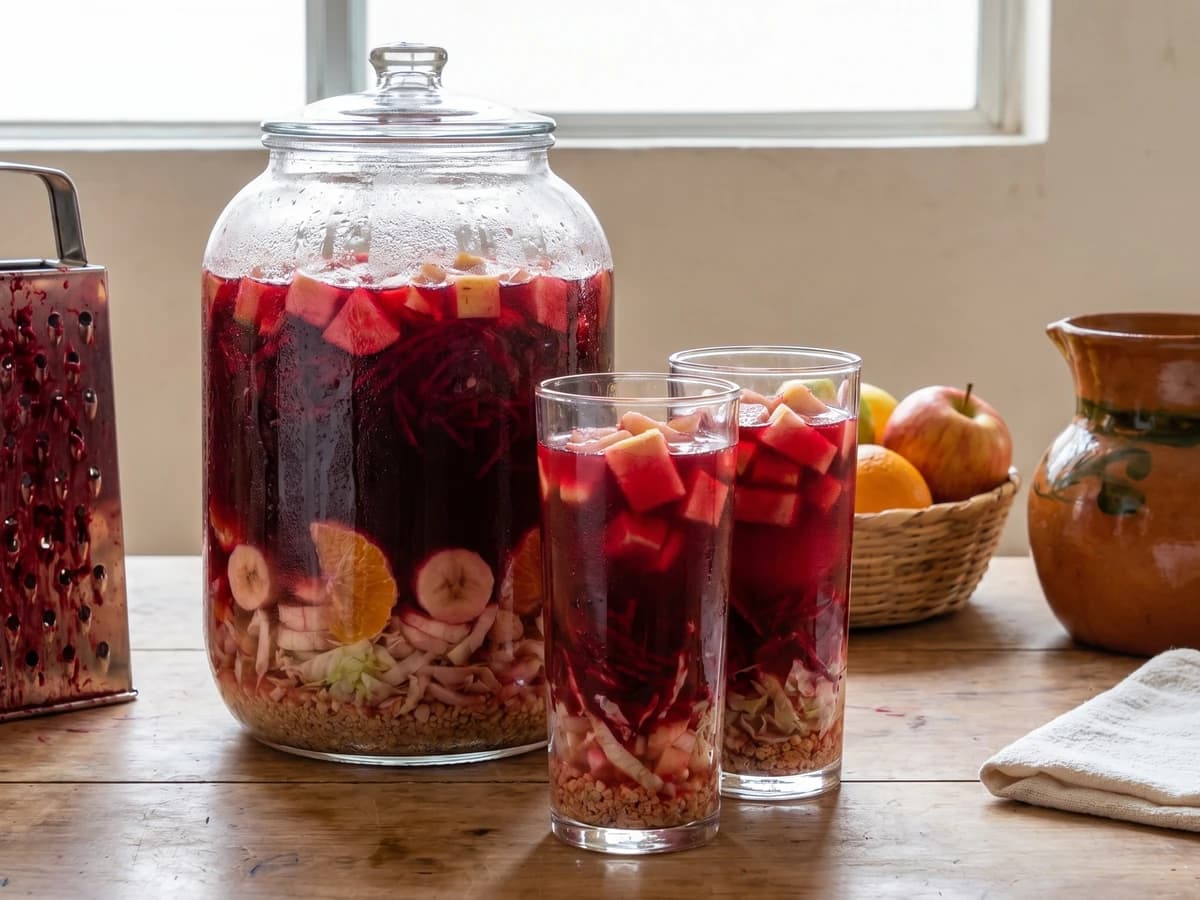
Aguascalientes' Lenten agua fresca, jewel-red from cooked beet and full of apple, banana, orange, lettuce, and ground peanuts, served cold when Holy Week meets the Feria de San Marcos.

Chef Lupita
Sonora and Sinaloa's creamy malted barley water, built on toasted cebada perla, Mexican canela, vanilla from Papantla, and evaporated milk. Pink-beige, rich, and served cold over heavy ice in a heavy glass tumbler. Liquid cookie comfort the northwest way.

Chef Lupita
Yucatán's everyday tonic of boiled chaya leaves blended with lima agria, sugar, and ice. The bright green jarra that sits on every Peninsula table from Mérida to Valladolid.