Culinary Explorer

A cooking platform built around craft, culture, and the stories behind what we eat.
Discover Culinary Explorer
Röggelchen

Röggelchen

Created by

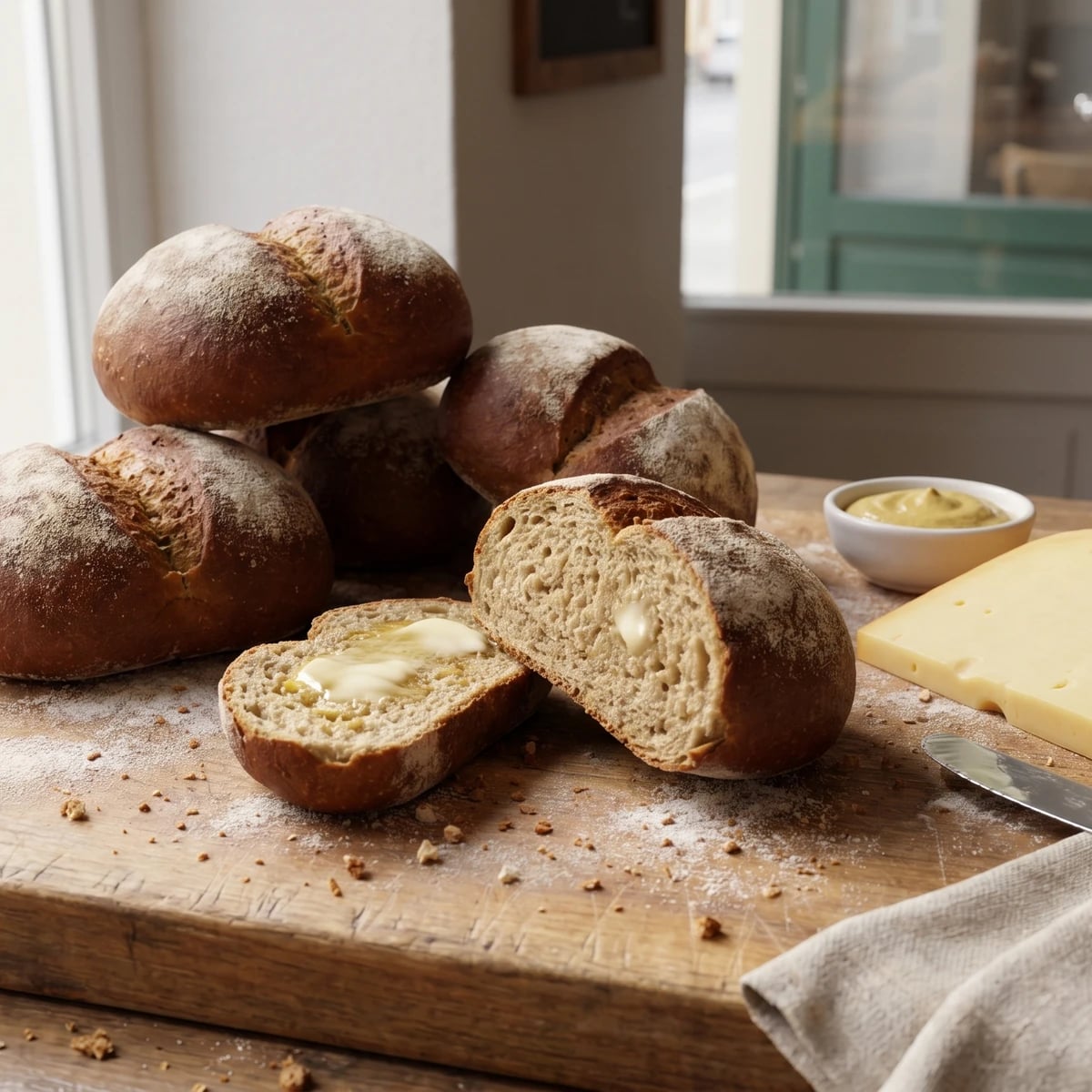
The Rhineland twin roll lives on sourdough, not a bread mix: two small rye rounds baked joined, crusty at the edge, close-crumbed inside, ready for Halve Hahn.

Breads
German
Weeknight
Budget Friendly
Make Ahead
35 min
Active Time
22 min cook16 hr 30 min total
Yield10 twin rolls

Röggelchen is Rhineland bread, the small twin roll that sits under a Halve Hahn in Cologne and next to an Altbier in Düsseldorf. It isn't feast bread. It is Brauhaus bread, market-day bread, the thing you split for butter, cheese, onion, and mustard when supper doesn't need ceremony. It has no season except bread day, which is a good season if the oven is hot.

Cologne will tell you it belongs under mature Gouda with Kölsch; Düsseldorf will put the same joined roll on the Altbier counter and call the argument settled until the next glass. Im Norden anders, im Süden anders: the north leans into darker rye loaves, the south has pale Semmeln and Laugengebäck, and the Rhineland keeps this mixed rye roll, small enough for the hand and sour enough to taste like bread.

The technique is acid. Rye doesn't build the same elastic net as wheat; it needs sourdough acidity to calm the enzymes that would turn the crumb damp and sticky. A Röggelchen without sourdough can look baked and still eat like paste. Give the rye its night, then mix in enough wheat flour to help the little rounds spring. Das braucht seine Zeit.

Watch the proof, not the clock. The dough should swell and show fine cracks in the rye dust before it goes into a hot oven with moisture at the start; the damp heat keeps the skin flexible long enough for lift, then the dry finish sets the crust. Shape two tight balls and let them kiss on the tray. Too much pressure makes a lump, too little and you've baked two rolls that don't know each other.

Röggelchen belongs to the Rhenish mixed-rye bread tradition, where sourdough gave small rolls flavour and keeping power while wheat flour gave enough lift for the Brauhaus basket. The best-known table it sits on is Cologne's Halve Hahn, recorded as a Brauhaus snack by the early 1900s: a buttered Röggelchen with Dutch Gouda, onion, and mustard, not a half chicken despite the name. Düsseldorf shares the form at the Altbier counter, which puts the little twin roll inside the Cologne-Düsseldorf rivalry rather than inside a single national bread style.

The technique, the tradition, and the story behind every dish.

Discover Culinary Explorer

Ingredients

mature rye sourdough starter

Quantity

20g

water

Quantity

180g

room temperature, for the sourdough build

medium rye flour (Roggenmehl Type 1150) or whole rye

Quantity

180g

for the sourdough build

medium rye flour (Roggenmehl Type 1150)

Quantity

270g plus extra

for the final dough and dusting

wheat bread flour (Weizenmehl Type 550 or strong white flour)

Quantity

250g

water

Quantity

275g

lukewarm, for the final dough

fine sea salt

Quantity

12g

Rübensirup (sugar beet syrup) or barley malt syrup (optional)

Quantity

10g

instant yeast (optional)

Quantity

3g

for a steadier home schedule

Equipment Needed

  • Kitchen scale
  • Large mixing bowl or stand mixer
  • Bench scraper
  • Baking stone or heavy baking sheet
  • Metal tray for oven moisture
  • Wire cooling rack

Instructions

  1. 1

    Build the sourdough

    The night before baking, mix the starter with 180g water and 180g rye flour until no dry flour remains. Cover it and leave it 12 to 16 hours at cool room temperature, until domed, sour-smelling, and just beginning to sink at the centre. The sourdough is not decoration here; rye needs acidity to calm the enzymes that would make the crumb damp and gummy.

    Don't fake the sour with vinegar. Vinegar gives sharpness, but it doesn't ferment the flour, and the roll still eats flat. Nicht aus der Tüte, and not from a bottle either.
  2. 2

    Mix the dough

    Scrape the ripe sourdough into a bowl and mix in the 275g lukewarm water and the Rübensirup if using it, so the sourdough loosens before the dry flour goes in. Add both flours, the salt, and the optional yeast, then mix 6 to 8 minutes on low speed or 8 to 10 minutes by hand. The dough should be sticky and heavy, not smooth like a white roll dough; rye has less gluten, so chasing a dry dough with extra flour only gives you hard little stones.

  3. 3

    Let it swell

    Cover the dough and let it rest 20 minutes, then fold it once with wet hands and leave it another 60 to 90 minutes, until it has swollen by about half. Don't wait for a full doubling. Rye dough that overproofs loses its strength, and then your twin rolls spread sideways instead of lifting in the oven.

  4. 4

    Shape the pairs

    Dust the bench lightly with rye flour, turn out the dough, and divide it into 20 pieces of about 55 to 60g each. Shape each piece into a tight round, using damp hands if it sticks, then set the rounds in pairs on baking paper so each two just touch along one side. That small line of contact matters: too far apart and they bake as separate rolls, too much pressure and you get one lump with no middle crease.

    A bench scraper is better than more flour. Rye dough sticks because it is rye, not because you failed. Keep moving and keep the surface lightly dusted.
  5. 5

    Proof the rolls

    Dust the paired rolls with a little rye flour, cover them with a cloth, and proof 45 to 60 minutes, until they look puffy and fine cracks show through the flour. Press the side of one roll gently. If it springs back at once, it needs more time; if the dent stays deep, bake now before the dough tires. Erst verstehen, dann kochen.

  6. 6

    Bake hard first

    Heat the oven to 240C with a baking stone or heavy tray inside, and put a metal tray on the lower rack. Slide in the rolls, pour a small cup of hot water into the lower tray while keeping your face and hands clear, and close the door. Bake 10 minutes, then open the door briefly to let the moisture out, lower the heat to 210C, and bake 10 to 12 minutes more, until the crust is chestnut-brown and the bottoms sound hollow. Moisture at the start keeps the skin flexible for oven spring; dry heat at the end gives the crust its bite.

  7. 7

    Cool before splitting

    Move the Röggelchen to a rack and let them cool at least 30 minutes before cutting. Rye crumb finishes setting as it cools; split it too soon and the knife smears the inside. Serve plain with butter, or make Halve Hahn: split roll, butter, mature Gouda, onion, mustard. Schön ist, was schmeckt.

Chef Tips

  • Use an active rye starter that has been fed within the last day. Weak starter gives weak acid, and weak acid gives a sticky rye crumb, no matter how brown the crust looks.
  • Roggenmehl Type 1150 is the right middle road if you can get it. Whole rye works, but it drinks more water and makes a denser roll; pale rye is easier but less Rhenish in taste.
  • Don't keep adding flour because the dough feels tacky. Rye dough always feels tacky. Damp hands, a scraper, and short confident movements do more good than burying the dough in bench flour.
  • For Halve Hahn, use a thick slice of mature Gouda, raw onion rings, butter, and medium-hot mustard. The joke is that no chicken arrives. The bread is the part that has to be right.
  • Refresh day-old Röggelchen in a 180C oven for 6 to 8 minutes. The crust comes back, and Weggeworfen wird nichts.

Advance Preparation

  • Build the sourdough the night before. That is the real make-ahead step, and it gives the rye the acid it needs before the final dough is mixed.
  • The shaped rolls can be covered and refrigerated after 20 minutes of room-temperature proofing, then baked the next morning from cold; add 2 to 3 minutes to the bake and watch for the same chestnut crust.
  • Baked Röggelchen freeze well the day they are made. Cool them completely, freeze in a bag, then reheat from frozen at 180C for 10 to 12 minutes.

Frequently Asked Questions

Nutrition Information

1 serving (about 110g)

Calories
250 calories
Total Fat
1 g
Saturated Fat
0 g
Trans Fat
0 g
Unsaturated Fat
1 g
Cholesterol
0 mg
Sodium
475 mg
Total Carbohydrates
51 g
Dietary Fiber
5 g
Sugars
1 g
Protein
8 g

Note: Chef personas and recipes are created with AI assistance. Cook with care: follow safe food-handling practices, check doneness with a thermometer when needed, and adapt for allergies and your kitchen.

Where cooking meets culture.

Culinary guides, cultural storytelling, and the editorial depth that makes cooking meaningful.

Discover Culinary Explorer

More from German Rolls & Pretzels (Brötchen & Laugengebäck)

Browse the full collection