
Chef Joost
Amsterdamse Ossenworst
The name means ox sausage, but the real story is Amsterdam itself: cattle trade, Jewish butchers, VOC spices, and raw beef sliced thin with onion.
A cooking platform built around craft, culture, and the stories behind what we eat.
Created by
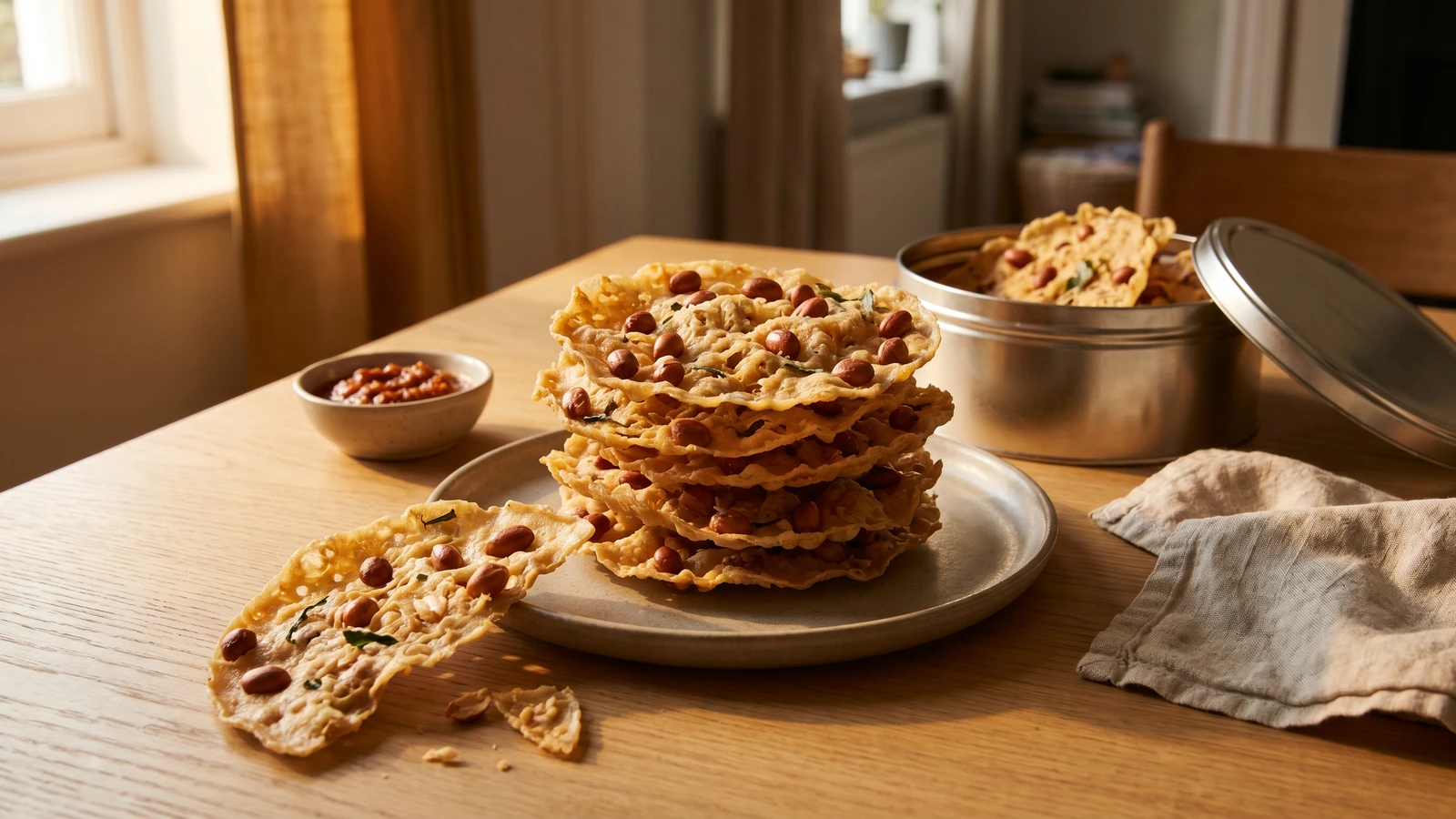
Old spelling, clean crackle at the table: rempejek katjang turns rice flour, coconut milk, lime leaf, and pinda's into the lacy peanut crisp that makes rijsttafel feel complete.
The old spelling is the first crackle. In the Indo cookbooks on my shelf, this little fritter often appears as rempejek katjang: not the modern Indonesian rempeyek kacang, but the older spelling that leaves the crossing visible. Tj is the old way of writing the sound now written c, and katjang is kacang, peanut. The name already tells you where to sit: between Java and the Netherlands, at the rijsttafel, the rice table that taught Dutch kitchens how much could happen around one bowl of rice.
But let me tell you a secret. The smallest dish on a rijsttafel often does the most work. Rempejek is not garnish, not decoration, not the polite extra left at the edge of the plate. It is the crackle that wakes up rice and a rich stew, the dry, spiced answer to sambal heat, sweet kecap, and the glossy patience of a braise. It has no Dutch calendar season in the way herring does; its season is the dinner party, the hour before the doorbell, when tins are filled and everyone pretends not to steal the broken pieces.
Rice flour is the reason, and also the trap. Wheat flour would make a little pancake; rice flour, thinned properly with coconut milk and water, fries into lace. The peanuts must be scattered, not buried, and the batter must run against the side of the wok before it touches the oil. Hou het altijd simpel, always keep it simple: a thin batter, a steady flame, small batches, and complete cooling before the tin closes. Hurry this and you get limp souvenirs. Wait, and you get the sound a rijsttafel needs.
Rempeyek kacang is an Indonesian, especially Javanese, rice-flour cracker fried thin with peanuts or small fish, eaten both as a snack and as a crisp companion to rice. In Dutch colonial cookbooks and Indo-Dutch family recipes it appears as rempejek katjang, preserving older spelling conventions: tj for the sound now written c, and katjang for kacang, peanut. Its place in Dutch culinary history comes through rijsttafel, the many-dish rice service shaped under Dutch colonial rule in Indonesia and carried to the Netherlands by Indo-European and Indonesian families, especially after the 1949 transfer of sovereignty.
Quantity
160g
Quantity
25g
Quantity
2 teaspoons
Quantity
3
Quantity
3
chopped
Quantity
1cm piece
peeled and chopped
Quantity
1/2 teaspoon
Quantity
1 teaspoon
Quantity
1/2 teaspoon
Quantity
1
beaten
Quantity
220ml
well shaken
Quantity
180ml
plus 2-3 tablespoons as needed
Quantity
6
center ribs removed and very finely shredded
Quantity
150g
small and whole, or halved if large
Quantity
1 liter
for frying
| Ingredient | Quantity |
|---|---|
| rice flour | 160g |
| tapioca starch | 25g |
| coriander seeds | 2 teaspoons |
| candlenuts (kemiri), or macadamia nuts | 3 |
| garlic cloveschopped | 3 |
| fresh kencur (sand ginger) (optional)peeled and chopped | 1cm piece |
| ground turmeric | 1/2 teaspoon |
| fine sea salt | 1 teaspoon |
| sugar | 1/2 teaspoon |
| eggbeaten | 1 |
| coconut milkwell shaken | 220ml |
| cold waterplus 2-3 tablespoons as needed | 180ml |
| makrut lime leaves (daun jeruk purut)center ribs removed and very finely shredded | 6 |
| raw unsalted peanuts (pinda's)small and whole, or halved if large | 150g |
| neutral oilfor frying | 1 liter |
Put the coriander seeds and candlenuts in a dry small pan over medium heat and toast for 2 to 3 minutes, until the coriander smells warm and the candlenuts show pale golden patches. Grind them with the garlic, kencur if using, turmeric, salt, and sugar to a rough paste. Candlenuts should never be eaten raw; the toasting and later frying take care of them, and the flavour becomes round instead of waxy.
Whisk the rice flour and tapioca starch in a bowl. Add the spice paste, beaten egg, coconut milk, and cold water, then whisk until smooth and thin, like single cream. Stir in the shredded lime leaves and rest the batter for 15 minutes. Do not add the peanuts yet; they sink, sulk, and make clumsy fritters.
Pour the oil into a wok or heavy pan to a depth of about 4cm, never more than halfway up the pan. Heat to 170C. If you have no thermometer, a small drop of batter should sink briefly, rise, and lace at the edges without turning brown at once. Set a wire rack over a tray before you begin, because hot fritters wait for no scholar.
Stir the batter, then put about 2 tablespoons of batter into a small ladle with 6 to 8 peanuts. Tip it against the inner wall of the wok just above the oil so the batter runs down in a thin fan. It should cling for a few seconds, set, then release and float into the oil. If you use a straight-sided pan, pour a very thin oval directly into the oil with a spoon; less pretty, still honest.
Fry each rempejek for 2 to 3 minutes, turning once, until pale gold, firm, and quieting in the oil. The peanuts should smell toasted, not dark. If the fritters brown before they harden, the oil is too hot; if they drink oil and stay soft, the oil is too cool or the batter is too thick. Drain on the rack and repeat, stirring the batter before every ladle because rice flour settles like an archivist guarding a footnote.
Let the fritters cool completely before serving or storing. Crispness arrives as the last moisture leaves, so closing the tin too soon traps damp and ruins your patience. Serve at room temperature beside rijsttafel, with rice, braises, sambal, and acar, or pass them as a snack with drinks before the meal.
1 serving (about 28g)
Culinary guides, cultural storytelling, and the editorial depth that makes cooking meaningful.
Discover Culinary ExplorerChef Joost
The name means ox sausage, but the real story is Amsterdam itself: cattle trade, Jewish butchers, VOC spices, and raw beef sliced thin with onion.

Chef Joost
The little yellow onion on the Amsterdam borrel board looks modest, until vinegar, turmeric, and patience turn it into the sharp bite that wakes cheese, herring, and sausage.

Chef Joost
The bear's claw of the northern snackbar: a seasoned gehaktbal, Dutch meatball, cut into thick discs, skewered with onion, fried until the edges catch, then dragged through peanut sauce.

Chef Joost
The name points to the drink, not the mood: bitterballen are crisp little balls of beef ragout made for the borrel table, mustard beside them, fingers slightly burned by impatience.