
Chef Makoa
Faiʻai Eleni (Sāmoan Mackerel in Coconut Cream)
Sāmoa's faiʻai eleni turns tinned mackerel, onion, and coconut cream into a quick, generous supper, the pantry fish that feeds the whole ʻaiga beside talo, ʻulu, green banana, or rice.
A cooking platform built around craft, culture, and the stories behind what we eat.
Created by
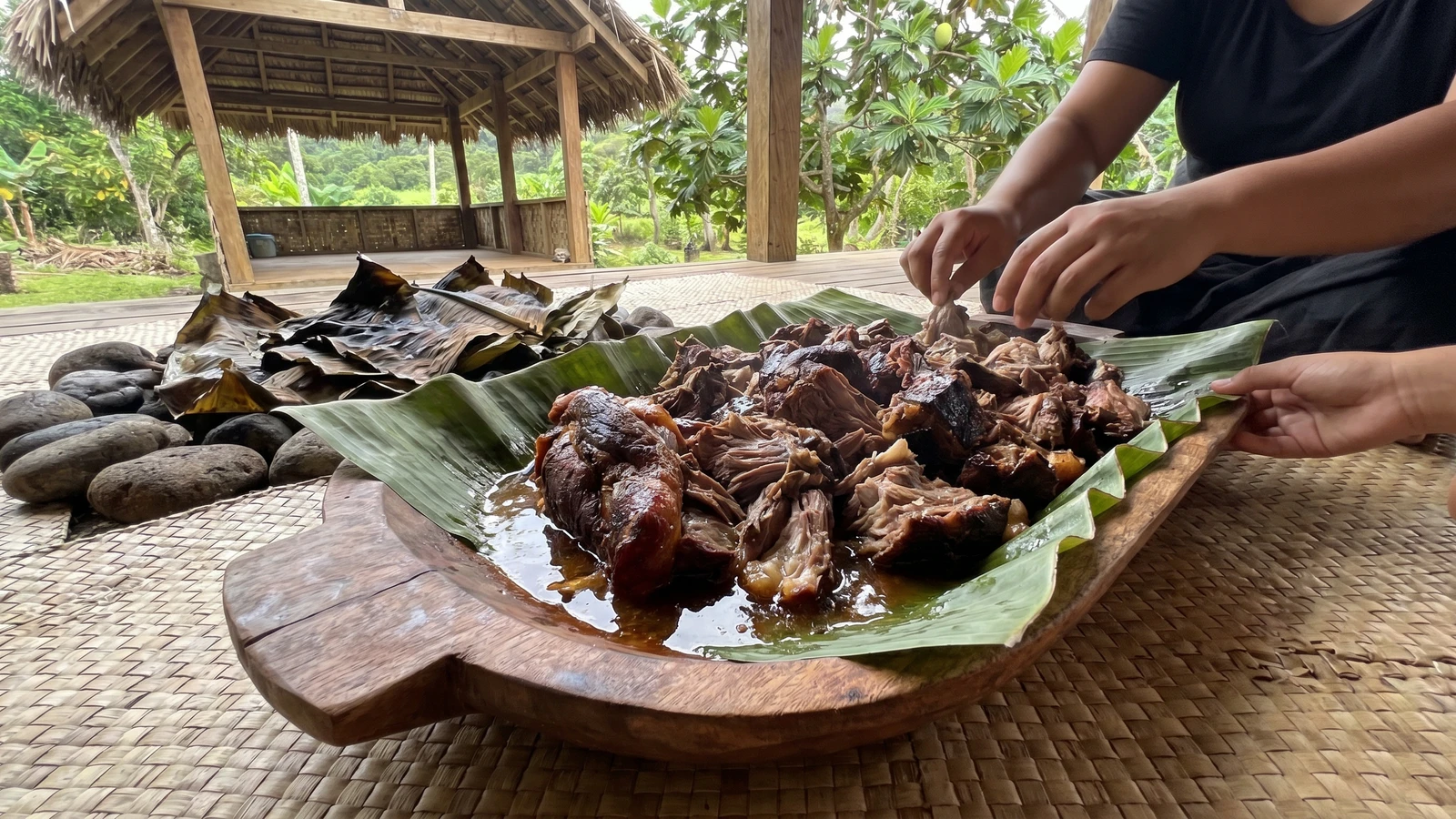
Sāmoa’s puaʻa umu, the toʻonaʻi pork from the above-ground hot-stone umu, brought into a home oven with banana leaf, salt, smoke, and patient hands.
The first time I sat at a Sāmoan umu, the old men let the young ones do the lifting and the stacking, and I did what a Hawaiian cousin should do: I watched more than I talked. Umu, the Sāmoan earth oven, is not a pit like the imu back home in Hawaiʻi. The stones sit above the ground, heated hard, then the food is layered over them, leaf and pork and fish and palusami, all of it covered until the fire gives the family its meal.
In Sāmoa, puaʻa umu belongs to the Sunday toʻonaʻi, the post-church meal where the aiga, the extended family, gathers around food cooked over hot stones in the above-ground umu. The same earth-oven knowledge travels across the Triangle by different names: imu in Hawaiʻi, umu in Sāmoa and Tonga, ahimaʻa in Tahiti, umukai in the Cook Islands, hāngī in Aotearoa. Pig was tied to chiefly and ceremonial food grammar across many islands before it became part of more ordinary celebration tables, and today the oven version sits beside sapasui, rice, corned beef, and all the living foods Sāmoa actually eats.
Quantity
1 (5 to 6 pounds)
Quantity
2 tablespoons
plus more to taste
Quantity
1 tablespoon
for browning
Quantity
1 tablespoon
preferably mesquite or kiawe-style
Quantity
2 tablespoons
Quantity
8 to 10
thawed if frozen, wiped clean, thick ribs trimmed
Quantity
1 large
sliced
Quantity
6
smashed
Quantity
1 cup
Quantity
as needed
for serving alongside palusami
| Ingredient | Quantity |
|---|---|
| bone-in pork shoulder or picnic shoulder (puaʻa) | 1 (5 to 6 pounds) |
| coarse sea saltplus more to taste | 2 tablespoons |
| brown sugar (optional)for browning | 1 tablespoon |
| liquid smokepreferably mesquite or kiawe-style | 1 tablespoon |
| neutral oil | 2 tablespoons |
| banana leavesthawed if frozen, wiped clean, thick ribs trimmed | 8 to 10 |
| onionsliced | 1 large |
| garlic clovessmashed | 6 |
| water | 1 cup |
| fresh coconut cream (peʻepeʻe) (optional)for serving alongside palusami | as needed |
Pat the pork dry and score the fat cap in shallow crosshatches. Rub the salt into every side, working it into the cuts, then rub on the brown sugar if using, the liquid smoke, and the oil. Let it sit at room temperature for 30 minutes while the oven heats, or cover and refrigerate overnight for deeper seasoning.
Pass the banana leaves briefly over a burner flame, or warm them in the oven for a few minutes, just until they turn glossy and bend without cracking. Wipe them clean. The leaf should fold around the pork like it wants to be there.
Heat the oven to 300F. Line a heavy Dutch oven or roasting pan with overlapping banana leaves, leaving enough hanging over the sides to fold back across the top. Scatter the onion and garlic underneath, set the pork fat-side up, pour the water around it, then wrap the leaves tightly over the meat.
Cover the pot tight with its lid, or seal the roasting pan with parchment and heavy foil. Cook for 5 to 5 1/2 hours, until the bone twists loose and the meat pulls apart with two forks. Don't keep opening it. The umu by any name is one oven, and one law too: the fire keeps its own time.
Let the covered pork rest for 20 minutes. When you open the leaves, the meat should be deep brown at the edges, glossy with rendered fat, and soft enough that the shoulder gives up without a fight. If it is still tight, no blame the pork. Cover it again and give it more time.
Pull the pork into big, tender pieces and fold the pan juices through until the strands shine. Taste for salt. Serve it family-style with palusami, taro or breadfruit, rice, and whatever else is on the table. Deep food sits beside everyday food. That's how a living table works.
1 serving (about 210g)
Culinary guides, cultural storytelling, and the editorial depth that makes cooking meaningful.
Discover Culinary ExplorerChef Makoa
Sāmoa's faiʻai eleni turns tinned mackerel, onion, and coconut cream into a quick, generous supper, the pantry fish that feeds the whole ʻaiga beside talo, ʻulu, green banana, or rice.

Chef Makoa
Sāmoa's faiʻai feʻe is reef octopus simmered patient in fresh coconut cream, rich and glossy enough to eat beside talo at toʻonaʻi, with the ocean feeding the whole aiga.

Chef Makoa
Sāmoa's taro-leaf parcel made generous with pisupo, coconut cream, and time: a toʻonaʻi kind of comfort, with Tonga's lū pulu and Hawaiʻi's laulau sitting close as cousins.

Chef Makoa
Sāmoa’s oka iʻa bathes fresh fish in citrus and peʻepeʻe, fresh coconut cream, then runs tomato, cucumber, and onion through it cold. Same fish as Tahiti’s ʻia ota, different bowl.