
Chef Lupita
Aguascalientes Beef Tongue Pozole (Pozole de Lengua)
Aguascalientes' Bajio pozole de lengua, built with cacahuazintle hominy, tender beef tongue, chile ancho and guajillo, with xoconostle brightness and table garnishes.
A cooking platform built around craft, culture, and the stories behind what we eat.
Created by
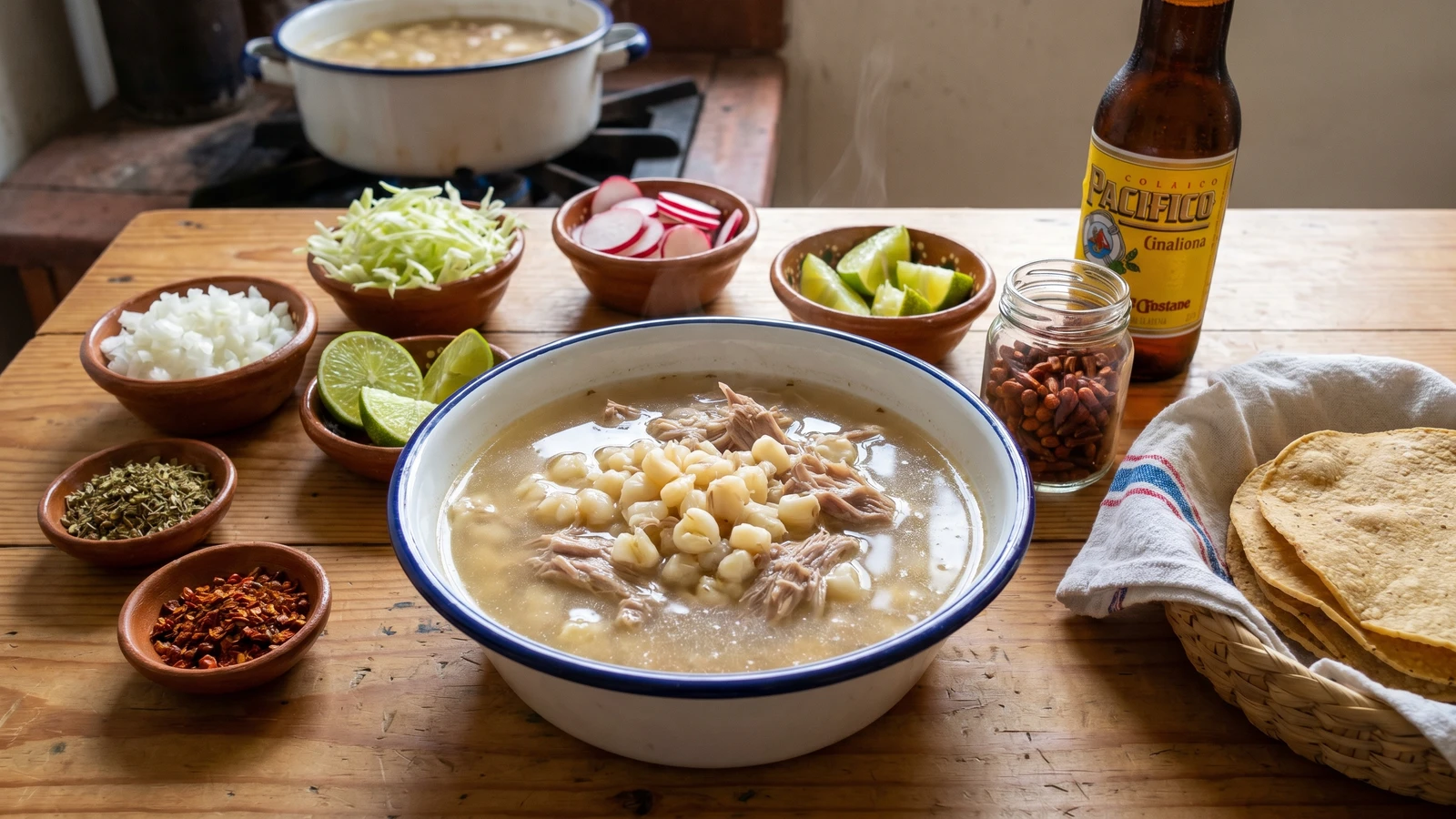
Sinaloa's white pozole, pork shoulder and hominy in a clear garlic-onion broth, no chile in the pot. The heat comes at the table, from a pinch of crushed chiltepin and a squeeze of lime.
Pozole blanco is Sinaloan. Not Guerrero's white pozole, which has its own school and its own rules. This is the noroeste version, the one that ladles up clear and clean in Culiacan and Los Mochis and Mazatlan, with no chile in the pot and the heat decided by each diner at the table.
The technique is restraint. You build a broth from pork shoulder, neck bones, and a split pig's foot if you can find one. You start it in cold water. You skim the foam until the surface runs clear. You add white onion, garlic, bay, salt. That is the entire pot. There is no guajillo, no ancho, no toasting, no frying of chile paste. If you put chile in the pot, you have made pozole rojo, badly. The whole point of pozole blanco is that the broth is clean enough to taste the pork and the corn for what they are.
The heat comes at the table, and in Sinaloa it comes from the chiltepin. Not chile de arbol, not cayenne, not a dash of hot sauce. Chiltepin, the small wild chile that grows in the hills of the noroeste from Sonora down through northern Sinaloa. You crush a pinch between your fingers over the bowl. It is sharp and quick and gone in two seconds, the way the women in Sinaloan kitchens have eaten it for generations. Cada estado, su propia cocina.
My mother did not make this one. The Jalisciense pot was always rojo. But I learned this recipe from a senora in El Recodo who gave me her version when I told her I was writing about all 32 states. She made me skim the foam three times before she let me put the lid on. She said: 'Si la espuma se queda, el pozole se ve sucio. Y un pozole sucio no es de Sinaloa.' If the foam stays, the pozole looks dirty. And a dirty pozole is not Sinaloan. Saber cocinar es saber vivir.
Pozole derives from the Nahuatl 'pozolli,' meaning frothy or foamy, a reference to the way nixtamalized corn kernels burst open during the long simmer. The three classic regional pozoles, rojo from Jalisco, verde from Guerrero, and blanco shared between Guerrero and Sinaloa, were codified through 19th- and 20th-century regional pride, but the white version is the oldest in form, closest to the pre-Columbian ceremonial dish prepared by the Mexica with hominy and meat in a clear broth. Sinaloa's chiltepin tradition, which ties this pozole to the noroeste rather than to central Mexico, comes from the wild chile populations that grow on the slopes of the Sierra Madre Occidental and which the indigenous peoples of the region, including the Yoreme and the Cahita, were harvesting and trading long before the arrival of the Spanish.
Quantity
3 pounds
cut into 2-inch chunks
Quantity
1 pound
Quantity
1
split
Quantity
1
halved
Quantity
1
halved crosswise, plus 4 cloves separated
Quantity
3
Quantity
1 tablespoon, plus more to taste
Quantity
2 cans (29 ounces each)
drained and rinsed, or 1 pound dried hominy soaked overnight
Quantity
1 tablespoon, plus more for serving
Quantity
8 cups, plus more as needed
Quantity
1 medium
finely diced
Quantity
2 bunches
thinly sliced
Quantity
1 small head
thinly shredded
Quantity
8
cut into wedges
Quantity
for serving
crushed
Quantity
for serving
Quantity
for serving
| Ingredient | Quantity |
|---|---|
| bone-in pork shouldercut into 2-inch chunks | 3 pounds |
| pork neck bones or pork ribs | 1 pound |
| pig's foot (optional)split | 1 |
| large white onionhalved | 1 |
| head of garlichalved crosswise, plus 4 cloves separated | 1 |
| bay leaves | 3 |
| kosher salt | 1 tablespoon, plus more to taste |
| Mexican-style hominydrained and rinsed, or 1 pound dried hominy soaked overnight | 2 cans (29 ounces each) |
| dried Mexican oregano | 1 tablespoon, plus more for serving |
| cold water | 8 cups, plus more as needed |
| white onion (for table) (optional)finely diced | 1 medium |
| radishes (optional)thinly sliced | 2 bunches |
| green cabbage (optional)thinly shredded | 1 small head |
| limes (optional)cut into wedges | 8 |
| dried chiltepin chiles (optional)crushed | for serving |
| hand-pressed corn tostadas (optional) | for serving |
| Mexican crema (optional) | for serving |
Place the pork shoulder, neck bones, and pig's foot if using in a heavy 8-quart stockpot. Cover with the cold water by at least two inches. Cold water draws the flavor out of the bones slowly. A rolling boil from a hot start clouds the broth and toughens the meat. This pozole is white and clean. The clarity is the dish.
Bring the pot to a bare simmer over medium heat. As it heats up, gray foam will rise to the surface for the first fifteen to twenty minutes. Skim it off with a ladle and discard. Skim until the foam stops rising and the surface looks clear. This step is what separates a clean Sinaloan broth from a muddy one. No me vengas con atajos.
Once the broth runs clear, add the halved white onion, the halved head of garlic, the bay leaves, and the salt. There is no chile in the pot. That is the whole point of pozole blanco. Let the pork, the garlic, and the onion do the work. Cover partially and simmer for two hours, until the meat pulls apart with a fork. If the water level drops below the meat, add more hot water to keep everything submerged.
Lift the pork pieces and bones out of the broth with a slotted spoon and set aside until cool enough to handle. Strain the broth through a fine-mesh sieve into a clean pot. Discard the spent onion, garlic, and bay leaves. Pull the meat off the bones, shred it into rough pieces with your fingers, and discard the bones, fat, and cartilage. Return the shredded meat to the strained broth.
If using canned hominy, add it now along with the four separated garlic cloves, lightly smashed, and the tablespoon of dried oregano. Simmer for thirty minutes more, partially covered, so the hominy absorbs the broth and the flavors marry. If you soaked dried hominy, it should have already simmered for two hours in its own water until the kernels burst open like flowers; add it now with its cooking liquid. Asi se hace y punto.
Now is the moment that decides everything. Taste the broth. The hominy will have softened the salt, so it almost always needs more. Add salt half a teaspoon at a time until the broth tastes assertive on its own, before any garnish. A weak white pozole has nowhere to hide. There is no chile to mask it. The broth has to stand up clean.
Arrange the diced onion, sliced radishes, shredded cabbage, lime wedges, crushed chiltepin, dried oregano, and tostadas in small bowls in the center of the table. Pozole blanco is built by the diner, not by the cook. Each person dresses their own bowl. The chiltepin is the Sinaloan signature. A pinch is enough. Two pinches if you grew up with it.
Ladle the hot pozole into deep bowls, making sure each gets a generous mound of shredded pork and plenty of hominy. Serve immediately. Pass the garnishes. Squeeze the lime first. Then the cabbage and radish for crunch. Then the onion. Then the oregano crumbled between your palms over the bowl. Finally the chiltepin. That order is not arbitrary. It builds the flavor in layers, the way they do it in Culiacan.
1 serving (about 450g)
Culinary guides, cultural storytelling, and the editorial depth that makes cooking meaningful.
Discover Culinary ExplorerChef Lupita
Aguascalientes' Bajio pozole de lengua, built with cacahuazintle hominy, tender beef tongue, chile ancho and guajillo, with xoconostle brightness and table garnishes.

Chef Lupita
Veracruz's Gulf coast rice from Alvarado, built with seafood stock, tomato, chile chipotle, epazote, shrimp, fish, jaiba, and pulpo, served loose and brothy in a clay cazuela.

Chef Lupita
Costa Chica's wet salt-beef stew, built from chile costeño, guajillo, tomato, manteca, yuca, plantain, and masa dumplings, the ranching pot of Cuajinicuilapa and Pinotepa.

Chef Lupita
Michoacán's P'urhépecha atápakua is a masa-thickened sauce and stew at once, built with pork, chile guajillo, and hierbabuena added only at the end.