
Chef Lupita
Acitrón de Cidra Conventual
Puebla's convent-style acitrón, made from cidra peel instead of endangered biznaga, built through repeated syrup soakings until the cubes turn firm, translucent, and ready for rosca or chiles en nogada.
A cooking platform built around craft, culture, and the stories behind what we eat.
Created by
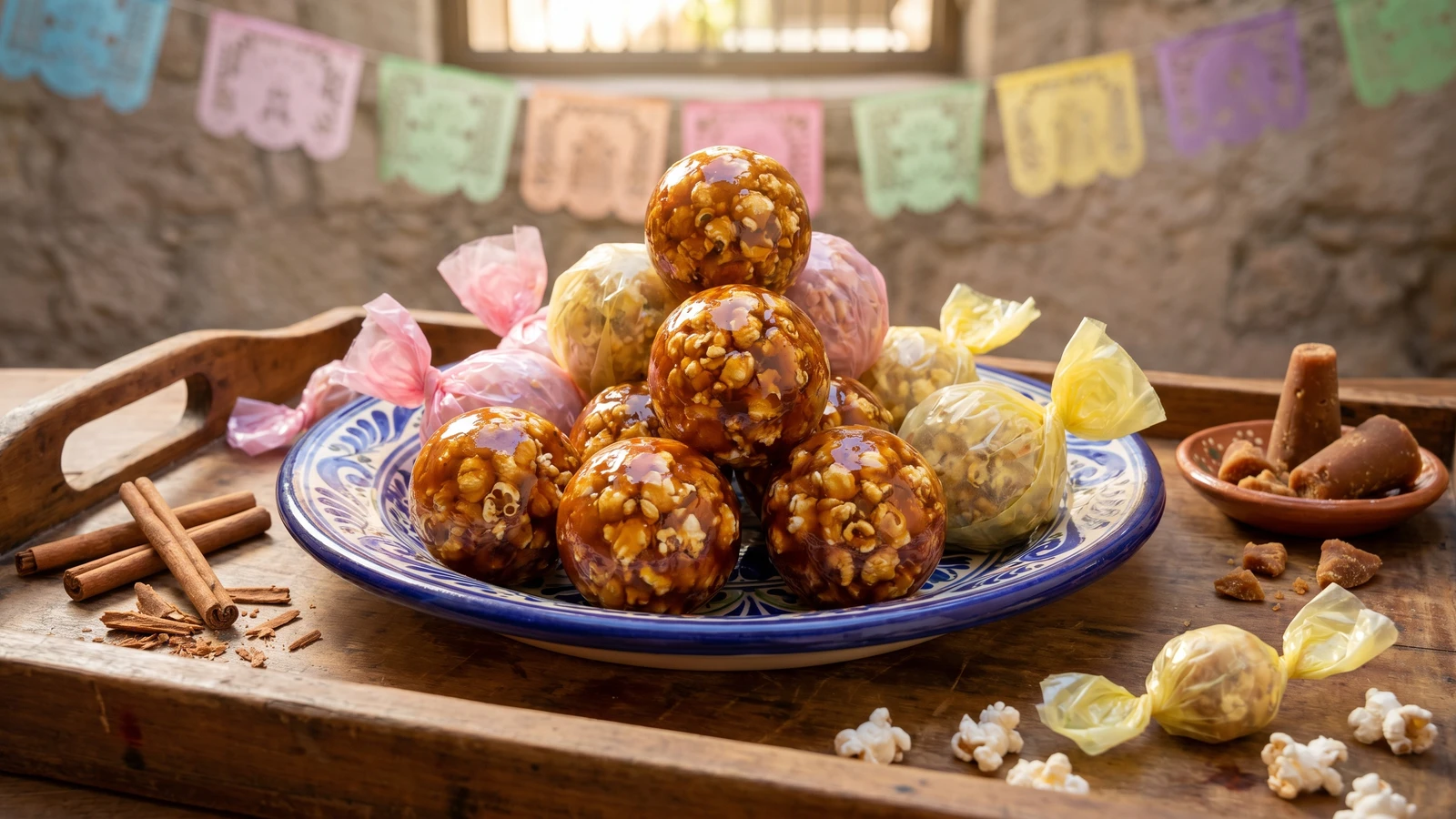
Campeche's holiday confection of popcorn bound in dark piloncillo caramel and canela, shaped by hand into spheres the size of a small orange. The dulce that anchors every feria from Champotón to San Francisco de Campeche.
This is from Campeche. Not from Yucatán, not from Quintana Roo. Campeche. The three states of the peninsula share a coast and a history, but they do not share their dulces, and ponteduro belongs to the campechanos.
You will find these spheres stacked in pyramids at every feria patronal across the state, wrapped in twisted cellophane the color of the Caribbean, sold by the women who have been making them the same way for sixty years. The recipe is short: popped maíz, piloncillo, canela, a squeeze of lime to keep the syrup from crystallizing, and the patience to cook the caramel to hard-crack so the spheres hold together. That last part is what separates a good ponteduro from a sad one. If your caramel does not reach hard-crack, you have made a sticky mess. If it goes past, you have made bitter glass. The window is narrow and there are no shortcuts. Así se hace y punto.
The name itself, ponteduro, ponte duro, set yourself hard, is the recipe in two words. The piloncillo has to harden completely around each kernel so the sphere snaps clean when you bite into it. My mother did not make ponteduro, she was from Jalisco, but I learned this one from doña Carmela in Pomuch, a town better known for its bread than its dulces, who let me sit in her kitchen for three afternoons during the fiestas of la Virgen de la Asunción. She wrapped each finished sphere herself, twisted the cellophane ends in opposite directions, and told me that the day a Campechana cannot make ponteduro is the day her grandchildren stop coming home for the fair. Saber cocinar es saber vivir.
Ponteduro belongs to a family of pre-Hispanic maíz confections that survived the colonial period by absorbing Spanish ingredients without losing their indigenous structure: the toasted or popped corn base predates the conquest, while the piloncillo binder arrived with sugarcane cultivation in the 16th century along the Gulf coast. Campeche, founded in 1540 as San Francisco de Campeche and fortified against pirate raids through the 17th century, developed its own distinct dulcería tradition tied to the seasonal ferias of the walled city and the smaller towns of the interior like Hecelchakán, Pomuch, and Champotón. The dish shares roots with Oaxaca's palanquetas and Michoacán's alegrías, but the campechano insistence on the spherical shape, the canela infusion, and the cellophane wrap is unique to the state's feria culture.
Quantity
8 cups
from about 1/3 cup unpopped kernels, unsalted and unbuttered
Quantity
1 cup
for added crunch
Quantity
1 pound (about 2 cones)
chopped roughly
Quantity
1/2 cup
Quantity
1 stick, about 3 inches
Quantity
1 tablespoon
Quantity
1/4 teaspoon
Quantity
2 tablespoons
for greasing hands and pan
Quantity
1/2 cup
skins removed
Quantity
1 tablespoon
lightly toasted
| Ingredient | Quantity |
|---|---|
| freshly popped popcornfrom about 1/3 cup unpopped kernels, unsalted and unbuttered | 8 cups |
| toasted maíz palomero or pepitas (optional)for added crunch | 1 cup |
| piloncillochopped roughly | 1 pound (about 2 cones) |
| water | 1/2 cup |
| canela (Mexican cinnamon) | 1 stick, about 3 inches |
| fresh lime juice | 1 tablespoon |
| sea salt | 1/4 teaspoon |
| manteca de cerdo (pork lard)for greasing hands and pan | 2 tablespoons |
| toasted cacahuates (peanuts) (optional)skins removed | 1/2 cup |
| anise seed (optional)lightly toasted | 1 tablespoon |
Pop the corn in a heavy pot with a little lard or in a hot-air popper. No salt, no butter. Plain. Pick through the popped kernels and discard any unpopped ones, the viejitas, because they will crack a tooth and ruin the ponteduro. Spread the popcorn on a wide sheet pan along with the peanuts and anise if using. Keep it nearby. Once the caramel reaches temperature, you will move fast.
Chop the piloncillo cones into rough pieces. The cones are hard, use a heavy knife and your weight, or wrap them in a towel and tap with a hammer. Put the piloncillo, water, canela stick, and salt in a heavy 4-quart pot. Bring to a low boil over medium heat, stirring until the piloncillo dissolves completely. The syrup will go from cloudy brown to a deep mahogany within ten minutes.
Once the piloncillo is dissolved, stop stirring. Let the syrup bubble steadily over medium heat. You are looking for the hard-crack stage, around 300 degrees Fahrenheit on a candy thermometer. Without a thermometer, drop a spoonful into a glass of cold water. If it sets into a brittle thread that snaps between your fingers, it is ready. If it bends, keep cooking. This is the step that decides whether your ponteduro holds together or falls apart in your hand. No me vengas con atajos.
Pull the canela stick out. Add the lime juice and swirl the pot. Working immediately, pour the hot syrup over the popcorn in a thin, steady stream while folding gently with a wooden spoon or silicone spatula. Coat every kernel without crushing them. The syrup is over 280 degrees, do not touch it. The mass will start to clump and turn glossy mahogany within thirty seconds. You have maybe two minutes before it sets up. Move.
Grease your palms generously with manteca. The lard creates a barrier between your hands and the hot caramel and gives the spheres their characteristic shine. Scoop up handfuls of the warm mixture and press them firmly into balls about the size of a small orange, the size of the ponteduros you find at the Mercado Pedro Sainz de Baranda in San Francisco de Campeche. Press hard. Loose ponteduro falls apart. Set each sphere on a sheet pan lined with parchment or greased with lard.
Let the ponteduros cool completely at room temperature for at least one hour. They should be rock-hard and glossy. Wrap each one in cellophane or wax paper the way the vendors at the ferias do, twisting the ends. Stored in a dry, sealed container, they keep for two weeks. Humidity is the enemy. In Campeche's coastal damp, the vendors know to sell them the day they make them. Recetas probadas y garantizadas.
1 serving (about 36g)
Culinary guides, cultural storytelling, and the editorial depth that makes cooking meaningful.
Discover Culinary ExplorerChef Lupita
Puebla's convent-style acitrón, made from cidra peel instead of endangered biznaga, built through repeated syrup soakings until the cubes turn firm, translucent, and ready for rosca or chiles en nogada.

Chef Lupita
Ciudad de México's Tulyehualco alegría is popped huautli folded into piloncillo honey, pressed with peanuts, pepitas, and raisins, then cut into the rectangular bars that built a pueblo's identity.

Chef Lupita
Oaxaca's pre-Columbian amaranth bar, popped on a hot comal and bound with piloncillo, honey, and the sacred Zapotec grain that the Spanish tried, and failed, to outlaw.

Chef Lupita
Querétaro's mercado candy of popped amaranto pressed with dark piloncillo syrup, pepitas, pecans, and cacahuate, a Bajío sweet that respects the seed before it decorates the table.