
Chef Dimitra
Agrafa Batzina (Μπατζίνα), Courgette and Feta Pie
Agrafa's batzina is the no-phyllo pie of Karditsa: grated courgette, feta, eggs, milk, and flour poured thin into a hot oiled tapsi.
A cooking platform built around craft, culture, and the stories behind what we eat.
Created by
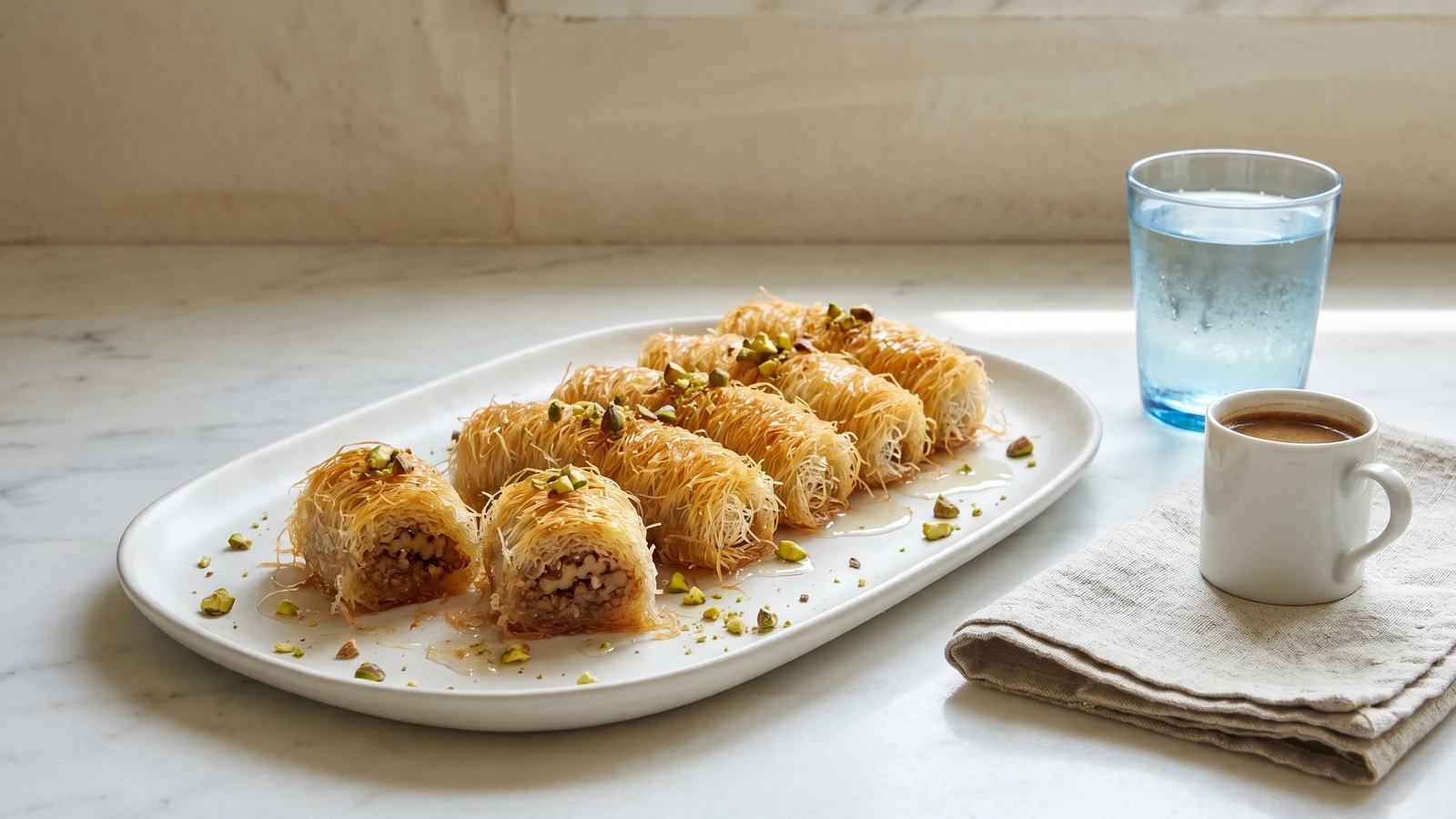
Politiko kataifi is shredded phyllo rolled snugly around walnuts and butter, baked until bronze, then soaked with lemon syrup so each strand stays crisp at the edges and tender within.
Politiko kataifi, the shredded phyllo sweet of Constantinople, is a nest of fine pastry threads rolled around walnuts, baked with butter, then soaked with clear lemon syrup. It belongs to the City and to the Asia Minor sweet tray, where syrup sweets were not decoration but the proof that a house knew how to receive guests.
The roll decides it. Pull the strands open until they lie like combed hair, butter them, then wrap the walnut filling snugly, not crushed. A loose kataifi drinks syrup in puddles and leaves dry middles; a crushed one bakes heavy. Pack the rolls side by side in the pan and they take the syrup evenly, each one crisp at the edges and sweet through the center.
I make it for Christmas because that's when Thessaloniki still smells of butter, cinnamon, and syrup cooling at the back of the stove. Your grandmother cooked by eye because she'd made it a thousand times. Here are the numbers until you have.
Kataifi belongs to the Politiki and Asia Minor pastry tradition, linked to Ottoman urban sweet shops where shredded dough called kadayıf was cooked on heated plates by specialists. The Greek rolled version, filled most often with walnuts and cinnamon, settled into Christmas and celebration trays in Constantinopolitan and Smyrnaic households. After the 1922 expulsions from Asia Minor, refugee families carried these syrup-sweet methods into Thessaloniki, Kavala, Volos, and Athens.
Quantity
500g
thawed if frozen and kept covered
Quantity
300g
finely chopped, not ground
Quantity
40g
Quantity
1 1/2 tsp
Quantity
1/8 tsp
Quantity
250g
melted and warm
Quantity
30g
finely chopped for finishing
Quantity
600g
Quantity
450ml
Quantity
80g
Quantity
1 wide strip
Quantity
1
Quantity
2 tbsp
| Ingredient | Quantity |
|---|---|
| kataifi pastry (shredded phyllo, κανταΐφι)thawed if frozen and kept covered | 500g |
| walnutsfinely chopped, not ground | 300g |
| caster sugar | 40g |
| ground cinnamon | 1 1/2 tsp |
| ground cloves | 1/8 tsp |
| clarified unsalted buttermelted and warm | 250g |
| unsalted pistachios (optional)finely chopped for finishing | 30g |
| granulated sugar | 600g |
| water | 450ml |
| Greek honey | 80g |
| lemon peel | 1 wide strip |
| cinnamon stick | 1 |
| fresh lemon juice | 2 tbsp |
Put the sugar, water, lemon peel, and cinnamon stick in a small saucepan. Bring to a boil, stirring only until the sugar dissolves, then simmer for 8 minutes. Pull it off the heat, stir in the honey and lemon juice, and leave it to cool completely. For kataifi, the syrup waits for the pastry.
Mix the walnuts with the caster sugar, cinnamon, and clove. The nuts should be small enough to roll neatly, but not powdered. Powdered walnuts turn heavy and pasty, and this sweet needs a little bite under the syrup.
Heat the oven to 160C fan or 175C conventional. Brush a 30 x 40cm metal baking pan with a little of the warm clarified butter. Open the kataifi pastry and pull the strands apart gently with your fingers until they loosen and fluff, then keep the pile covered with a clean towel while you work. Dry kataifi cracks before it rolls.
Take about 20g of kataifi threads and lay them into a narrow strip, roughly 25cm long. Brush or drizzle with butter, set 1 tablespoon of walnut filling at one end, fold the sides in, and roll snugly around the filling. Place seam side down in the pan. Repeat with the remaining pastry and filling, setting the rolls close together so they support each other.
Pour the remaining warm clarified butter evenly over the rolls, especially over the dry ends. Bake on the middle rack for 55 to 65 minutes, until the kataifi is deep gold all over and the underside is colored too. If the top browns too early, lower the oven by 10C and let the center dry properly.
As soon as the pan comes from the oven, ladle the cooled syrup slowly over the hot kataifi in three passes, moving across the whole pan. Use all the syrup. Do not flood one corner and hope for mercy. The tight rolls drink evenly, and this is what gives you crisp edges with a sweet center instead of dry middles and soggy ends.
Leave the kataifi at room temperature for at least 4 hours, uncovered or very loosely covered, until the syrup has settled into the rolls. Scatter with pistachios if you like. Serve in small pieces with Greek coffee, because this is a sweet that knows exactly how rich it is.
1 serving (about 170g)
Culinary guides, cultural storytelling, and the editorial depth that makes cooking meaningful.
Discover Culinary ExplorerChef Dimitra
Agrafa's batzina is the no-phyllo pie of Karditsa: grated courgette, feta, eggs, milk, and flour poured thin into a hot oiled tapsi.

Chef Dimitra
Zagori's flour pie skips phyllo completely: a loose egg-and-flour batter, crumbled feta, and a hot buttered tapsi that makes the edges crisp.

Chef Dimitra
Hydra and Andros give amygdalota their island surname: ground almond, sugar, egg white, and rosewater, baked pale so the center stays soft as marzipan.

Chef Dimitra
Asia Minor ekmek kataifi is built in three clear layers: crisp syruped kataifi, thick semolina custard, and cold kaimaki cream under pistachios.