
Chef Graziella
Piadina with Sausage and Stracchino
The working person's lunch from Romagna, where thin, lard-enriched flatbread folds around crumbled sausage and soft, melting cheese. This is not a wrap. This is piadina.
A cooking platform built around craft, culture, and the stories behind what we eat.
Created by
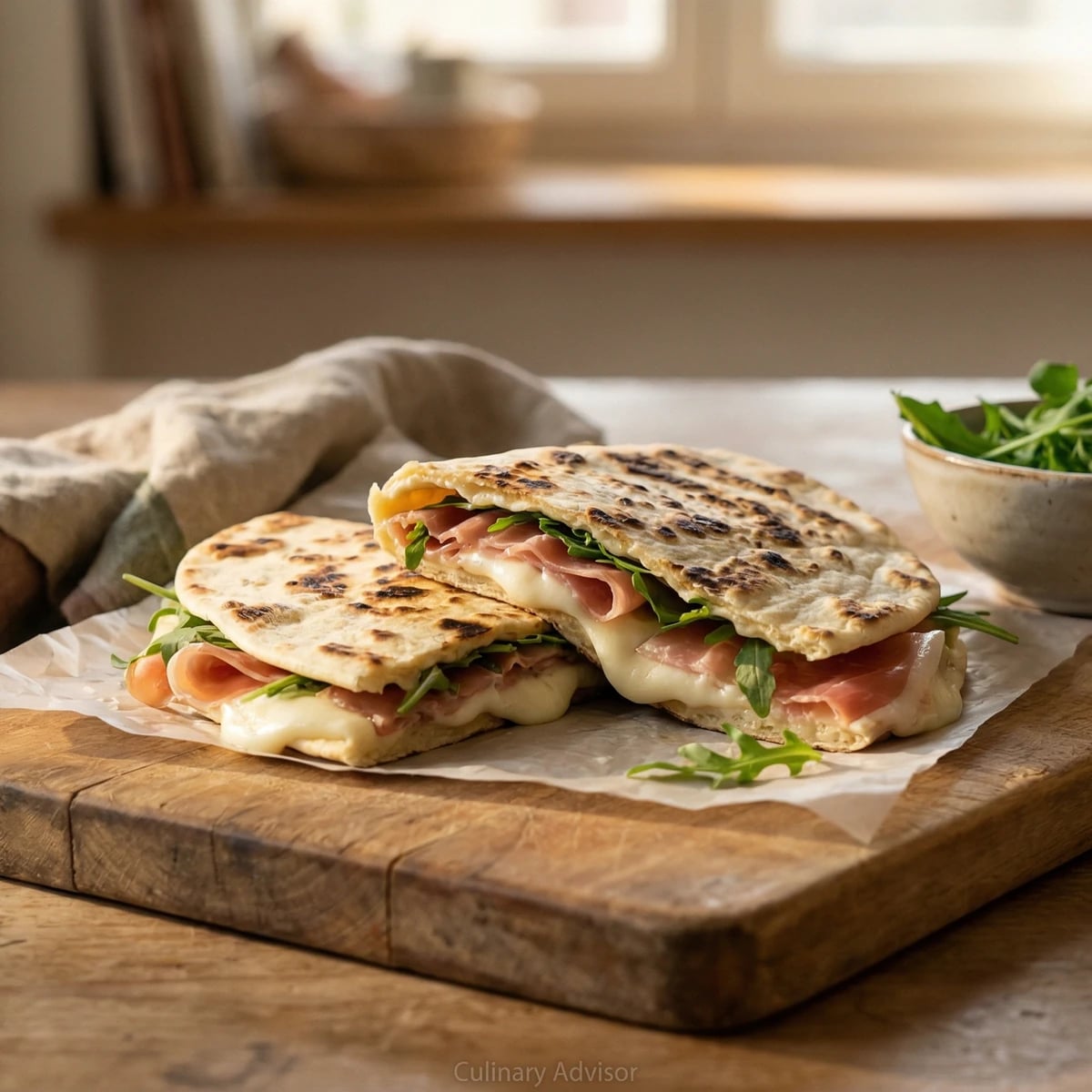
The street food of Romagna, where a thin flatbread made with lard becomes the vessel for prosciutto, tangy fresh cheese, and bitter greens. Three fillings. Nothing more.
Piadina is not a wrap. It is not a tortilla. It is not flatbread in any generic sense. It is the bread of Romagna, and only Romagna, a thin disc made with flour, lard, salt, and water, cooked on a hot griddle until it blisters and chars in spots. To call it anything else is to misunderstand what you are eating.
The filling I give you here is the classic, the one you find at every piadineria from Rimini to Cesena. Squacquerone is the cheese, soft and spreadable and slightly sour, made only in this region. The prosciutto is sliced thin and laid on cold. The arugula provides the bite. That is all. Americans want to add things. Resist this impulse.
My grandmother made piadina on a testo, a thick terracotta disc that held heat like nothing else. You may use a cast iron griddle or a heavy skillet. What matters is that the surface is dry and very hot. The piadina should cook quickly, developing those characteristic brown spots while staying pliable enough to fold.
Piadina originated as peasant food in Romagna, where farm families made it daily because they lacked ovens for proper bread. The earliest written recipe dates to 1371, though the tradition is certainly older. In 2014, Piadina Romagnola received IGP protection, officially recognizing that authentic piadina can only come from this narrow strip of coast and hills along the Adriatic.
Quantity
500g, plus more for rolling
Quantity
100g
at room temperature
Quantity
1 teaspoon
Quantity
1/2 teaspoon
Quantity
200ml
Quantity
250g
Quantity
150g
sliced thin
Quantity
100g
| Ingredient | Quantity |
|---|---|
| tipo 00 flour | 500g, plus more for rolling |
| lard (strutto)at room temperature | 100g |
| fine sea salt | 1 teaspoon |
| baking soda | 1/2 teaspoon |
| warm water | 200ml |
| squacquerone cheese | 250g |
| prosciutto di Parmasliced thin | 150g |
| wild arugula | 100g |
Mound the flour on your work surface and create a well in the center. Add the lard, salt, and baking soda to the well. Pour in most of the warm water, reserving a few tablespoons. Using a fork, begin incorporating the flour from the inner walls of the well into the liquid. When the mixture becomes too thick to stir, use your hands to bring it together into a rough dough. Add the remaining water only if the dough feels dry.
Knead the dough firmly for 8 to 10 minutes. It should become smooth, pliable, and slightly tacky but not sticky. The lard will fully incorporate as you work, creating a dough that feels almost silky. If it sticks to your hands, dust with flour. If it cracks when folded, add a few drops of water.
Shape the dough into a ball, wrap tightly in plastic, and let it rest at room temperature for 30 minutes. This relaxes the gluten and makes rolling easier. Do not refrigerate. Cold dough will not roll thin enough.
Divide the dough into 6 equal pieces, about 130 grams each. Keep the pieces you are not working with covered. Roll each piece into a thin disc about 25 centimeters across and 2 to 3 millimeters thick. The dough should be thin enough that you can almost see your hand through it, but sturdy enough to handle. Dust your surface and rolling pin with flour as needed.
Heat a large cast iron skillet or griddle over medium-high heat until very hot. Test by flicking a drop of water onto the surface. It should evaporate immediately. Do not grease the pan. The lard in the dough provides all the fat you need.
Lay one disc of dough on the hot surface. Within 30 seconds, bubbles will form and the bottom will develop brown spots. When the underside is speckled with char marks and the bubbles have set, flip it. Cook the second side for another minute or so. The piadina should be pliable, not crisp. It will firm slightly as it cools.
Stack the cooked piadine on a plate and cover with a clean kitchen towel. They will stay warm and pliable while you cook the remaining discs. Work efficiently. A piadina that sits too long becomes stiff.
Work quickly while the piadina is still warm. Spread a generous layer of squacquerone across the entire surface. Lay slices of prosciutto over half the disc. Do not heat the prosciutto. Italians do not cook quality cured meat. Scatter a handful of arugula over the prosciutto. Fold the piadina in half, pressing gently to seal. Serve immediately.
1 serving (about 210g)
Culinary guides, cultural storytelling, and the editorial depth that makes cooking meaningful.
Discover Culinary Explorer
Chef Graziella
The working person's lunch from Romagna, where thin, lard-enriched flatbread folds around crumbled sausage and soft, melting cheese. This is not a wrap. This is piadina.

Chef Juliette
Five classical fillings between bread buttered to every edge, cut into tidy rectangles and held under a light weight: a French buffet lesson in softness, proportion, and restraint.

Chef Juliette
Steak grilled dark at the edges, cooled, sharpened with horseradish and mustard, then pressed between buttered loaf heels until the crumb catches every juice: a race-day sandwich substantial enough to be supper.

Chef Thomas
Back bacon crisped in a hot pan, a ripe tomato that actually tastes of something, crisp lettuce and real butter on proper toast. A sandwich that earns its place in the notebook.