
Chef Graziella
Arrosto di Maiale alle Erbe Aromatiche
Bone-in pork loin rubbed with fennel, rosemary, and sage, roasted until the herbs form a crackling crust and the meat stays pink and succulent. This is the roast that brings Sunday to life.
A cooking platform built around craft, culture, and the stories behind what we eat.
Created by
Two ingredients, no eggs, and a technique that transforms coarse golden semolina into the chewy, sauce-gripping pasta of Southern Italy. This is the dough that built Puglia.
North of Rome, they make egg pasta with soft flour. South of Rome, they make this: semolina and water, nothing more. The difference is not just geography. It is philosophy. Egg pasta is rich and tender. Semolina pasta is firm, chewy, and rough enough to grip sauce as though its life depended on it.
This dough does not require a pasta machine. In fact, a machine would defeat its purpose. Semolina pasta is hand-formed into shapes that catch sauce in their curves and crevices: the little ears of orecchiette, the ridged shells of cavatelli, the twisted spirals of fusilli. The texture of your hands pressing and dragging against a wooden board creates the surface that holds the sauce. A machine cannot replicate this.
The technique is simple but not easy. Semolina absorbs water slowly and grudgingly. The dough will feel dry and impossible at first. You must trust the process. Knead it, rest it, knead it again. After twenty minutes your hands will know what your head cannot yet understand: when the dough is ready.
Semolina water dough predates egg pasta by centuries, emerging in the south where eggs were scarce but durum wheat thrived in the hot Mediterranean climate. Pugliese women have shaped orecchiette by hand for at least six hundred years, passing the thumb-dragging technique from grandmother to granddaughter with a precision that rivals any culinary school.
Quantity
300g (2 1/3 cups)
Quantity
150ml (2/3 cup)
Quantity
1/2 teaspoon
Quantity
as needed
| Ingredient | Quantity |
|---|---|
| semola di grano duro (durum wheat semolina) | 300g (2 1/3 cups) |
| warm water | 150ml (2/3 cup) |
| fine sea salt | 1/2 teaspoon |
| semolina for dusting | as needed |
Pour the semolina onto a wooden board or clean work surface. Make a wide well in the center, pushing the flour up into walls like a volcano crater. The well must be wide enough to hold the water without breaching. Dissolve the salt in the warm water.
Pour the salted warm water into the center of the well. Using a fork, begin incorporating flour from the inner walls of the well, working in a circular motion. Move gradually, pulling in more flour as the mixture thickens. When the dough becomes too stiff to stir, set aside the fork.
Using a bench scraper and your hands, gather all the flour and shaggy dough into a single mass. Press and fold the mixture, incorporating the dry bits. The dough will look rough and unpromising. It will feel dry and crumbly. This is correct. Semolina resists hydration at first. Do not add more water.
Knead the dough aggressively for 10 minutes. Push it away from you with the heel of your palm, fold it over itself, turn it ninety degrees, and push again. The rhythm should be steady and forceful. Your arms will tire. This is how you know you are working. The dough will transform from shaggy and resistant to smooth and elastic. When you press it with your finger, it should spring back slowly.
Wrap the dough tightly in plastic wrap. Let it rest at room temperature for at least 30 minutes, or up to 2 hours. This rest is not optional. The gluten relaxes, the semolina continues to hydrate, and the dough becomes workable. Skip this step and your pasta will fight you.
After resting, unwrap the dough and knead briefly, about one minute. It should be noticeably smoother and more pliable than before resting. Press it with your thumb. The surface should feel satiny. The dough is now ready to shape.
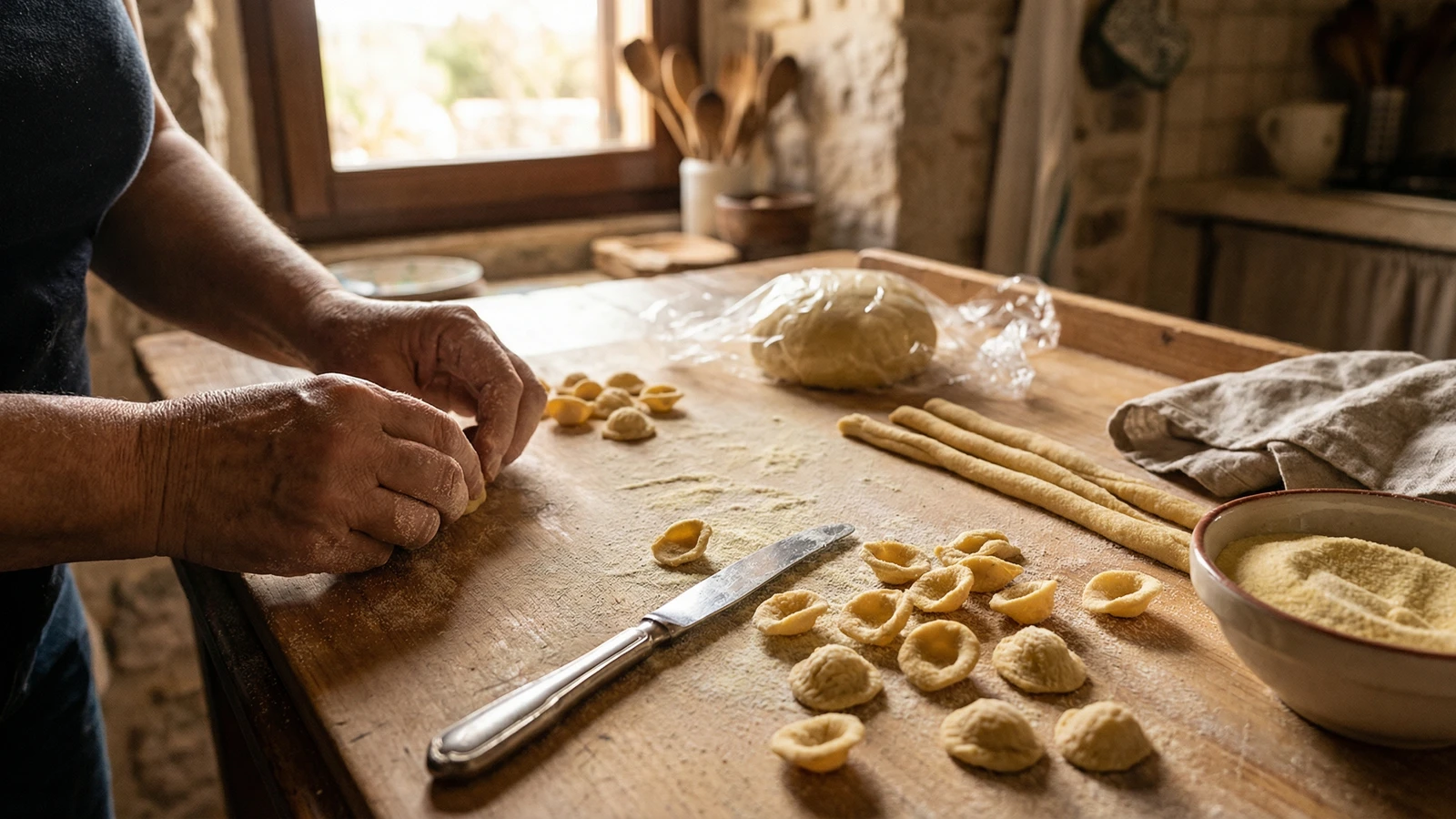
For orecchiette: Cut a piece of dough and roll it into a rope about half an inch thick. Cut the rope into small pieces the size of chickpeas. Working on an unfloured wooden board, place a piece under a butter knife or small rounded knife blade held at an angle. Press down and drag toward you in one motion. The dough will curl around the knife and form a rough textured disk. Invert it over your thumb to create the characteristic ear shape. The roughness is intentional. It holds sauce.
For cavatelli: Roll the dough into ropes about as thick as your little finger. Cut into pieces about one inch long. Press two or three fingertips into each piece and drag toward you, curling the dough into a ridged shell. The ridges should be visible and pronounced. Set shaped pasta on a semolina-dusted tray.
Shaped pasta can be cooked immediately or dried for storage. To cook fresh, boil in abundant salted water until they float and are tender but chewy, about 4 to 6 minutes depending on thickness. To dry, spread on a semolina-dusted tray in a single layer and leave at room temperature for 24 to 48 hours, turning occasionally. Dried pasta keeps for weeks in an airtight container.
1 serving (about 180g cooked)
Culinary guides, cultural storytelling, and the editorial depth that makes cooking meaningful.
Discover Culinary ExplorerChef Graziella
Bone-in pork loin rubbed with fennel, rosemary, and sage, roasted until the herbs form a crackling crust and the meat stays pink and succulent. This is the roast that brings Sunday to life.

Chef Graziella
The ancient technique of salt-baking creates a sealed chamber where the fish steams in its own moisture. What emerges is flesh of remarkable purity, seasoned perfectly, ready for nothing but your best olive oil.

Chef Graziella
The ugly fish that cooks like veal, braised in tomatoes until the firm white flesh absorbs the briny sweetness of olives and capers. Fishermen's wives along the Adriatic knew its worth before restaurants discovered it.

Chef Graziella
A fifteen-minute lesson in restraint: pork chops, butter, sage, and the understanding that what you leave out matters as much as what you put in.