
Chef Lupita
Aguascalientes Beef Tongue Pozole (Pozole de Lengua)
Aguascalientes' Bajio pozole de lengua, built with cacahuazintle hominy, tender beef tongue, chile ancho and guajillo, with xoconostle brightness and table garnishes.
A cooking platform built around craft, culture, and the stories behind what we eat.
Created by
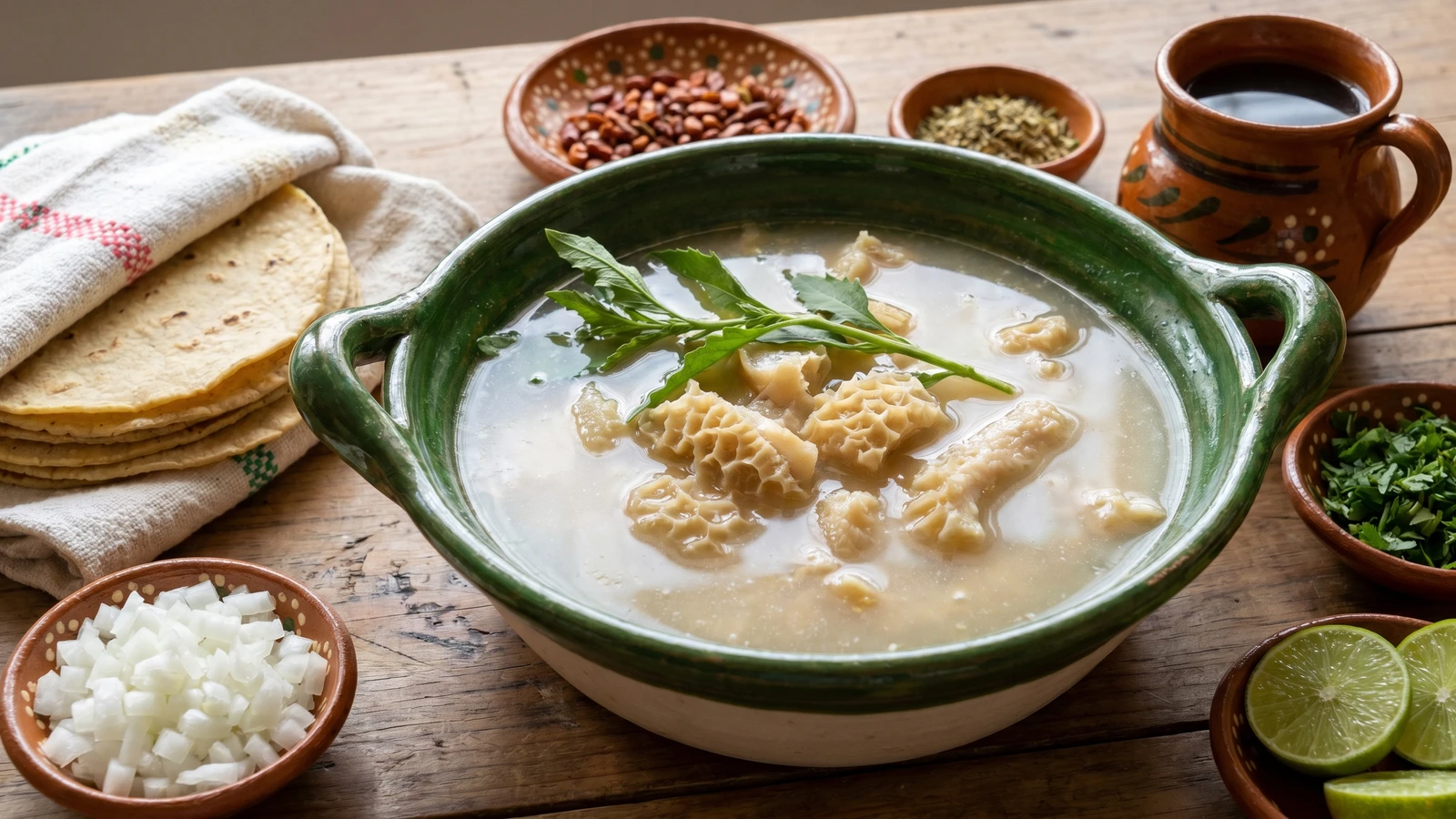
Ciudad de Mexico's Sunday pancita, a clear caldo of slow-simmered tripe and pata perfumed with epazote and finished with arroz, dressed at the table with chile piquin, cebolla, and limon.
This is from Ciudad de Mexico. The capital's menudo is blanco, not rojo. No guajillo, no ancho, no chile in the pot at all. The caldo is clear, the panza is white, and the heat comes at the table from a small dish of chile piquin that each diner shakes into their own bowl. Cada estado, su propia cocina, and the north can keep its red menudo. The capital does it like this.
The two ingredients that make this version capitalina are epazote and arroz. The epazote, sharp and almost medicinal, cuts through the richness of the tripe the way no other herb does. The rice, added in the last half hour, loosens its starch into the broth and gives the caldo a body that the northern versions do not have. Skip either one and you have made some other menudo. You have not made pancita capitalina.
My mother made this on Sunday mornings when I was small, in a tall olla on the back burner of our kitchen in Colonia Roma. She started it Saturday night, scrubbing the panza with lime and vinegar at the sink while my father drank coffee at the table. The smell on Sunday morning, epazote and slow tripe and warm tortillas, is what Sunday in Ciudad de Mexico smells like to anyone who grew up there. The senoras at La Merced sell pancita by the kilo on Sunday mornings for a reason. It is what the city eats to start the week. Asi se hace y punto.
Menudo's roots in central Mexico predate the conquest in spirit, the pre-Columbian Mexica practice of using every part of the animal in long-simmered pozolli-style preparations laid the groundwork, but the dish as known today was shaped by the colonial introduction of cattle in the 16th century and the working-class kitchens of the Valley of Mexico that adopted offal cuts the wealthier classes discarded. The clear, rice-thickened menudo blanco of Ciudad de Mexico diverged from the red, chile-based menudos of the northern states (Sonora, Chihuahua, Sinaloa) and the western tradition of Jalisco by the 19th century, when capital cooks began finishing the broth with arroz as both economic stretch and signature thickener. The dish's enduring association with Sunday mornings and crudas, the morning after a long Saturday night, is a 20th-century social custom; Ciudad de Mexico's neighborhood fondas and mercado stalls still draw lines for pancita on Sunday at dawn.
Quantity
3 pounds
well cleaned
Quantity
1 pound
split by the butcher into 3 or 4 pieces
Quantity
1/2 cup
for the initial scrub
Quantity
1/4 cup
for the initial scrub
Quantity
2
halved, for the initial scrub
Quantity
1
halved, plus 1 cup finely diced for serving
Quantity
2
1 halved crosswise and 1 separated into peeled cloves
Quantity
3
Quantity
1 tablespoon
Quantity
1 tablespoon, plus more to taste
Quantity
4 large sprigs, plus more for serving
Quantity
1/2 cup
rinsed until the water runs clear
Quantity
for serving
Quantity
for serving
Quantity
for serving
chopped
Quantity
for serving
Quantity
for serving
warmed
| Ingredient | Quantity |
|---|---|
| honeycomb beef tripe (panza de res)well cleaned | 3 pounds |
| beef pata (cow's foot)split by the butcher into 3 or 4 pieces | 1 pound |
| distilled white vinegarfor the initial scrub | 1/2 cup |
| kosher saltfor the initial scrub | 1/4 cup |
| limeshalved, for the initial scrub | 2 |
| large white onionhalved, plus 1 cup finely diced for serving | 1 |
| heads of garlic1 halved crosswise and 1 separated into peeled cloves | 2 |
| bay leaves | 3 |
| black peppercorns | 1 tablespoon |
| kosher salt | 1 tablespoon, plus more to taste |
| fresh epazote | 4 large sprigs, plus more for serving |
| long-grain white ricerinsed until the water runs clear | 1/2 cup |
| dried chile piquin (optional) | for serving |
| dried Mexican oregano (optional) | for serving |
| fresh cilantro (optional)chopped | for serving |
| lime wedges (optional) | for serving |
| hand-pressed corn tortillas (optional)warmed | for serving |
Even tripe sold as 'cleaned' needs another wash. Cut the panza into 2-inch squares. Put it in a large bowl with the vinegar, the 1/4 cup of salt, and the cut limes. Scrub the pieces against each other with your hands for five minutes. Rinse under cold running water until the water runs clear and the smell is gone. Repeat the scrub one more time. La cocina no es decoracion, es trabajo. Skip this step and your caldo will taste of barn.
Put the cleaned tripe and the pata pieces in your largest stockpot. Cover with cold water by three inches. Bring to a hard boil over high heat. Boil for ten minutes. You will see gray foam and a slick of impurities rise. Drain the pot completely in a colander and rinse the tripe and pata under cold water. This blanch is what gives you a caldo blanco, a clean white broth, instead of a cloudy gray one. No me vengas con atajos. The blanch is the recipe.
Return the rinsed tripe and pata to the clean pot. Cover with fresh cold water by three inches, about four to five quarts. Add the halved onion, the halved head of garlic, the bay leaves, the peppercorns, and the tablespoon of salt. Bring to a gentle simmer over medium heat. Skim any foam that rises in the first twenty minutes. Cold water draws the flavor out slowly. A rolling boil clouds the broth and toughens the tripe.
Reduce the heat until you see lazy bubbles breaking the surface every few seconds. Partially cover the pot. Cook for three to three and a half hours, until the tripe is fully tender but still has a clean bite. Tripe that is undercooked is rubber. Tripe that is overcooked turns to mush. You want it to yield to the tooth without resistance, the way a well-cooked tendon does. Check at three hours by lifting one piece out and biting into it. That is the only way to know.
When the tripe is almost tender, fish out the spent onion and the halved garlic head with a slotted spoon and discard them. Add the peeled garlic cloves and the four sprigs of epazote. Epazote is not optional. It is the herb that defines this dish in the central highlands. Its smell is sharp, almost medicinal, and it cuts through the richness of the tripe in a way no other herb does. If your market does not carry it fresh, the dried is a poor substitute. Find the fresh.
Stir in the rinsed rice. Simmer for another twenty to twenty-five minutes, partially covered, until the rice is fully cooked and has loosened a little of its starch into the broth. The caldo will thicken slightly. This is what distinguishes the capitalina version from the menudos of the north and the west, the rice is the body. Taste for salt now and adjust. Tripe absorbs salt slowly, so the broth needs to be assertive.
Remove the pata pieces with a slotted spoon. When they are cool enough to handle, pull the meat and the gelatinous connective tissue off the bones and chop them roughly. Discard the bones. Return the chopped meat to the pot. The pata is what gives the broth its body. Without it, you have soup. With it, you have caldo.
Ladle the pancita into deep clay bowls. Set the diced raw onion, chile piquin, dried oregano, chopped cilantro, lime wedges, and warm tortillas in small platitos around the table. Each person builds their own bowl. A squeeze of lime, a pinch of piquin, a scatter of onion and oregano. That ritual is part of the dish. In Ciudad de Mexico on a Sunday morning, you eat this slowly, with bolillos on the side if there are no tortillas, and you do not check your phone. Saber cocinar es saber vivir.
1 serving (about 380g)
Culinary guides, cultural storytelling, and the editorial depth that makes cooking meaningful.
Discover Culinary ExplorerChef Lupita
Aguascalientes' Bajio pozole de lengua, built with cacahuazintle hominy, tender beef tongue, chile ancho and guajillo, with xoconostle brightness and table garnishes.

Chef Lupita
Veracruz's Gulf coast rice from Alvarado, built with seafood stock, tomato, chile chipotle, epazote, shrimp, fish, jaiba, and pulpo, served loose and brothy in a clay cazuela.

Chef Lupita
Costa Chica's wet salt-beef stew, built from chile costeño, guajillo, tomato, manteca, yuca, plantain, and masa dumplings, the ranching pot of Cuajinicuilapa and Pinotepa.

Chef Lupita
Michoacán's P'urhépecha atápakua is a masa-thickened sauce and stew at once, built with pork, chile guajillo, and hierbabuena added only at the end.